Features
Part of 5 notes on Cancer to Virgo celebrities worth reading
Career vocabulary for Cancer, Leo, and Virgo still traces back to chart position, not the sign
Cancer to virgo celebrities careers advice rests on pre-industrial trades: where vocation sits in a chart, and what an interest inventory does instead.
Traditional material on vocation was written for a working world that no longer exists, and its categories are trades: metalwork, husbandry, the sea. Letters, medicine, and law are the rest.
Modern career pages map that vocabulary onto job titles invented in the last forty years, and whoever writes the page does the mapping on no stated principle. Seeing where the gap opens beats another list of suggested professions.
What to take away
- Vocation in the tradition is read from the tenth house and the point at the top of the chart, not from the sun sign. Both need a birth time, and most readers do not have one.
- The occupational categories in the source material are pre-industrial trades. Converting them into modern job titles is an editorial act, not a reading.
- If the question is what work someone might enjoy, there is an instrument family built for it, and it asks about interests rather than about symbols.
Where the tradition actually looks
Not at the Sun. A traditional vocational reading works from the tenth house, the sector tied to public standing and occupation, the planet ruling that sector, and the degree culminating at the top of the chart.
Some methods weigh the planet with the strongest claim over that part of the chart and rank several candidates against each other.
Every one of those needs the time of birth, because the houses rotate through the entire circle in a day. Two people born in the same city twelve hours apart share a sun sign and share almost nothing in this layer.
A page that offers career guidance from a birth month is not doing a simplified version of the tradition's method. It is doing a different thing that the method does not license, as the account of what a chart contains makes clear.
The vocabulary problem
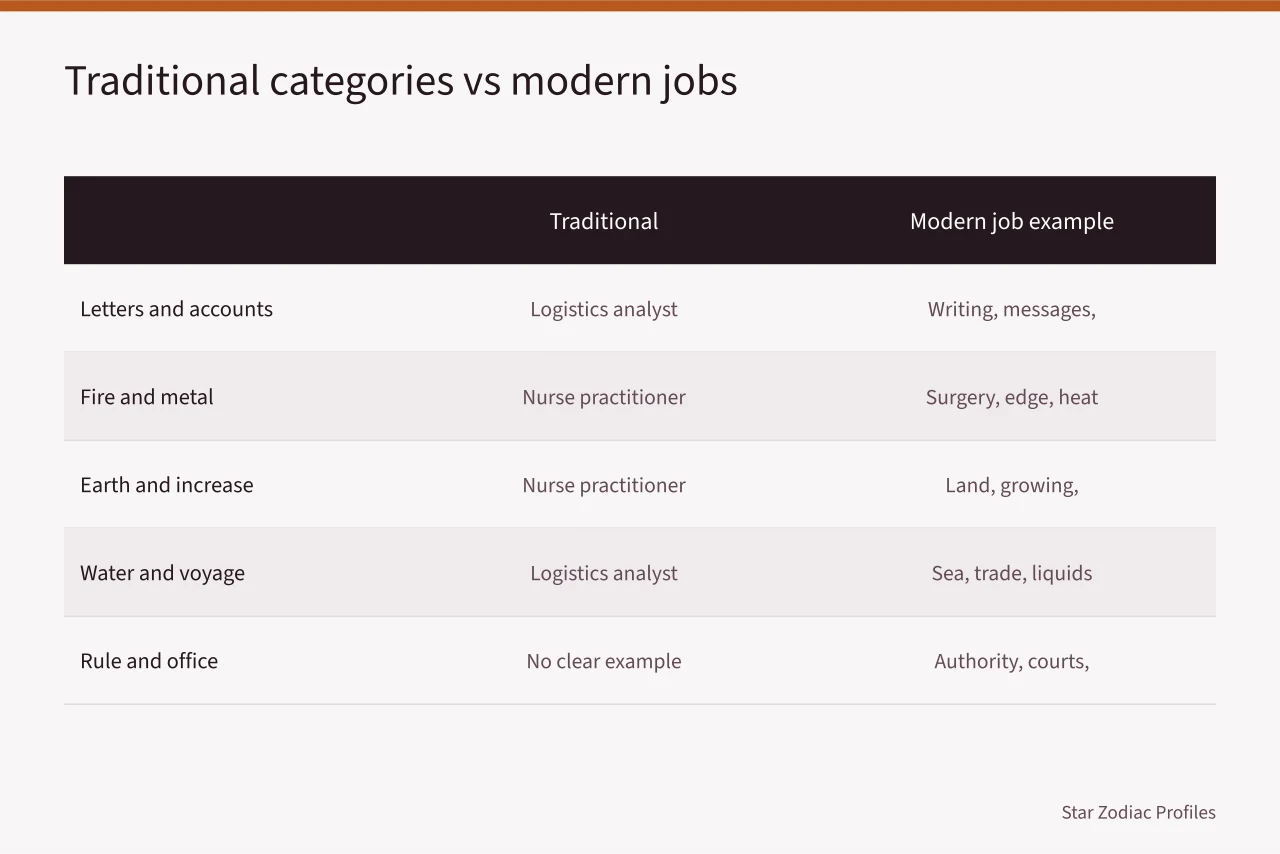
Suppose the birth time is known and the reading is done properly. It produces terms like these, which are the terms the source material uses.
| Traditional category | What it covered |
|---|---|
| Letters and accounts | Writing, reckoning, messages, record keeping |
| Fire and metal | Smithing, surgery, anything with edge or heat |
| Earth and increase | Land, growing things, husbandry, building |
| Water and voyage | The sea, trade at a distance, liquids |
| Rule and office | Authority, courts, positions held from above |
Place a modern job in one of those. A logistics analyst is letters and accounts, or water and voyage, or both, while a nurse practitioner is fire and metal by the surgical route and earth and increase by the caring one.
A software engineer belongs nowhere in particular, and every published attempt to place one is the writer's choice.
That is the gap. The categories are not wrong; they are addressed to a different economy. Translating them requires a rule for what a modern job is essentially about, and no such rule is stated anywhere. The equivalent lists for a cardinal fire sign show the same substitution happening under a different heading.
The three summer signs as a case
Cancer, Leo and Virgo sit in a row and draw on three different traditional registers: the household and what is kept, rule and display, and the analytical and medical. Those registers are genuinely there in the source material.
What they do not do is name occupations. The household register does not mean a career in hospitality; it names a concern. The analytical register does not mean accountancy; it names an approach. Turning either into a job list requires the missing rule, and the further the register travels from its original economy, the more the writer supplies.
The structure of the three signs is worth having in mind here, because the registers follow from the element and mode assignments rather than from anything occupational.
The instrument that was built for the question
If the question is what work a person might find satisfying, a family of instruments is built for it. Vocational interest inventories ask what activities someone likes, sort both people and work environments on the same dimensions, and report a match.
The best-known scheme organizes the field into six broad orientations, described in general accounts of Holland codes.
Two features matter. It asks about interests, which is closer to the question than a symbolic assignment is. And it is built against an external reference, namely the interests of people already in various fields, so its claim can be argued with on evidence.
It is still one input. What a person is good at, what is available where they live, what it pays, and what they are willing to tolerate all sit alongside it, and none of those is on any chart. The career reading for a mutable air sign makes the same point about what a sign-based reading cannot know.
Reading a "careers for your sign" page
Four questions.
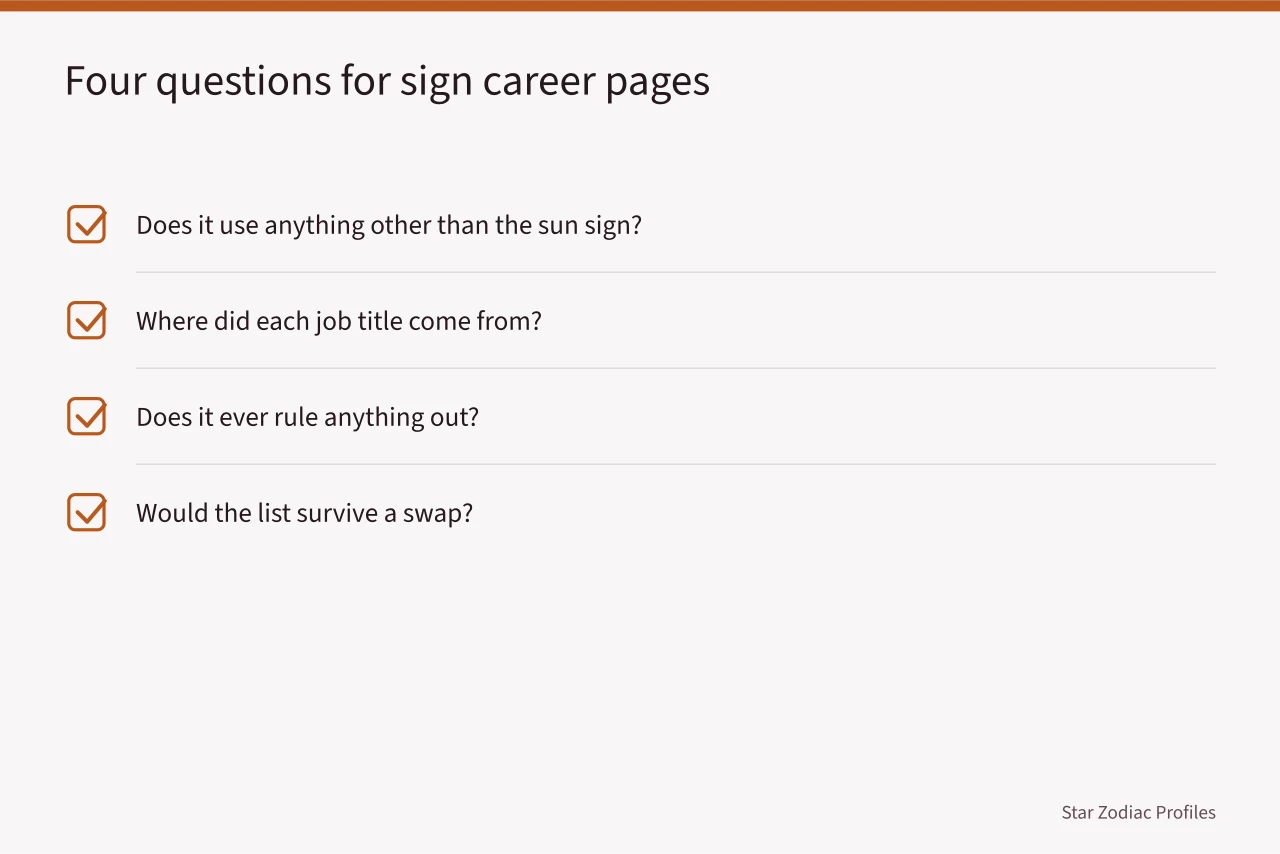
Does it use anything other than the sun sign? If not, it has skipped the part of the tradition that deals with vocation.
Where did each job title come from? A traditional register does not name modern jobs. Somebody chose.
Does it ever rule anything out? Honest guidance can say no. These pages only add.
Would the list survive a swap? Put a different sign at the top. If most of the jobs still look plausible, the list was never about the sign.
That last test is the quickest, and most of these pages fail it outright. A general description feels personal to everyone for the same reason: the material is written broadly enough to exclude nothing. The comparison of the three signs' pairings traces that mechanism in a different setting.
Common questions
Does the tradition really say nothing about careers from a sun sign?
It says a good deal about the Sun, and very little of it is occupational. The occupational material lives in the house structure, which needs a birth time.
What if I do not know my birth time?
Then the vocational layer is not available to you. Some practitioners attempt to estimate it from life events, which is a contested procedure and not a substitute for a record.
Are the old trade categories useless now?
Not for reading old texts, where they are essential. They are unusable as a modern job list without a translation rule nobody has written down.
Should I take an interest inventory instead?
If the question is about work, it is closer to the question. Treat the result as one input and check it against what the work is actually like day to day.
Why do these pages always suggest appealing jobs?
Because they are written to be enjoyed. A list that told readers their sign suits unglamorous work would not circulate.