Features
Part of MBTI analysts: the one typing step no outside observer can perform
5 things nobody tells you about MBTI analysts compatibility
The 256-cell pairing grid is a third-party invention, and the four analyst codes get read through it hardest. Here is what survives a check.
Search two four-letter codes and you get a grid: 256 cells, each stamped ideal, good, workable or difficult. It reads like output. Nothing in the questionnaire produces it.
The four analyst codes, INTJ, INTP, ENTJ and ENTP, sit at the center of that grid. They are the types the pairing pages write about most, and the ones readers arrive already half-convinced they are hard to live with.
What to take away
- The questionnaire returns four preferences and nothing else. No pairing rating exists in the scoring, the manual or the published research.
- Every grid picks a rule first, similarity or complementarity, then rates the cell. The two rules disagree, and the page rarely says which one it used.
- A pairing claim needs three things to be testable: a named outcome, a measure taken without knowing the types, and a comparison group. Most pages supply none.
- Analysts attract more pairing copy than any other group because the reputation is dramatic. The same paragraph fits other codes when you swap the letters.
- The one use that holds up is vocabulary. Two people who typed themselves can name a working difference instead of arguing about character.
Where the 256 cells came from
The questionnaire's output is four letters, each settled by the respondent rather than the score, as the analyst type profiles set out. There is no relational term in the instrument. There is no second-person input and no scale on which two results combine.
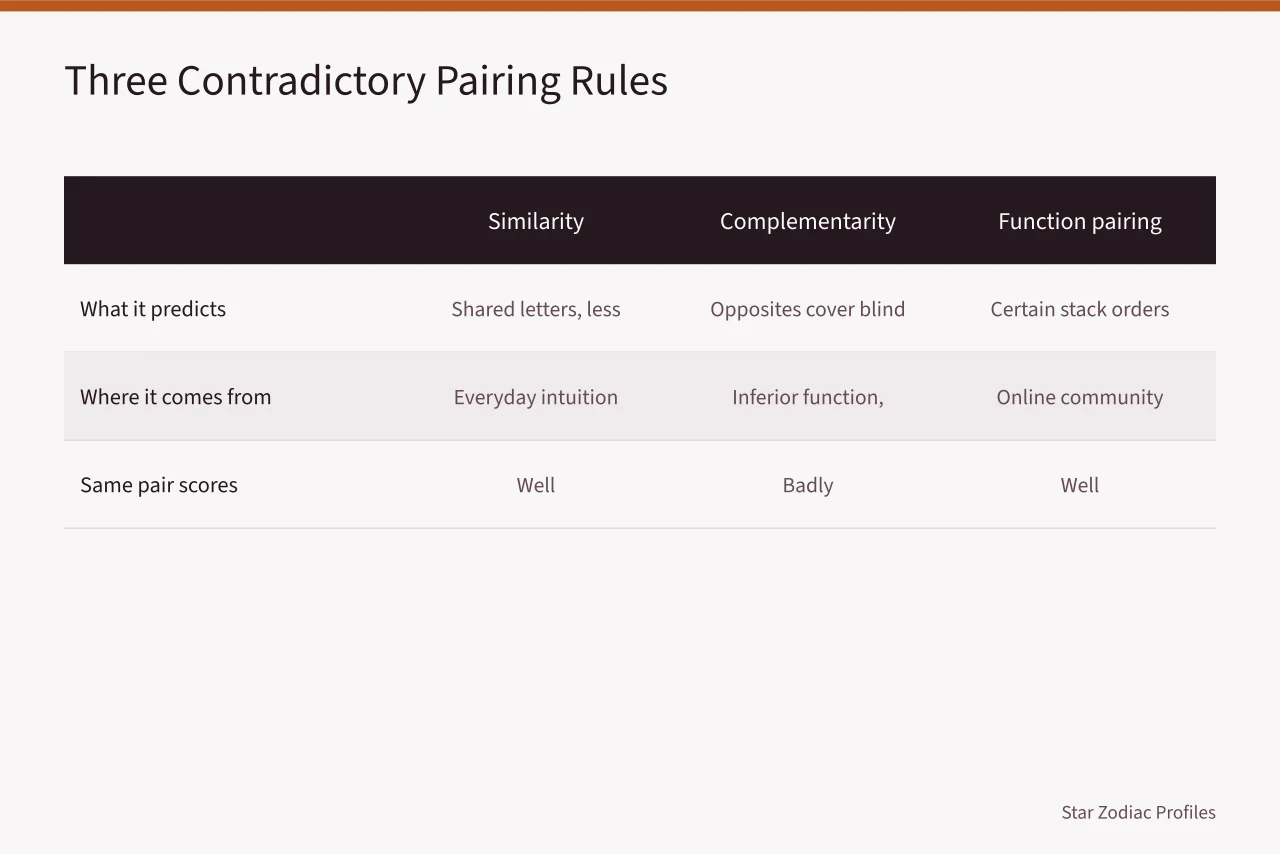
So the grid has to invent its rule, and the rules in circulation contradict each other:
| Rule | What it predicts | Where it comes from |
|---|---|---|
| Similarity | Shared letters mean shared habits, so less friction | Everyday intuition about getting along |
| Complementarity | Opposite letters cover each other's blind spots | The inferior function, borrowed loosely |
| Function pairing | Certain stack orders click | An elaboration by online communities |
Any two codes score well under one rule and badly under another. A grid that prints a rating has already chosen, and it does not tell you which. That silence is the tell.
The analyst reputation, and why it drives the pages
The four analyst codes carry a reputation for being difficult to live with and rewarding to understand. That pairing of friction and payoff is what relationship editors reach for, and it produces a specific failure: pages that describe the pairing instead of the people.
A paragraph on what an INTJ needs from a partner will hold together perfectly and describe nobody. Swap INTJ for ESFJ and reread it. If it still fits, it was never about the type.
That effect is the same one that makes a horoscope column land. General descriptions read as personal to almost everyone, which is why the sign-based pairing pages and the analyst grid produce the same nod of recognition. The test is identical in both: change the label, reread, and see whether the paragraph survives.
What a testable pairing claim would need
This part transfers to every pairing system, including the Taurus compatibility write-ups.
A named outcome. Compatible in what sense? Staying together, reported satisfaction, speed of resolving a disagreement, performance on a deadline. These are different outcomes and they do not move together.
A measure taken blind. Something recorded without knowing either person's type, so the typing cannot color the rating.
A comparison group. Pairs of the rated combination against pairs of other combinations, drawn the same way. Without it you cannot separate a real difference from the ordinary spread of relationships.
That structure is what construct validity asks of any measure claiming to be about something. A grid with no outcome, no measure and no comparison is not weak evidence. It is not evidence, and more cells will not fix it.
Four questions for reading any pairing page
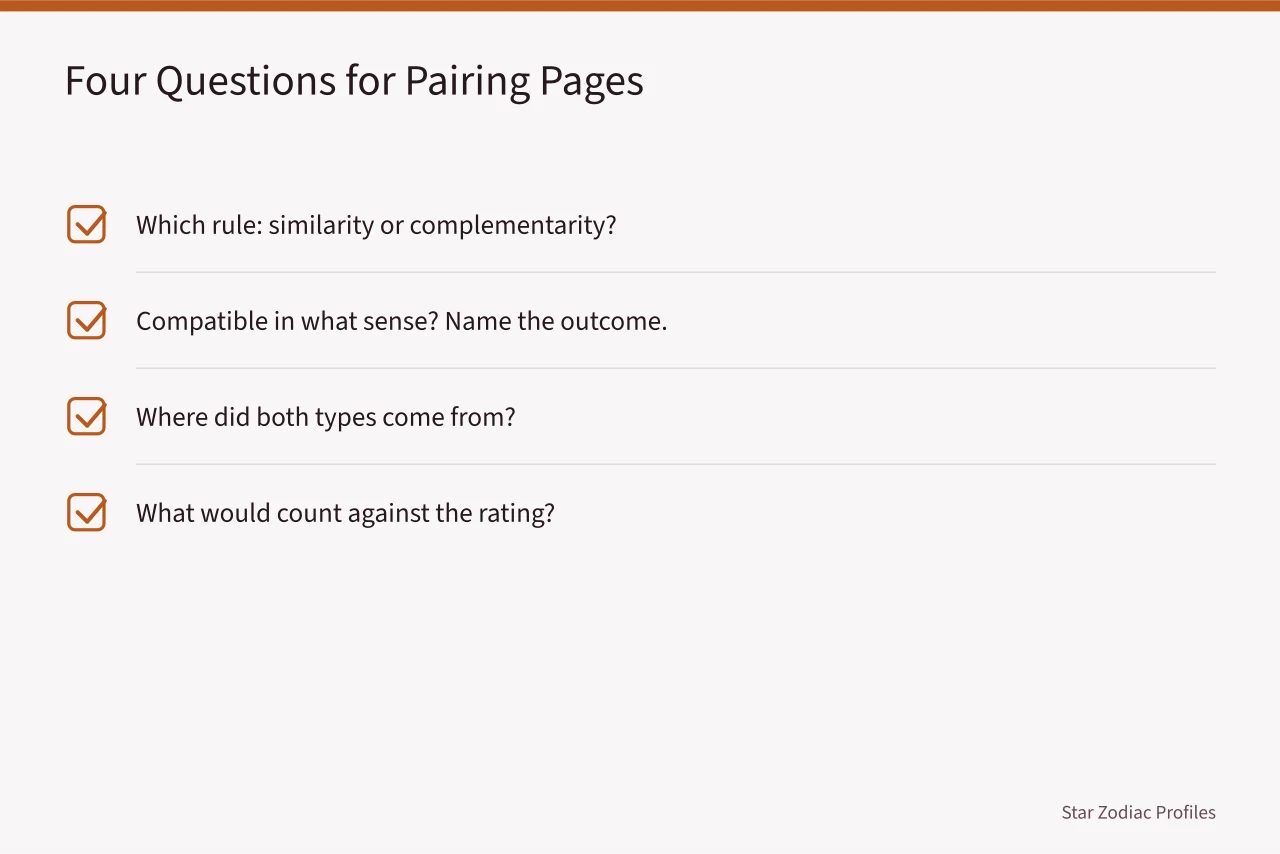
- Which rule is it using, similarity or complementarity? If it uses both in different sections, it has no rule.
- Compatible in what sense? If the page never names the outcome, the rating means nothing.
- Where did both types come from? A rating for two people who never took the questionnaire rates two labels.
- What would count against the rating? If nothing could, the page is not making a claim.
These four dismantle every public-figure pairing article, the format the famous analyst lists feed into, and they work just as well on the nine-point model's charts.
The use that survives
Two people who took the questionnaire, did their own best-fit step and read their own description now share words for one kind of disagreement. One wants the plan written before the conversation. The other wants to talk first and write after.
Naming that as a preference difference, rather than one person being disorganized and the other rigid, defuses an argument that otherwise repeats every week.
Notice how narrow it is. Both people typed themselves. It predicts nothing about the relationship and rates no pairing. It also works without the letters, if both people can describe the preference in plain words. The letters are shorthand, and the shorthand is the least important part.
The instrument's publishers have argued for decades against using type to select, screen or match people, and general treatments of personality assessment record the same caution about the family of instruments. Matching is the use they warn against most directly, because it turns a self-description into a judgment about someone else's suitability.
Common questions
Are there really no compatible and incompatible type pairs?
The model names none. Individual practitioners and communities do, using rules they chose, and those rules contradict each other. A rating is only as good as the rule behind it, and the rule is usually unstated.
Would sharing three letters out of four help in practice?
It might mean two people describe their preferences in similar words. Whether that helps depends on the relationship and the situation, and the model has no view on it. Treat it as a conversation starter, not a forecast.
Is it useful to know a partner's type?
Only if they determined it themselves and told you. A type you assigned to them is your description of them, presented as theirs. That is a different claim, and it is the one that causes trouble.
Does the nine-point system handle compatibility better?
It has the same gap. Its pairing charts are later additions too, and they also leave the outcome undefined. The four questions above apply unchanged.