Industry
Part of Aries celebrities: the record, kept honest
How Aries career advice still borrows its vocabulary from old planet-to-trade tables
Aries celebrities careers advice is Mars vocabulary in workplace clothing: the old planet-to-trade lists, and where a practitioner reads vocation instead.
Long before articles matched signs to jobs, older astrological handbooks matched planets to trades. Each of the seven classical bodies came with a list of occupations it was said to govern.
Those lists are the ancestor of the modern "careers for your sign" piece. For the first sign, the planet is Mars. The Mars list is the most instructive of the seven, showing how a "difficult" planet became a vocabulary of work.
What to take away
- The tradition's vocational vocabulary belongs to planets, not signs. A sign borrows its work associations from its ruler, and Aries borrows from Mars.
- Mars was classed as a malefic, a planet of harm, and its trades were the ones involving heat, iron, cutting and risk. Modern readings keep the energy and drop the harm.
- A practitioner reads work from the chart's tenth and sixth houses and their rulers, none of which a birthday supplies. The Mars vocabulary is what the reading uses, not what it concludes.
The older lists
The handbooks that circulated in Europe from the late medieval period into the seventeenth century gave each of the seven planets of the older scheme a set of occupations. The lists vary by author but the pattern is stable.
| Planet | The trades it was said to govern |
|---|
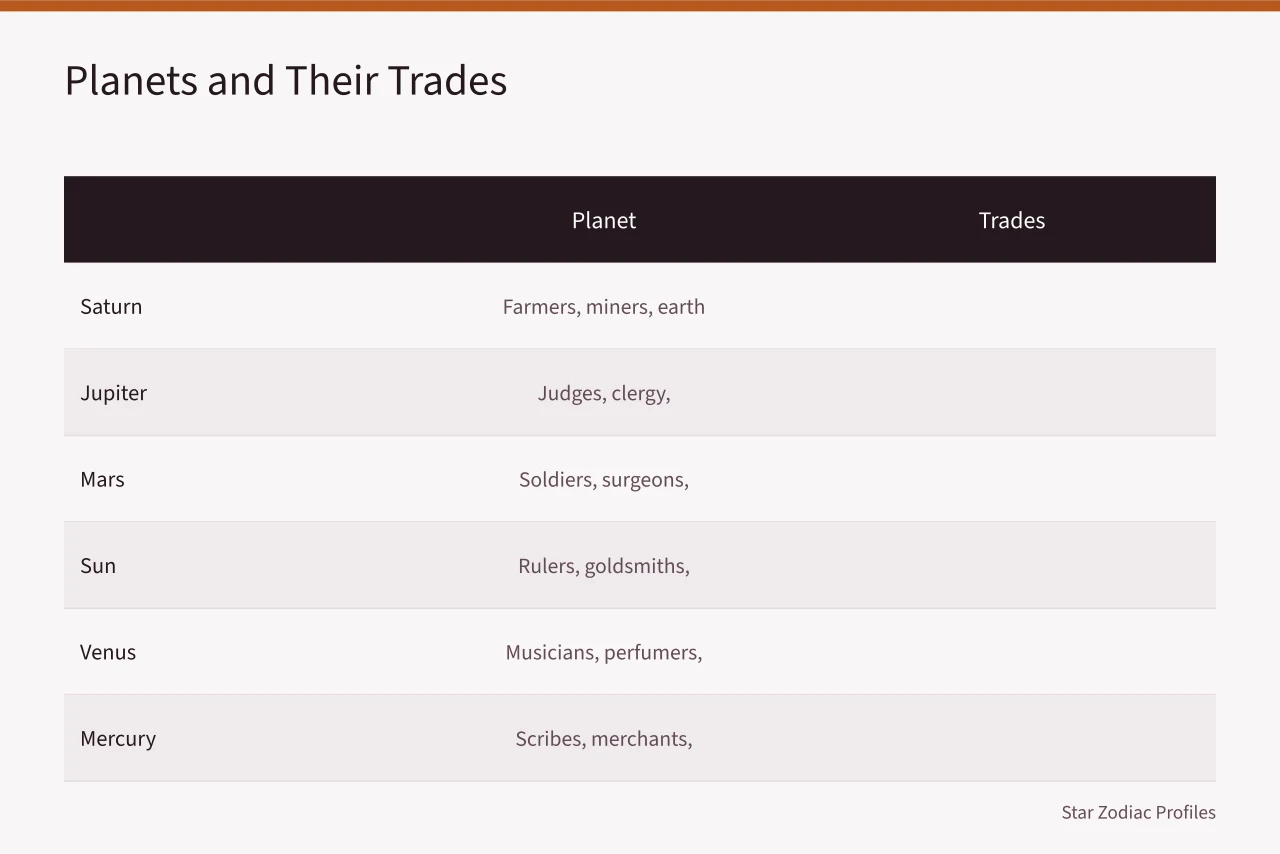
Read the Mars row. It is not a list of careers suited to a temperament but a list of trades tied to what Mars signified: heat, iron, cutting, blood, contest.
The reasoning ran from the planet's nature to the physical stuff of the work, and it says nothing about whether anyone born in April would enjoy any of it.
From malefic to energetic
Classical astrology sorted the planets into benefics and malefics, one of many ratings collected in its account of the planets. Mars was the lesser malefic and Saturn the greater.
The Mars trades in the table are the dangerous and bloody ones for that reason. The tradition did not pretend otherwise: the surgeon and the butcher sit in the same row because both cut.
Modern practice softened this. Mars now means drive, initiative and energy. Its harmfulness became the cost of those traits: impatience, aggression, the accident that follows haste.
The trades changed too. Soldiers and smiths gave way to entrepreneurs, athletes and emergency workers. Still heat and risk, now called qualities rather than hazards.
Both readings are Mars readings. What an article on "Aries careers" contains is the modern list, with the sign's name substituted for the planet's. The notes on the sign's derivation show why the substitution is so easy: the sign's whole vocabulary comes from the planet plus its element and mode.
What the sign adds
Beyond Mars, the sign brings two assignments to the work vocabulary.
- Cardinal. The tradition reads the cardinal signs as initiators: they open the seasons. In work language that becomes starting things, and the counterpart, which the tradition states just as plainly, is difficulty finishing them.
- Fire. The element of expenditure rather than storage. Work vocabulary: effort, visibility, the short intense push rather than the long steady one.
So the derived description of the sign at work is: begins, exerts, competes, tires of the middle. It is double-sided by construction, and any version that gives only the first half is a description of a symbol with the price removed. The same double-sided construction shows up in Gemini celebrities traits, where Mercury's speed and retrogrades cut both ways.
Where a practitioner actually looks
The tradition does not read vocation from the sun sign. It reads it from parts of the chart that need a birth time.
- The tenth house and the Midheaven, for public role and reputation.
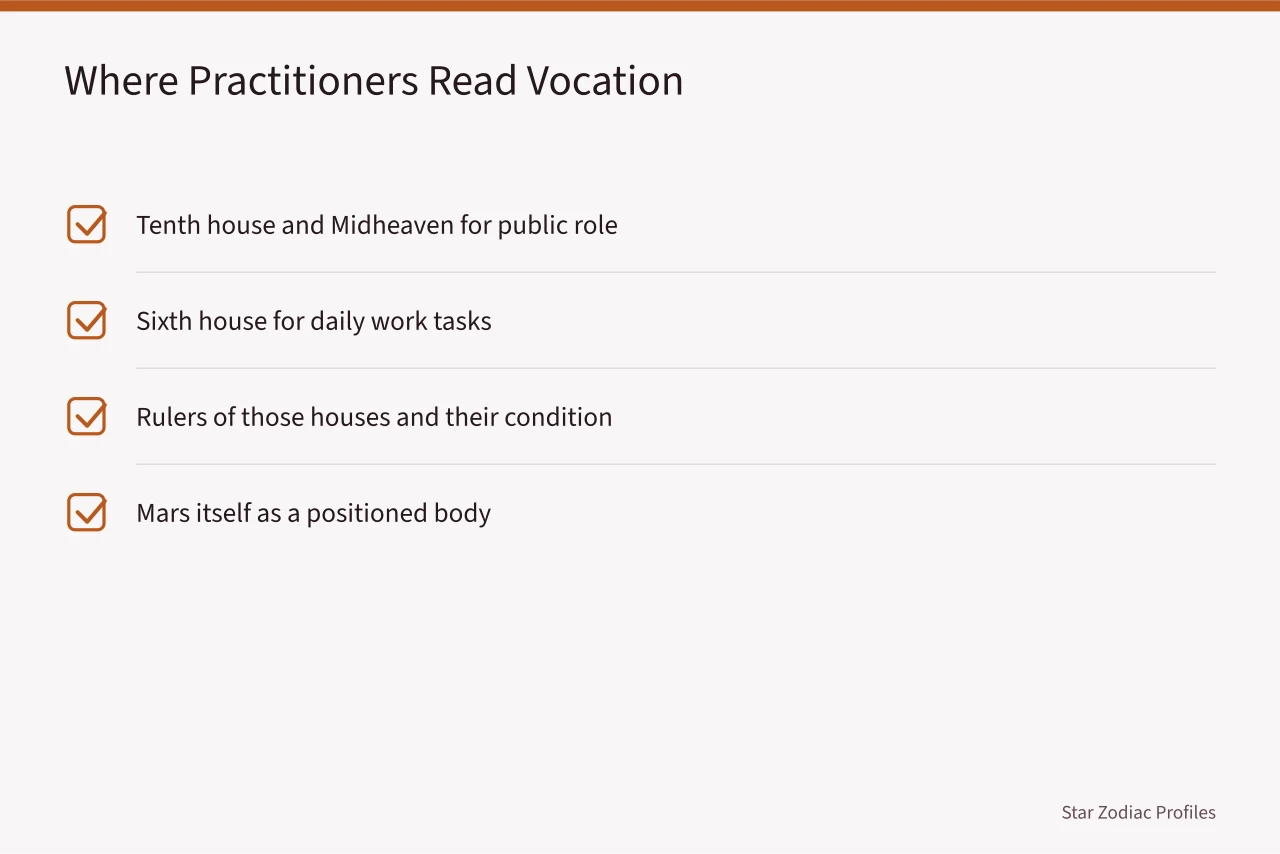
The distinction between the tenth and the sixth is worth keeping. The tradition separates what a person is known for from what they do all day. The two can be in different signs, ruled by different planets.
A sun-sign article collapses both into one paragraph, the second thing it gets wrong; the first is starting from the sun at all.
The outline of the three summer signs explains how signs and houses are paired in the first place, and the notes on the six signs from Libra onward show the house sequence continuing into the public half of the chart.
Reading a "careers for the sign" piece
Once you know the derivation, such a piece can be read quickly.
- Find the planet behind it. For this sign, every entry is Mars, cardinal or fire in workplace clothing.
- Look for the cost. If the piece lists drive without impatience, or initiative without abandonment, half the tradition's claim has been cut, which is the same edit the trait lists make.
- Notice the grammar. "The sign is associated with beginnings" is a statement about a symbol; "you thrive in fast-paced roles" is that statement turned to face the reader. Nothing was added between the two except the pronoun.
- Ask what was skipped. The houses, the ruler's position and the rest of the chart are where the tradition says the vocational reading lives.
And leave named people out. Pairing a well-known person's job with their sun sign states something about that person's character on the strength of a birthday, which the tradition's own method would not do and which nobody is placed to check.
Common questions
Is there a best career for Aries?
Not within the tradition, which reads work from the tenth and sixth houses and their rulers. The sign's vocabulary is Mars vocabulary, and it describes the flavor of effort, not a job.
Why do the old lists include such grim trades?
Because Mars was a malefic, and its occupations were the ones involving the things it was said to govern: fire, iron, cutting. The modern softening is a change in reading, not in the planet's assignments.
Does Mars in the birth chart matter more than the sun sign for work?
A practitioner would say that where Mars sits, and which houses it rules in that chart, tells them more about effort than the sun's sign does.
Is the sixth house about work or about health?
Both, in the tradition: it groups daily labor, routine and the body's upkeep together. That is a symbolic grouping and no practitioner would offer medical advice from it.
What is the difference between the tenth house and the sixth?
The tenth is read as the public role, the sixth as the daily task. The tradition keeps them apart because the two are often in different hands.