Costs
Part of MBTI diplomats: the parts worth your attention
Clearing up MBTI diplomats misconceptions
MBTI diplomats misconceptions start with one word: feeling names a way of deciding, not a level of emotion. Eleven slips and the repair for each.
The group built from intuition and feeling collects a particular kind of misreading: not hostile, mostly affectionate, and wrong in a way that makes the four codes smaller than they are. Eleven of them are set out below, with the point at which each enters the description and what it costs the reader who believes it.
What to take away
- The feeling preference is a way of deciding, not a level of emotion. Almost half the misconceptions on this page follow from getting that one word wrong.
- The family name is a later addition and carries connotations the four codes never had, including a suggestion that the group avoids conflict.
- Free questionnaires tilt toward this group's letters for a reason that has nothing to do with the respondent, and knowing the reason changes how you read your own result.
Misreadings of the F
One: feeling means emotional. In the model, feeling is one of two judging processes. It reaches decisions by weighing effect on people and what matters to them. Emotion is something everyone has; feeling in this sense is a decision procedure, and someone can use it while entirely composed.
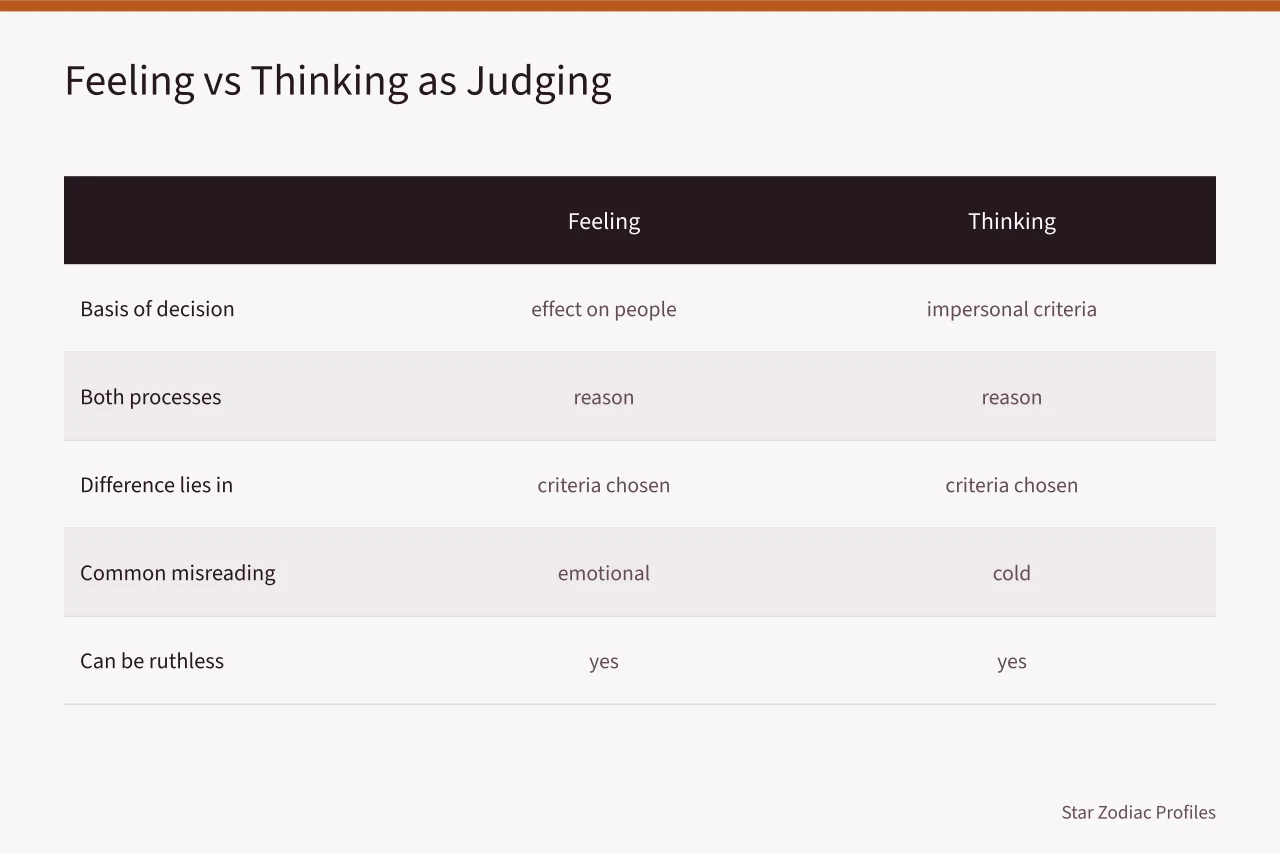
Two: feeling is the opposite of logic. It is the opposite of thinking, which the model defines as deciding by impersonal criteria. Both processes reason. They differ in what they take as the relevant criteria, not in whether criteria are applied.
Three: this group cannot make hard decisions. A decision weighed by its effect on people is still a decision, and it can be ruthless. The published descriptions include the costs of the preference: difficulty setting the personal consideration aside when the situation calls for it, not an inability to choose.
Four: the F preference is a gendered trait. This is the one pair on which the question of differing distributions between men and women is most often raised, and the stereotype that follows does real damage: men with the preference read the descriptions as unmasculine, women with the thinking preference read theirs as cold. The model treats all four processes as available to everyone, and a general treatment of personality assessment records how easily an instrument's reported distributions get read as a statement about who should be what.
Misreadings of the N
Five: intuition means empathy or insight into others. It names attention to patterns and implications rather than to the immediate and concrete. Reading other people is a separate matter, and the model does not claim the preference confers it.
Six: idealist means unrealistic. The word came from a temperament scheme, not from the four pairs, and in that scheme it named an orientation toward meaning and possibility. It was never a claim about someone's grip on facts.
Seven: this group is all in caring professions. Descriptions of preferences are not descriptions of occupations. The model makes no vocational prediction, and the association is a folk one built from the flattering half of the vocabulary.
Misreadings of the group label
Eight: the family name is part of the instrument. It is not. Sorting sixteen codes into four families is an organizing layer added later, most influentially by the temperament sorter tradition, which grouped the codes on its own reasoning. Useful shorthand, no separate authority, and the words carry meanings the codes do not.
Nine: diplomats avoid conflict. The name suggests it. The four descriptions do not. One of the codes in this group is described as the most directive in the whole system when it is organizing people toward something it believes in.
Ten: the group is one personality. The four codes differ in the order the model assigns to their underlying functions, and two of them share no function in the same position despite sharing three letters. Reading the family summary instead of the individual descriptions is the single most common way to end up with the wrong code, and the structure of the group is where that becomes visible.
The one that is about the test, not the type
Eleven: my free test says F, so I am an F. Free questionnaires usually replace forced choice with an agreement scale, and an agreement scale attached to a warmly worded statement invites agreement from almost everyone. That effect is social desirability doing the scoring, and it pushes results toward whichever side of a pair is written more attractively. On the thinking and feeling pair, that is usually the feeling side.
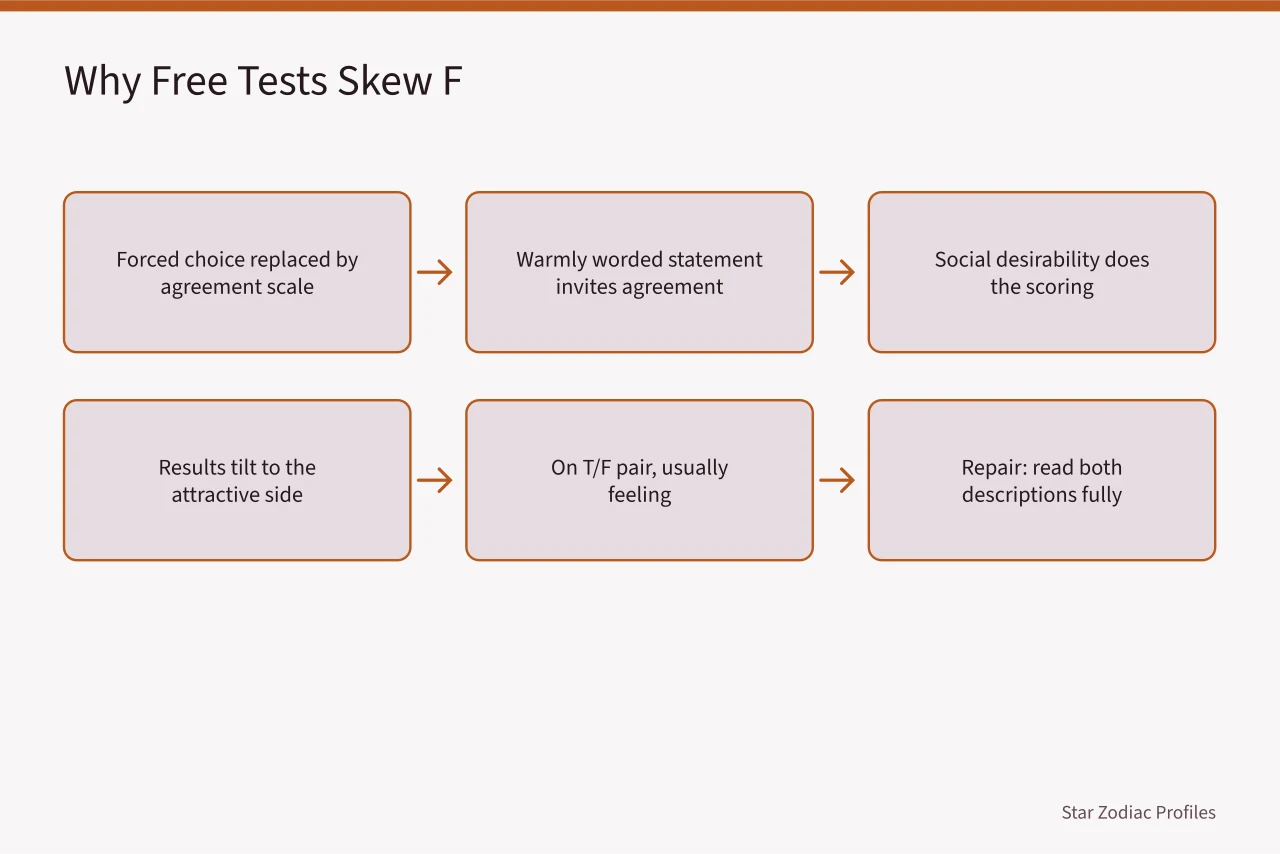
The repair is the step the free format skips: read both descriptions, all the way through, including the costs, and decide which one describes how you actually reach decisions. That is the same repair the free-questionnaire notes recommend for every pair.
The pattern across all eleven
| Where it enters | What happens | What to do |
|---|---|---|
| A borrowed English word | The everyday meaning survives the borrowing | Substitute the model's definition and reread |
| The family label | A connotation is imported that the codes never had | Read the four individual descriptions |
| The questionnaire format | Item wording tilts the tally | Do the best-fit reading yourself |
None of this is unique to these four codes. The equivalent list for the thinking group has the same three sources with different words in the first row, and the trait-versus-preference problem set out in the notes on how these descriptions are written sits underneath all of them.
Common questions
Is there any sense in which this group is more empathetic?
The model does not claim it. It claims a preference for weighing decisions by effect on people, which is a different statement and does not imply skill at reading anyone.
Why does the family name matter if everyone knows it is shorthand?
Because shorthand travels further than the caveat. The name arrives in the reader's head before the descriptions do, and it shapes what they notice in them.
My result changes between F and T depending on the test. What does that mean?
Usually that your answers sit near the cut on that pair, and that different item wording pushes you to different sides of it. Read both descriptions and choose.
Can someone tell I have a feeling preference by watching me?
No. Decision criteria are not visible, and composed behavior is compatible with either preference. This is the constraint that makes third-party typing fail across the whole system.
Are the four codes in this group really that different?
Different enough that people commonly identify with one and find the neighboring one foreign, despite three shared letters.