Industry
Part of MBTI diplomats: the parts worth your attention
MBTI diplomats traits from the ground up
MBTI diplomats traits are written as trait claims when the instrument supports only preference claims: how to spot the swap and audit a profile.
Take any published description of INFJ, INFP, ENFJ or ENFP, and mark every sentence that states a preference, then every sentence that states a trait.
The two sets look alike but claim different things. A preference sentence says where attention goes first, while a trait sentence says how much of something a person has.
The model supports the first kind, but popular descriptions are written almost entirely in the second.
What to take away
- A preference claim and a trait claim are different in kind. The instrument produces preference claims; the descriptions circulating online convert them into trait claims without saying so.
- The conversion is easy to spot once you know the grammar of it, and it explains why these four descriptions read as praise for warmth and vision.
- A model that reports positions on continuous dimensions handles the same material without the conversion, which is a useful comparison rather than a rival.
The two grammars
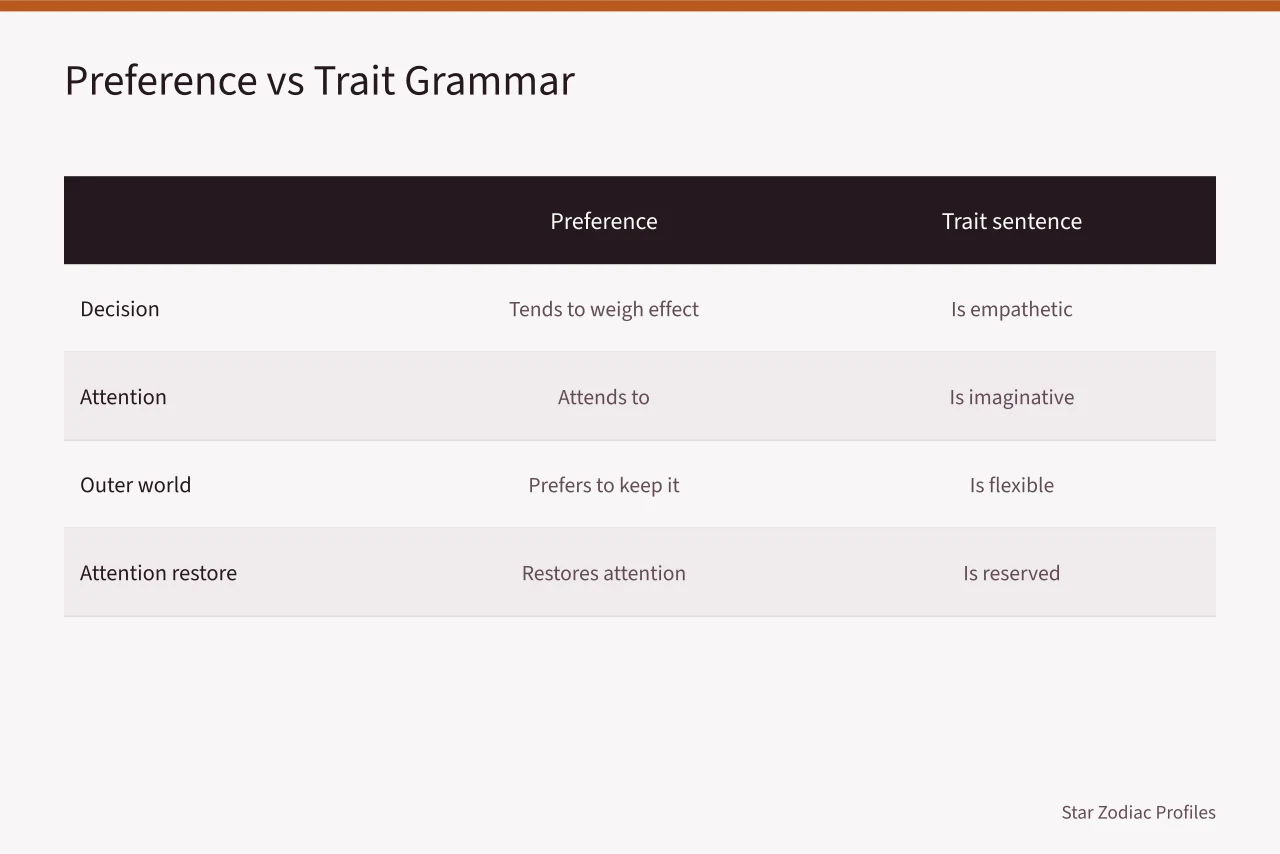
| Preference sentence | Trait sentence it becomes |
|---|---|
| Tends to weigh a decision by its effect on people | Is empathetic |
| Attends first to implications rather than to detail | Is imaginative |
| Prefers to keep the outer world open rather than settled | Is flexible |
| Restores attention alone rather than in company | Is reserved |
The right-hand column is what almost every profile page is made of. Each entry is a compliment, each is measurable in principle, and none of them is what the questionnaire asked about. The instrument asked which of two options a person would rather, over and over. It never asked how much.
This matters most for this group because the four codes pair intuition with feeling, and both words become flattering trait nouns in ordinary English. Nobody minds being told they are imaginative and empathetic. The conversion goes unchallenged because its output is pleasant.
Where the difference bites
Three places, in ascending order of consequence.
Self-description. A preference claim leaves room to be bad at the thing you prefer. Someone can weigh decisions by their effect on people and still handle a difficult conversation clumsily. The trait version closes that room, and a person who does not recognize themselves in it concludes they have the wrong type rather than that the sentence overreached.
Comparison. Trait claims invite ranking. If a description says a type is empathetic, the obvious next question is who is more empathetic, and the model has no answer because it never measured an amount. Preference claims resist the question by construction.
Prediction. A trait claim implies behavior. A preference claim implies a route. Two people with the same code will often do different things, and the code will have described both of them accurately, because it described how they approached the problem rather than what they concluded.
The comparison worth making
There is an entire tradition that reports positions rather than kinds. Work in trait theory starts from the assumption that the useful description of a person is a set of numbers on continuous dimensions, and its best-known modern form, the five-factor model, reports exactly that. A middling result is reported as middling. There is no cut and no code.
Two consequences follow, and they are the honest way to compare the traditions.
First, the trait approach cannot give you the thing people like about type: a memorable label, a community, a shorthand. A vector of five numbers is not a name.
Second, the type approach cannot make the claims people take from it. Once the letters are printed, the amounts are gone. Everything downstream that sounds like an amount, including the percentages on a results page, was added afterward. That is the point the scoring notes for the thinking-and-intuition group work through in detail, and it applies unchanged here.
Neither tradition invalidates the other. They answer different questions and report in different formats.
Where the descriptions came from
The four-function scheme underneath the letters comes from a 1921 book on psychological types. It described ways of taking in information and ways of judging it, treating all as ordinary human equipment rather than talents.
The book's own presentation is closer to preference language than most modern profiles are. Trait grammar entered later, through popularization, because trait sentences are easier to write and better to read.
The group label is later still. Sorting the sixteen codes into four families is an organizing layer added by others, and the family names carry connotations the four codes do not, as the overview of this group sets out.
Auditing a profile you find online
Four passes over the text, each quick.
- Underline every "is". Rewrite each one as "tends to prefer". If the sentence stops making sense, it was never a preference claim.
- Count the costs. A published description pairs each preference with what it makes harder. A profile with no costs has been edited for sharing.
- Check for amounts. Words like highly, deeply and strongly are amounts. The questionnaire produced none.
- Swap the code. Put a different four-letter code at the top and read it again. The sentences that still work were never about the type.
The fourth pass is the most informative and the most uncomfortable, because a surprising share of any profile survives it. That is not a fault in this group specifically. It is a property of descriptions written in general terms, and it applies equally to the practical group and to the group described through spontaneity.
Common questions
Does the feeling preference mean being emotional?
No. It names a way of deciding, weighed by effect on people and by what matters to them. It is a judging process in the model's own vocabulary, and it sits opposite thinking rather than opposite reason.
If these are only preferences, why do the descriptions feel so specific?
Because they are written in trait grammar, which sounds specific, and because general descriptions are read as personal by nearly everyone. Both effects push in the same direction.
Can I be an intuitive type and still be detail-oriented?
Yes. The preference says which you reach for first, not which you are capable of. Many people are good at the thing they do not prefer, often because their work required it.
Is the five-factor model better?
It is better at reporting amounts and at avoiding artificial cuts. It is worse at giving people a shorthand they enjoy using. Choose by what you need the description for.
Do the four codes in this group differ much from each other?
Considerably, in the function orderings the model assigns, even where three letters are shared. The family name hides that, which is one reason to read the individual descriptions rather than the group summary.