Industry
Part of What to expect from Taurus celebrities, updated for 2027
The short version of Taurus celebrities misconceptions, 2027 edition
Taurus celebrities misconceptions come from six sources: the animal, two technical words, the planet, the dignities, the calendar and the list format.
Misreadings of the second sign come from five different places, and it helps to know which is which, since each correction differs.
Sources include the emblem's animal, a technical word with an everyday meaning, and the calendar. One is the format usually used to write about the sign, and this page sorts them by source.
What to take away
- The bull, the word "fixed", the word "earth", the planet Venus and the classical dignities each feed a different misreading of the sign. None of them is a misreading of astrology; each is a step past what the scheme says.
- The tradition's own account of the sign is double-sided, conditional and dependent on a full chart. The popular account keeps the flattering half and drops the conditions.
- A list of famous people under the sign is not an error about the sign. It is an error about what counts as evidence.
Where each misreading enters
| Source | The misreading | What the scheme holds |
|---|---|---|
| The bull | The sign is aggressive, or slow-witted | The animal is an inherited constellation label, not a description |
| "Fixed" | Stubborn, rigid, incapable of change | A mode: the middle month of a season, read as holding and sustaining |
| "Earth" | Materialistic, dull, unimaginative | An element: substance and the tangible, read as one of four symbolic styles |
| Venus | Lazy, indulgent, vain | A ruler: the planet of attraction, harmony and pleasure, with costs the tradition states |
| The dignities | "Taurus people are bad at conflict" | Mars is in detriment in the sign: a rating of a planet's condition, not a fact about anyone |
| The calendar | Fixed dates, or "your sign has changed" | The sign is thirty degrees from a moving boundary; two zodiacs exist and disagree |
| The list | Famous names prove the traits | Birthdays are spread across the year; any sign can be stocked with names |
From the animal
The bull came with the constellation, and the constellation came from a much older sky, the one recorded in Babylonian sky lore. The tradition kept the figure as a label and did not build its description of the sign from it. The keywords come from the three assignments, earth, fixed and Venus, and none of them is bovine.
When a description leans on the animal (charging, stubborn as a bull, placid in the field), it draws on an image the scheme inherited, not on anything the scheme says. The outline of the sign's derivation shows how the vocabulary is built without the animal at all.
From the technical words
"Fixed" and "earth" are the two words most responsible for the sign's reputation, and both are technical terms with everyday cousins.
Fixed is one of three modes. The cardinal signs open a season, the fixed signs hold its middle, the mutable signs close it. The tradition reads fixed as sustaining, concentrating, keeping a thing going once started. Stubbornness is that quality named from the outside by someone who wanted it to move. The scheme states both: a fixed sign is described as persistent and as resistant to change, in the same breath, because those are one claim in two registers.
Earth is one of four elements. Tradition reads it as the element of substance: what can be touched, built, kept, grown. Materialism adds judgment to that quality, and the layered derivation of the sign's words shows each half's older system.
The scheme's account is nearer to "attends to what is tangible", and it applies the same double-sidedness: reliable and slow, grounded and heavy.
A description that keeps only the flattering half of each pair is incomplete. One that keeps only the unflattering half is the same description in a bad mood.
From the planet
Venus rules the sign, and its vocabulary is pleasure, attraction, harmony, and value. Popular readings turn that into indulgence and vanity, but the tradition lists those as the planet's costs and does not assign them to everyone with the sun in the sign.
It reads Venus from where it sits in a chart and what it contacts. A chart with the sun in Taurus and Venus in Aries is not read as the paragraph reads.
There is also a confusion of two Venuses. Venus as a ruler is an adjective for the sign; Venus as a planet has a position of its own. The notes on the first sign explain why the whole chart, and not the sun's sign, is where the tradition places character.
From the dignities
The classical scheme rates how each planet is said to operate in each sign, under the heading of essential dignity. For Taurus: Venus is in its domicile (at home), the Moon is exalted (working at its best), and Mars is in detriment (working against its nature). Those are ratings of planets, used when a practitioner finds one of them in the sign in a particular chart.
The misreading turns a rating of Mars into a fact about people: because Mars is weak in Taurus, the sign avoids conflict. The scheme says nothing of the kind.
It says that a chart with Mars in Taurus has Mars in a sign that does not suit it, a remark about one placement in one chart, and says the opposite about a chart with the Moon there. Within the same sign, one factor is described as amplified and another as obstructed. That alone rules out any single-adjective summary.
From the calendar
Two errors, pulling in opposite directions. The first is that the sign runs between fixed printed dates. It runs from the point thirty degrees after the equinox to the point sixty degrees after it, and because the sun's motion and the calendar do not divide evenly, the boundary moves by a day between years. Near a boundary, the printed table is a rounding and a calculated chart is the answer.
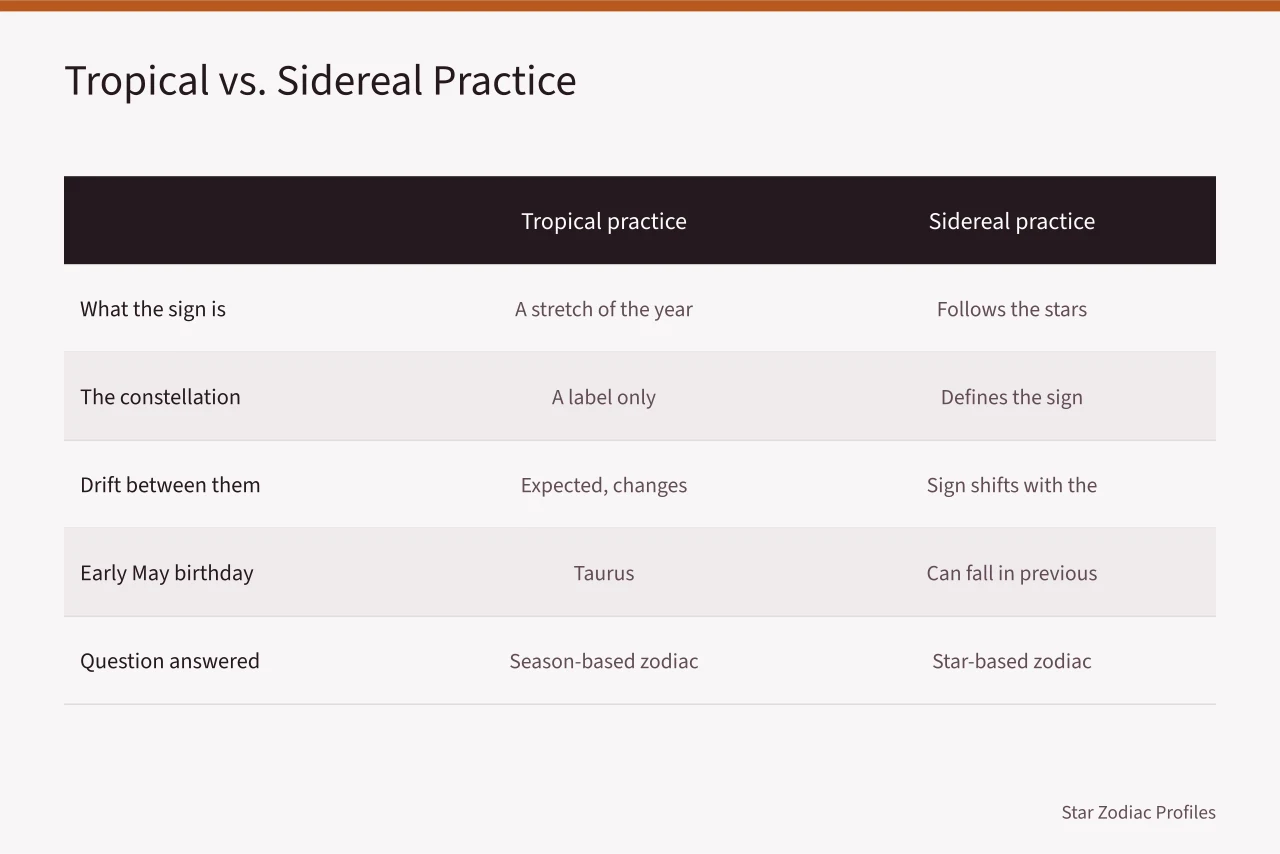
The second is that the sign has moved because the constellation has. In tropical practice the sign is a stretch of the year and the constellation a label; the drift between them is expected and changes nothing. In sidereal practice the sign follows the stars, and a birthday in early May can fall in the previous sign. The two systems answer different questions. "Your sign has changed" is what switching between them without saying so sounds like.
From the format
The last misreading is not about the sign. It is the belief that a list of well-known people born under it demonstrates the description, but it cannot.
Birthdays are spread evenly through the year, and every field has people from every month, so any of the twelve signs can be filled with recognizable names. The list looks like a sample and is a selection.
It also claims each named person's character from a birthday. Nobody compiling the list could check that, and the tradition's own method would not make it.
Practitioners read a chart, which needs a time, and read it with the person. This site names nobody for that reason, not as a criticism of astrology but as the tradition's own rule applied. The outline of the three summer signs shows the same rule applied to the signs that follow.
Common questions
Is Taurus really the stubborn sign?
The tradition reads the fixed mode as sustaining and resistant to change, both at once. Whether that is stubbornness depends on who is describing it and what they wanted moved.
Why is the Moon exalted in Taurus?
The classical scheme places each planet's exaltation in one sign, and the Moon's is here. The reasoning given is that the Moon, the body of habit and need, is best served by a sign of substance and stability. It is a rating within the scheme.
Does Mars in detriment mean Taurus avoids conflict?
It means that a chart with Mars in this sign has Mars in a placement the scheme rates as unsuited to it. It is a statement about one planet's condition in one chart.
Are the older descriptions of the sign different from modern ones?
Blunter, and more conditional. They were written for readers who would go on to cast a chart, so they state the costs plainly and qualify everything by the rest of the scheme.
Why does every source describe Taurus so similarly?
Because every source is rendering the same three assignments into prose. Agreement between authors reflects a shared derivation, not repeated observation of people.