Industry
Part of MBTI analysts: the one typing step no outside observer can perform
MBTI analysts quiz: what to keep and what to drop
MBTI analysts quiz results come from free questionnaires missing two steps: what the answer format changes, and how to turn a code into a decision.
Most people who know their four-letter code got it from a free website in about eight minutes, but that is not the instrument.
It is a questionnaire that resembles the instrument and uses a different scoring method. It omits the two steps the published procedure treats as part of the result. Knowing exactly which parts are missing lets you read your own result honestly.
What to take away
- A free online quiz is a separate questionnaire that produces a four-letter string. It is not the licensed instrument, and its items, scoring and cut points are usually undisclosed.
- Two omissions matter more than the item wording: nobody explains what the four pairs mean, and nobody asks you to make the best-fit decision that settles a type.
- The result is still worth something, provided you treat it as a prompt for that decision rather than as the decision itself.
What gets dropped between the two
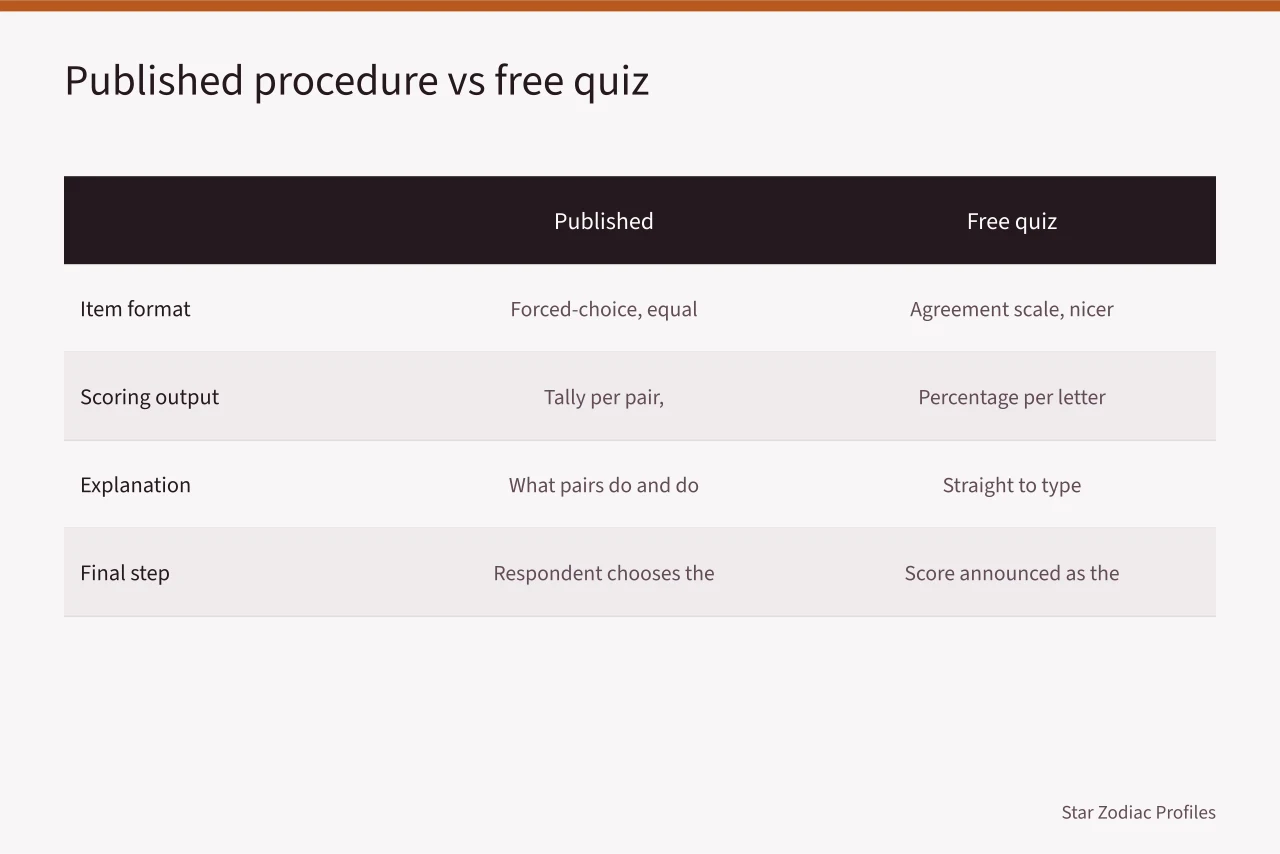
| Step in the published procedure | What a free quiz usually does |
|---|---|
| Forced-choice items, both options written to be equally acceptable | Agreement scales, where one end of the statement is plainly nicer |
| A tally per pair, with a reported clarity figure | A percentage per letter, presented as a strength |
| An explanation of what the pairs do and do not mean | A results page that goes straight to the description |
| The respondent reads descriptions and chooses the fit | No such step; the score is announced as the answer |
The last row is the one that changes the nature of the output. In the model, a questionnaire result is a hypothesis and the person's own reading settles it. Remove that and you have an assignment handed down by a website, which is closer to a horoscope in its delivery than to a self-report inventory used properly.
Why the answer format matters more than it looks
The published items force a choice between two options built to be equally attractive. That design exists to defeat one specific problem: people answer questionnaires partly as they wish to be seen, an effect documented across the whole field as social desirability bias. If one option sounds better, the tally measures aspiration rather than preference.
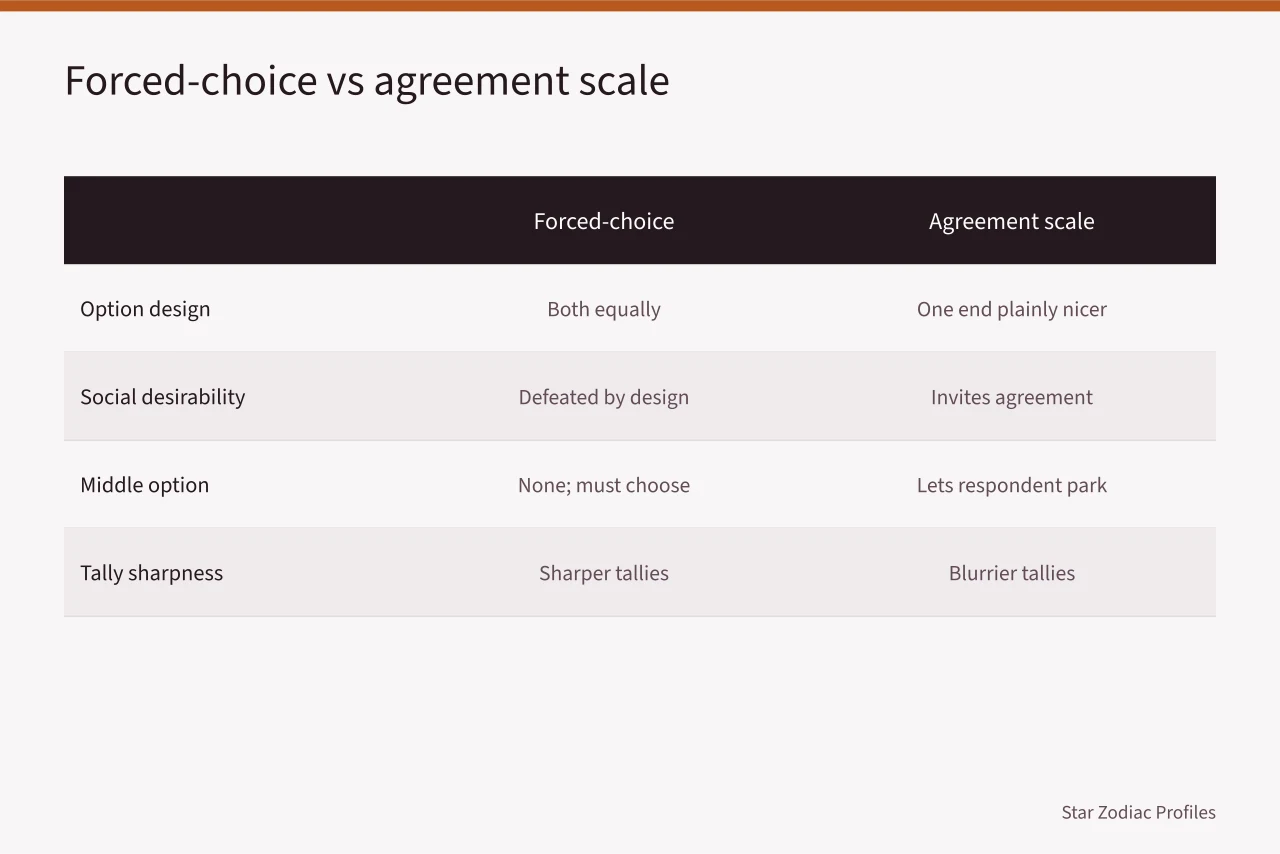
Most free quizzes use an agreement scale instead, usually five or seven points, because it is easier to write and easier to score. That format is a Likert scale, and it is a perfectly respectable tool. But an agreement scale attached to a flattering statement invites everyone to agree.
Read the items on any free version of a test aimed at the analyst codes and count how many describe qualities a person would be pleased to have. The tally that results is not neutral between the four pairs, and it tilts hardest on the thinking pair, where the vocabulary itself sounds like a compliment.
There is a second effect. An agreement scale lets a respondent avoid choosing, by parking in the middle. The forced-choice format does not, which is why it produces sharper tallies from the same person.
What a percentage on a results page is telling you
Usually this is the proportion of items on that pair you answered toward one side. It does not measure how strongly you hold the preference or how much of the trait you have.
Someone at seventy percent intuitive does not have more intuition than someone at fifty-five percent. They answered more questionnaire items the same way. The scoring notes cover what the underlying tally can and cannot support.
The practical consequence: a result near the middle on any pair means the questionnaire could not separate those types. Retaking it on another day may flip that result.
That is expected when a cut is applied to a continuum. So read the two descriptions instead of retaking the test until it agrees with you.
How to use a free result well
Five steps, and they take longer than the quiz.
- Write the four letters down and treat them as a starting guess. Nothing more has happened yet.
- Read the description of the reported type in full, including the parts about what the preferences make harder. A version that lists only strengths has been rewritten for sharing.
- Read the descriptions of the neighboring types. Change one letter at a time and read those four. This is the step the quiz skipped.
- Choose. If a neighbor fits better, that is your answer, and the model agrees with you rather than with the score.
- Notice what you did there. You made a judgment about your own preferences from the inside. That is the only place a type has ever come from, which is why the parent page treats third-party typing as impossible rather than merely unreliable.
The recognition problem
One more thing to watch for isn't specific to typology at all. A general description will feel accurate to nearly everyone reading it about themselves.
That is why the results page feels like a revelation. A sign-based quiz built on completely different assumptions gives the same feeling. The notes on quiz scoring and ground truth examine that mechanism.
The test for it is quick. Take the results paragraph for your reported type, then read the paragraph for the type that shares no letters with yours. If both feel largely true, the paragraph is doing the work, not the questionnaire.
A well-written type description survives this test on the specifics but fails on the generalities, which is a useful way to find the specifics.
What the quiz format is genuinely good at
Getting someone to think about their own preferences for ten minutes, in an organized way, with a vocabulary attached. That is not nothing.
It has the same value as a good self-assessment worksheet. It does not depend on the questionnaire being any good, provided the reader does the reading afterward. The failure mode is stopping at the four letters, adopting them as an identity, then applying them to other people. That is where the pairing grids begin.
Common questions
Is the free test the same as the real one?
No. The licensed instrument is administered through a trained practitioner and includes an explanation and a best-fit step. Free versions are separate questionnaires that produce a similar-looking code.
My result changes when I retake it. Is that a problem with me?
No. It usually means one or two pairs sat near the cut. Read both descriptions and decide.
Should I trust the percentages?
Read them as consistency of answering, not as strength or amount. Most sites do not say which they mean.
Does a longer quiz give a better answer?
More items reduce noise, which is a real improvement. It does not add the explanation or the best-fit step, so the main gap stays open.
Can I use my result to understand a colleague?
You can use it to describe yourself to them. Their type is theirs to determine and to share, or not.