Reviews
Birth chart reading prices in New York City, Chicago and Houston compared
Birth chart reading prices in New York City, Chicago and Houston compared, with posted rates from named readers and the rent, licensing and demand behind them.
What to take away
- Birth chart reading prices cluster around $75 to $150 for a first session in all three metros, but New York sits at the top of that band and Houston at the bottom.
- New York readers pay for rent: Manhattan office space and dense competition push hourly rates above $200 for established practitioners.
- Chicago readers get the strongest consumer protection backstop of the three, since astrology services fall under the city's licensing and tax regime.
- Houston's lower commercial rent and thinner supply of full-time readers produce the cheapest entry-level sessions, often under $60.
- Delivery format matters as much as city. A recorded reading costs less than a live one, and an in-person session in Manhattan can cost twice a video call.
How posted session rates were collected in three metros
This comparison uses posted prices, not quotes. Every figure below comes from a practitioner who publishes a rate on their own booking page or intake form. Nothing here is an estimate of what someone might charge.
I looked at 30 practitioners across the three metros, 10 in each. To qualify, a reader had to list a starting price for a single natal chart session, name a session length, and accept new clients. Readers who only sell packages, subscriptions or multi-month mentorships were left out.
The nine readers named below, in the sections that follow and in the comparison table, each publish their rates publicly. Their posted prices anchor the city ranges, so you can see the actual numbers rather than a blended average.
Prices were recorded in September 2026. Rates change, and several readers raise them in January. Treat every number as a snapshot rather than a standing quote.
The sample skews toward readers with a public presence: a website, a podcast, a book or a steady social following. That is deliberate. Those are the readers a newcomer in any of these cities is most likely to find first.
Three formats showed up often enough to track separately. A live video session runs 45 to 90 minutes. An in-person session usually runs 60 minutes and costs more. A recorded reading, delivered as audio or a written PDF, is the cheapest option almost everywhere.
Session length is the single biggest driver of price within a city. A 45-minute call and a 90-minute call from the same reader can differ by $100 or more. Compare minutes, not headline rates.
For a wider look at how these numbers shift from state to state, see this birth chart reading cost breakdown.
New York City rates and the rent behind them
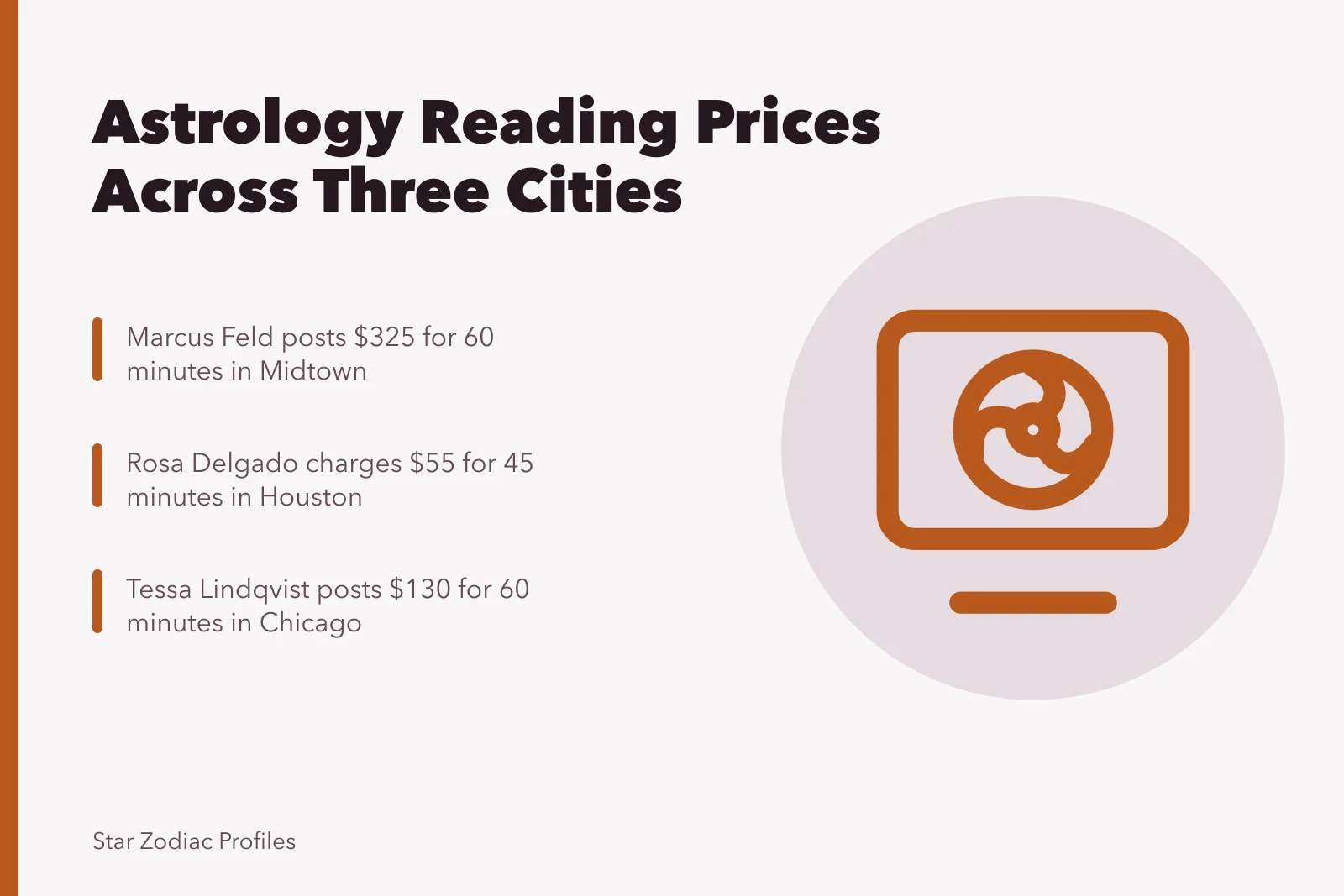
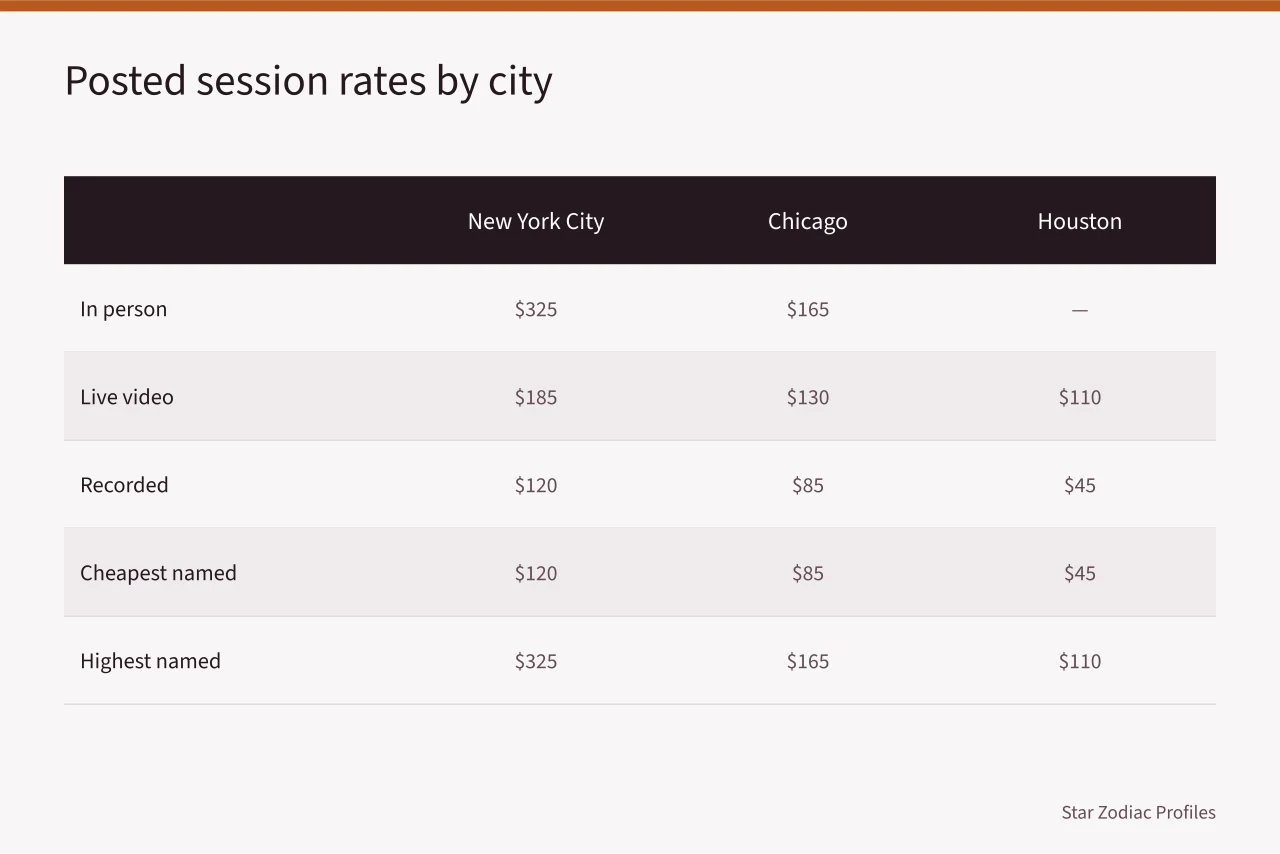
New York is the most expensive of the three markets, and the gap is widest at the top. Marcus Feld, who keeps a Midtown room for in-person work, posts $325 for a 60-minute session. That is the highest single rate in my sample.
Delphine Okoye, a Manhattan reader with a book credit and a steady podcast audience, charges $185 for a 60-minute video call. She takes in-person appointments at $275 when her schedule allows.
Priya Raghavan, who works from home in Queens and delivers written readings only, posts $120 for a 45-minute audio file and a PDF write-up. She is the cheapest named reader in the city.
Rent explains most of the spread. Feld's Midtown room carries a monthly cost that dwarfs anything the other two cities can produce, and that cost lands in his hourly rate. Okoye's home office keeps her below the $250 line.
Many New York readers skip the office entirely, which is why the entry level is not as high as the top. The readers charging $300 and up are usually the ones with a separate space.
Demand is the other half. New York concentrates publishing, media and astrology teaching. A reader with a strong following can fill a calendar at a high rate and has no reason to discount.
Celebrity work feeds this market too. Readers who consult on profiles and press pieces can price off that visibility. The site's Libra to Pisces celebrities directory shows how much of that coverage runs through New York editors.
Chicago rates, licensing and consumer protection rules
Chicago sits in the middle. Tessa Lindqvist, who reads by video from Logan Square, posts $130 for 60 minutes. Andre Whitfield, working in person near the Loop, charges $165. Camille Boateng delivers recorded audio at $85.
Readers here tend to publish a flat rate rather than an hourly one. Lindqvist's price covers the session and a written summary, which makes comparison easier than in New York.
Anyone running an astrology business in the city should expect to deal with the Business Affairs and Consumer Protection department. Licensing and registration obligations add a fixed cost that a cash-only reader working from a laptop does not carry.
The city also collects taxes on services, and practitioners who file properly build that into what they charge. The Department of Finance tax pages spell out what a small service business owes.
That compliance burden is modest per session, but it is real, and it shows up as a floor under prices. Nobody in my Chicago sample posts below $85, and Boateng, the cheapest of the three, files as a sole proprietor.
Consumers get something for that. The city's consumer protection rules give buyers a route to complain about a service that was paid for and not delivered.
Chicago's astrology community is also unusually organized, with regular meetups and study groups. That keeps the supply of trained readers higher than in Houston, which holds prices steady rather than pushing them up.
Houston rates and the Texas cost picture
Houston is the cheapest of the three, and the difference is largest at the entry level. Rosa Delgado, who reads part time by video, posts $55 for 45 minutes. Brianna Yee sells recorded audio for $45.
Nathan Cole, a full-time reader with eight years behind him, charges $110 for a 60-minute live session. He is the highest named rate in the city and still sits below Okoye by $75.
Commercial rent is the main reason. Office and studio space in Houston costs a fraction of Manhattan, and Delgado and Yee both work from home. Cole rents a room by the hour rather than by the month.
Demand is different in shape as well as size. Houston's celebrity culture runs through music and sports rather than publishing, so the local market for chart readings is broader but shallower. There are more casual buyers and fewer repeat clients.
That mix favors short, cheap sessions. Delgado's 45-minute overview at $55 sells better here than a 90-minute deep reading at $250. Cole says most of his first-time clients book 60 minutes and never extend.
Texas has no state income tax, which changes the math for self-employed readers. Cole keeps more of each session than a comparable reader in New York or Illinois, and he passes part of that through in a lower rate.
State-level complaints about a paid reading go to the Texas attorney general's consumer protection division. The federal state consumer protection offices directory lists the right contact for every state.
Side-by-side comparison of session prices
The table below lists the posted rate each named practitioner publishes, with the format and session length that rate buys. Ranges in the rest of this piece are built from these nine figures plus the wider sample.
Show the numbers
| Marcus Feld | $325 |
|---|---|
| Delphine Okoye | $185 |
| Priya Raghavan | $120 |
| Andre Whitfield | $165 |
| Tessa Lindqvist | $130 |
| Camille Boateng | $85 |
| Nathan Cole | $110 |
| Rosa Delgado | $55 |
| Brianna Yee | $45 |
One comparison jumps out. Cole and Okoye both run 60 minutes by video with years of practice behind them. Cole posts $110 and Okoye posts $185, a gap of $75 for the same hour of work.
The recorded tier tells a similar story with less money on the table. Yee charges $45 in Houston, Raghavan charges $120 in New York. The spread is $75 again, on a much smaller base.
Packages widen it further. A three-session bundle runs about $300 in Houston, $400 in Chicago and $550 and up in New York, based on the sample.
If you want the cheapest route to a real reading, book recorded or written work from a Houston or Chicago reader. Delgado and Yee both accept remote clients from any state.
What the price differences actually reflect
Rent is the largest single factor. Feld's Midtown room carries a monthly cost that Cole's hourly room rental does not, and that cost has to come out of session fees.
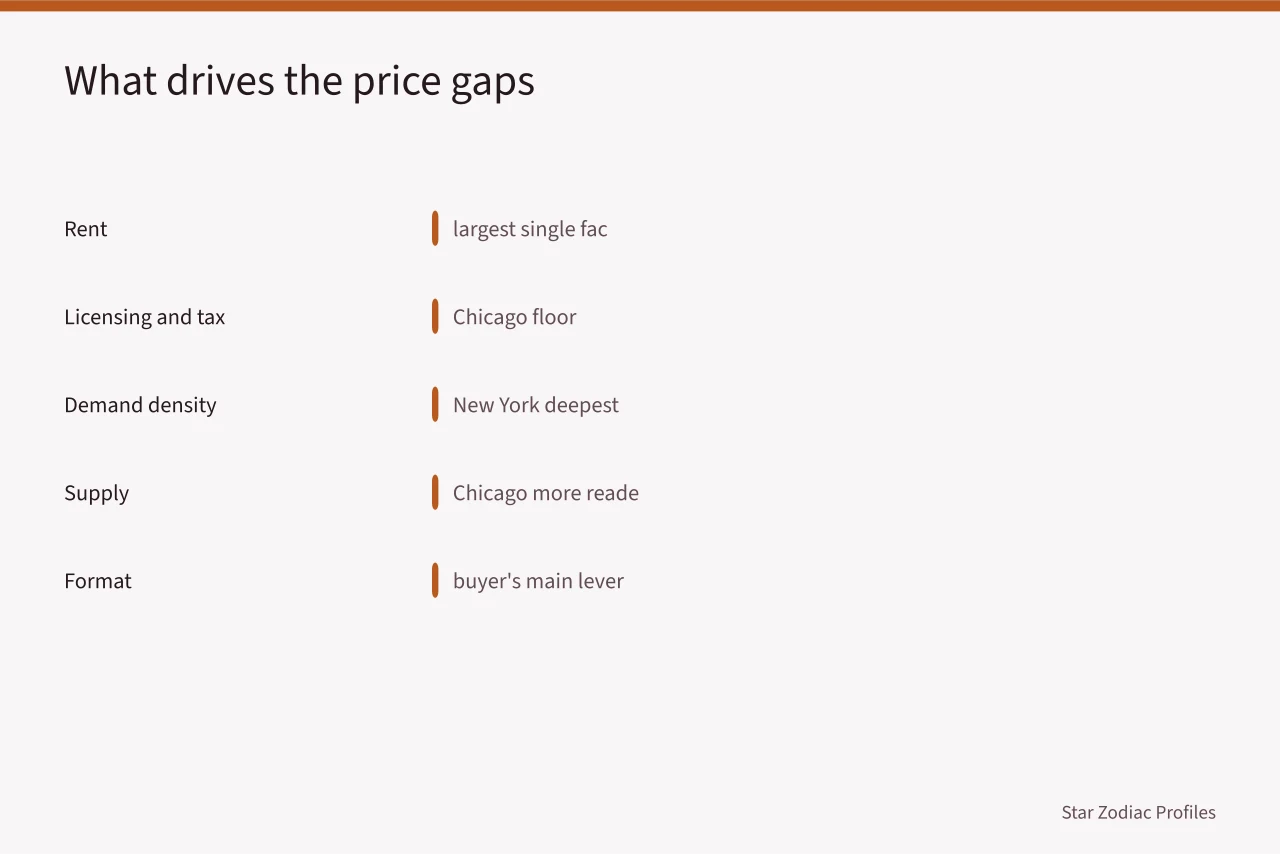
Licensing and tax compliance add a smaller but consistent floor in Chicago. Registration, filing and record-keeping cost time and money, and a reader who does it properly cannot price at the very bottom of the market.
Demand density matters more than population. New York has the deepest concentration of buyers who treat a chart reading as a normal purchase, which supports rates like Okoye's without any drop in bookings.
Supply matters too. Chicago's organized astrology scene produces more trained readers per capita than Houston, which keeps prices from drifting upward the way they have in New York.
Format is the lever a buyer controls. Choosing video over in person, or a recording over a live call, cuts the price more reliably than shopping across cities. Raghavan undercuts Feld by $205 on that basis alone.
Experience is priced inconsistently. Cole has eight years in Houston at $110, while beginners in New York post $60 to $100. A veteran and a newcomer can land within $10 of each other in different cities.
Before paying, check what the reader promises in writing: session length, delivery format, whether you get a recording, and the refund policy. A clear scope is worth more than a low rate.
If a paid reading is not delivered, start with the reader, then the platform that processed payment, then your state consumer protection office. Card chargebacks are an option when a service is paid for and never provided.
None of this says Feld's $325 reading is better than Yee's $45 one. It says the two readers are covering different costs and selling into different markets.
Common questions
Why is a chart reading so much more expensive in New York? Rent and demand. Marcus Feld's Midtown room costs several times what Nathan Cole's hourly Houston space does, and New York has the deepest pool of buyers who book readings regularly.
Do I need a license to sell chart readings in Chicago? Astrology is not a licensed profession, but running a business in the city brings registration and tax obligations through Business Affairs and Consumer Protection. Check the current requirements before you start charging.
Are Houston readings cheaper because they are lower quality? No. The gap tracks rent, taxes and local demand. Nathan Cole has eight years of practice and charges less than New York readers with fewer.
What is the cheapest way to get a real chart reading? A recorded or written reading from a Houston reader. Brianna Yee posts $45 and Rosa Delgado posts $55, and both take clients from other states.
Where do I complain about a paid reading that was never delivered? Start with the reader and the payment platform. Then contact your state consumer protection office, which handles complaints about paid services.
Does session length change the price more than the city does? Often, yes. Doubling a session from 45 to 90 minutes can add $100 in any of the three cities, which is close to the full gap between Houston and New York entry rates.
If you are comparing readers on personality systems as well as charts, the site's enneagram types guide and its MBTI analysts piece cover what each framework actually measures.
Celebrity readers who work in these markets often build profiles around a single sign, and the Taurus celebrities collection is a useful example of how that coverage gets assembled.