Industry
Taxes for US astrology practitioners, self-employment and 1099s explained
Astrology business taxes in the US: Schedule C lines, self-employment tax thresholds, 1099-K and 1099-NEC rules, deductions, EINs and quarterly payments.
What to take away
- Astrology business taxes hinge on Schedule C, where you report chart-reading income and deduct ordinary costs.
- Self-employment tax kicks in once net earnings reach $400, and it covers both the employee and employer halves of Medicare and Social Security.
- Third-party payment platforms and clients may send you a 1099-K or 1099-NEC, but you owe tax on all income even without a form.
- Deductions for software, courses, studio space and mileage lower your net profit, which in turn lowers what you owe.
- An EIN separates your business identity from your Social Security number and is free from the IRS.
- Quarterly estimated payments are due in April, June, September and January for most self-employed readers.
Who counts as self-employed in an astrology practice
If you sell chart readings, you are almost certainly self-employed for US tax purposes. The IRS treats anyone who carries on a trade or business as self-employed, and paid astrology work fits that definition. You do not need a formal business entity or a storefront to be self-employed.
A single paid reading can make you self-employed. The threshold is not a minimum number of clients or dollars; it is whether you are in business to make a profit. Occasional free charts for friends do not count, but a steady stream of paid sessions does.
Part-time readers are self-employed too. Many astrologers keep a day job and read charts on evenings and weekends. The IRS still expects you to report that income on Schedule C and pay self-employment tax when net earnings reach $400.
The self-employed individual tax center explains that you generally must file an annual return and pay estimated tax if you expect to owe $1,000 or more. The same page covers the $400 self-employment tax trigger.
You can review the agency's guidance on self-employment tax obligations for astrology practitioners at the Self-employed individuals tax center | Internal Revenue Service.
A side practice that loses money year after year may be treated as a hobby. The IRS looks at whether you keep records, depend on the income, and run the activity like a business. If it is a hobby, you report the income but cannot deduct expenses the same way. Most working readers clear this bar easily.
Your state may also require a business license or a fictitious name filing. California, New York, Texas and Florida all have their own registration rules for sole proprietors. Check with your state's revenue department or a local accountant before you assume a federal filing is enough.
Schedule C lines that matter for chart readings
Schedule C is the profit or loss form for sole proprietors. It is two pages, and most astrologers use only a handful of lines. The form asks for your name, Social Security number or EIN, business name, and accounting method.
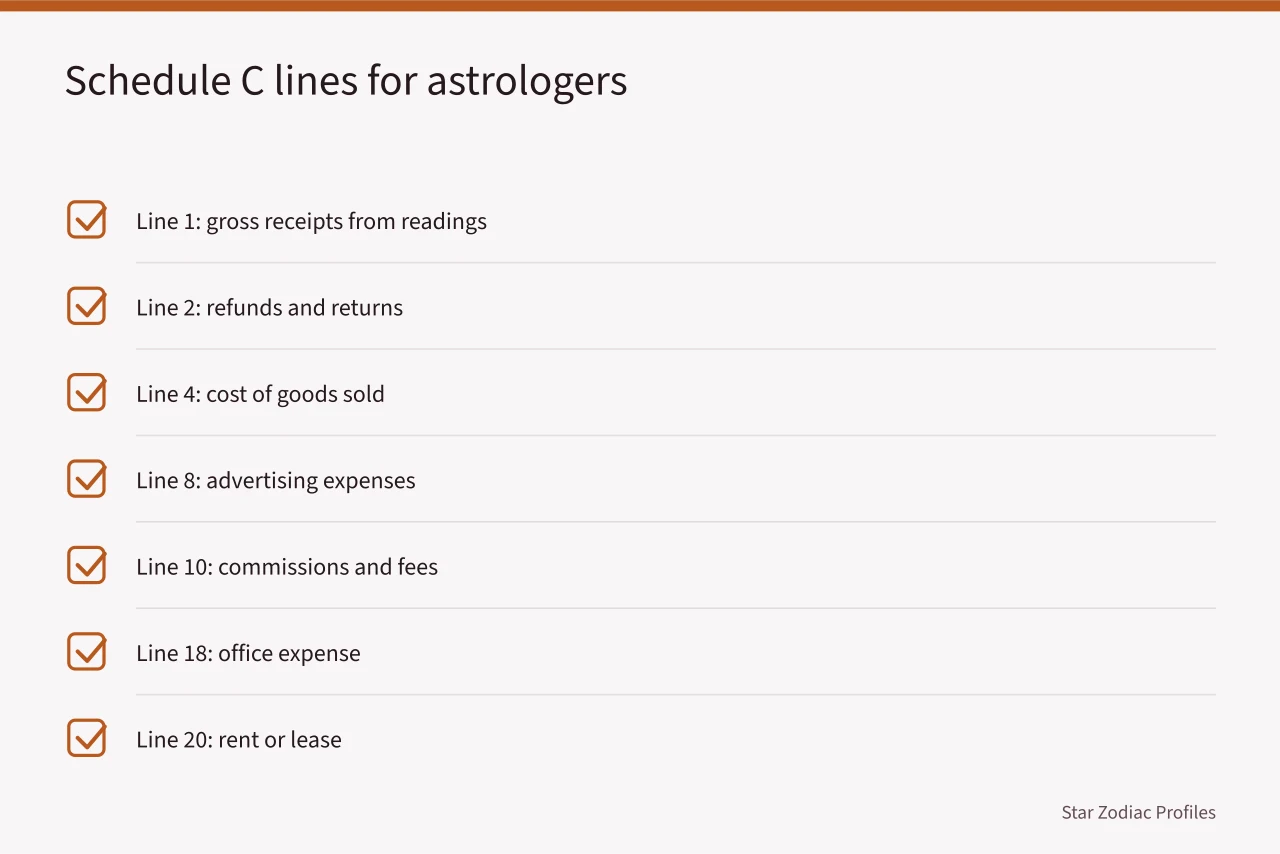
Line 1 is gross receipts. This is every dollar you took in for readings, classes, and written reports. It includes cash, card, PayPal, Venmo, and platform payouts. You report the full amount before fees.
Line 2 is returns and allowances. If you refunded a client for a missed session, you subtract that here. Keep a record of every refund, because the IRS can ask for it.
Line 4 is cost of goods sold. Most astrologers have no inventory, so this line stays blank. If you sell printed chart books or decks, you may have a cost of goods figure.
Line 8 is advertising. Money spent on Instagram ads, podcast sponsorships, or a booth at a metaphysical fair goes here. Keep receipts and note the platform.
Line 10 is commissions and fees. Payment processor fees, Etsy fees, and platform commissions belong on this line. If a client pays $100 and Stripe keeps $3, you report $100 on line 1 and $3 on line 10.
Line 18 is office expense. This covers small supplies like printer ink, paper, and postage. It does not cover your home office, which has its own line.
Line 20 is rent or lease. If you rent a studio or a desk in a shared space, put that amount here. Do not include your home rent unless you are using the home office deduction on Form 8829.
Line 24a is travel. This is for overnight trips, not local driving. If you fly to a conference, the airfare, hotel, and meals go here.
Line 27a is other expenses. You list items like software subscriptions, professional dues, and continuing education here. Each item needs a description and an amount.
Line 30 is business use of your home. If you have a dedicated space for readings, you may qualify. The simplified method lets you deduct $5 per square foot up to 300 square feet.
Line 31 is net profit or loss. This number flows to Schedule SE and to your Form 1040. A positive number means you owe self-employment tax. A loss may reduce your overall tax bill.
A clean Schedule C starts with a separate bank account. Run all reading income and expenses through one account so the lines are easy to fill. If you mix personal and business spending, you will spend hours sorting receipts.
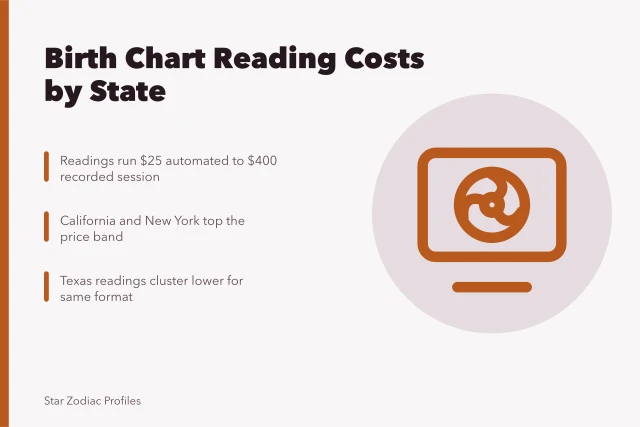
Readers who price sessions low, as the birth chart reading cost breakdown shows for many states, often find the paperwork costs more than the fee.
Self-employment tax thresholds and how they are calculated
Self-employment tax is separate from income tax. It funds Social Security and Medicare for people who do not have an employer withholding those amounts. The tax rate is 15.3 percent on net earnings up to a wage base, then 2.9 percent for Medicare above that base.
The threshold is $400 of net earnings. If your Schedule C shows $400 or more in profit, you must file Schedule SE and pay self-employment tax. Below that, you may still owe income tax, but you do not owe self-employment tax.
Net earnings are not the same as gross receipts. You multiply your net profit by 92.35 percent before applying the tax rate. That adjustment gives you credit for the employer half of the tax, which you can deduct on your 1040.
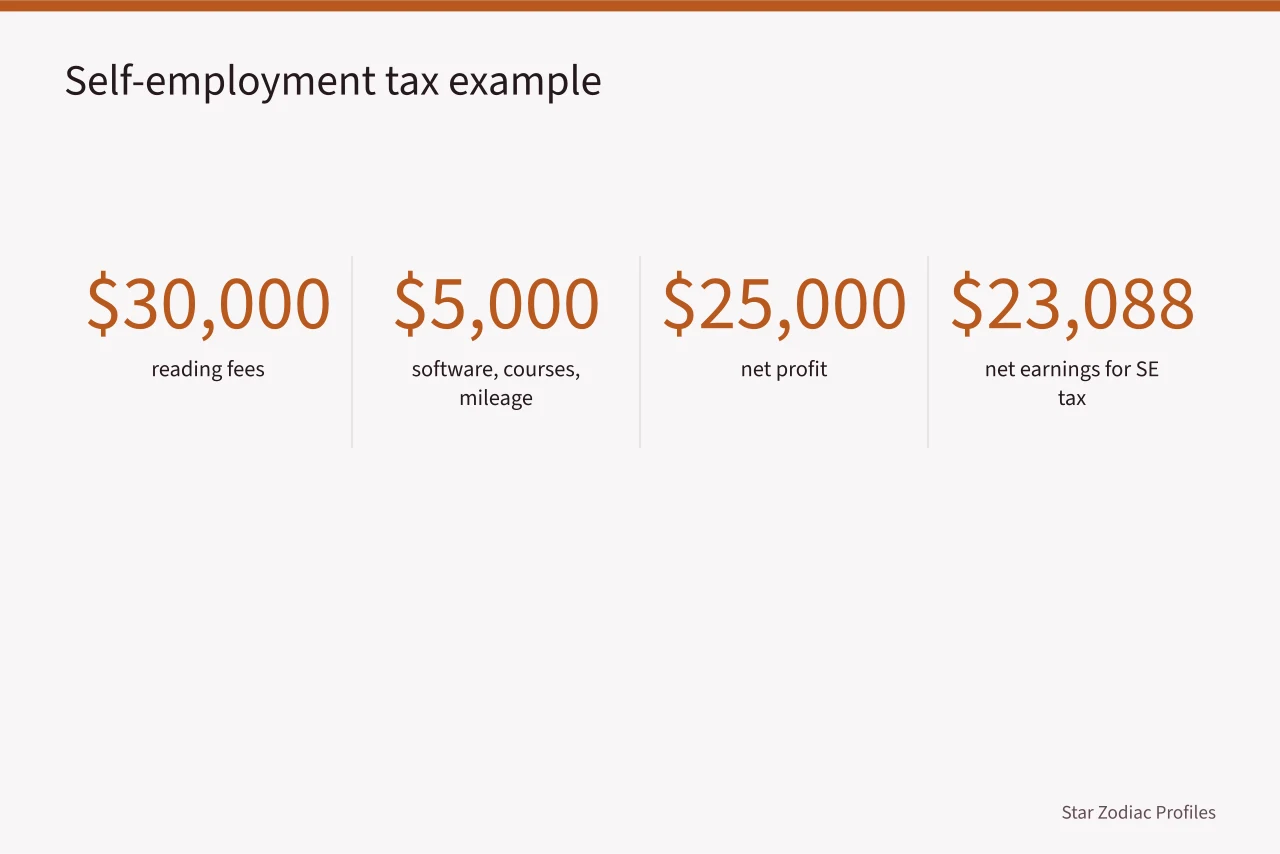
Here is a simple example. Suppose you earn $30,000 in reading fees, spend $5,000 on software, courses, and mileage, and end with $25,000 net profit. Your net earnings for SE tax are about $23,088. The SE tax at 15.3 percent is roughly $3,532.
Half of that SE tax, about $1,766, is deductible on your Form 1040. It reduces your adjusted gross income, which can lower your income tax. This is one of the few breaks built into the self-employment system.
The Social Security wage base changes most years. For 2026, the base is $184,500. Earnings above that are subject to the 2.9 percent Medicare portion only. High-earning readers with multiple income streams should track this figure.
Income tax is layered on top of SE tax. Your net profit is taxed at your ordinary income rate. That means a reader in a high-tax state like California or New York may owe more than a reader in Texas or Florida, which have no state income tax.
You can lower SE tax by lowering net profit. Deductions for legitimate business costs reduce the number that Schedule SE uses. This is why good recordkeeping matters all year, not just in April.
If you also have a W-2 job, your employer withholds Social Security and Medicare on those wages. When you file, the IRS reconciles the two. You may find that you have already met part of the wage base, which reduces the SE tax on your reading income.
1099-K, 1099-NEC and 1099-MISC reporting for readers
Third-party payment platforms may send you a 1099-K. This form reports payments made in settlement of transactions. The reporting threshold has changed several times in recent years, so check the current IRS rule for your tax year.
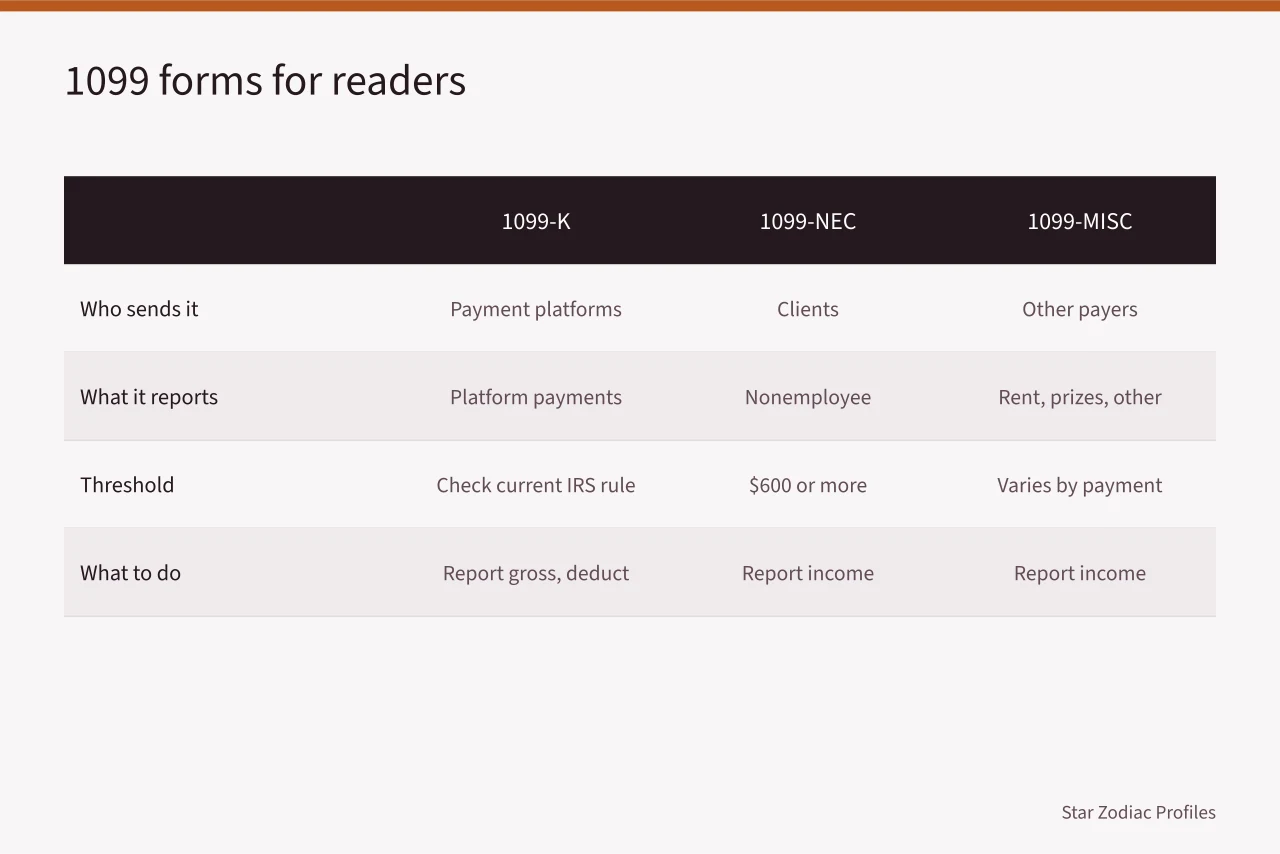
A 1099-K is not a tax bill. It is an information return that tells the IRS how much money moved through the platform. You still report your gross receipts on Schedule C, and you can deduct the platform fees.
Clients who pay you as a contractor may send a 1099-NEC. This form reports nonemployee compensation of $600 or more. The IRS explains the filing rules for payers on its About Form 1099-NEC, Nonemployee Compensation | Internal Revenue Service page.
A 1099-MISC covers other types of payments, such as rent or prizes. If you receive one for your reading services, it may be filed in error, but you still report the income. The agency's About Form 1099-MISC, Miscellaneous Information | Internal Revenue Service page explains what belongs on the form.
You must report income even if you never receive a form. The IRS matches 1099s to your return, but the absence of a form does not make income tax-free. Keep your own records of every payment.
If you receive a 1099-K that includes personal transactions, such as money from friends, you may need to reconcile it. Report the business portion on Schedule C and explain any personal amounts. Do not ignore the form.
Squarespace, Stripe, PayPal, and similar platforms issue these forms based on their own thresholds. Some issue them at lower amounts than the IRS requires. Read the form carefully and compare it to your records.
If a client sends a 1099-NEC with the wrong amount, ask them to correct it. If they refuse, report the correct amount and keep documentation. The IRS prefers accurate reporting over matching a wrong form.
Some of your clients come from the celebrity side of the practice. Readers who market around Taurus celebrities or other sun signs should keep those promotional costs separate from the reading income itself.
Common deductions: software, courses, studio space, mileage
Ordinary and necessary expenses are deductible. The IRS defines ordinary as common in your field and necessary as helpful to your business. For astrologers, that covers a wide range of tools and training.
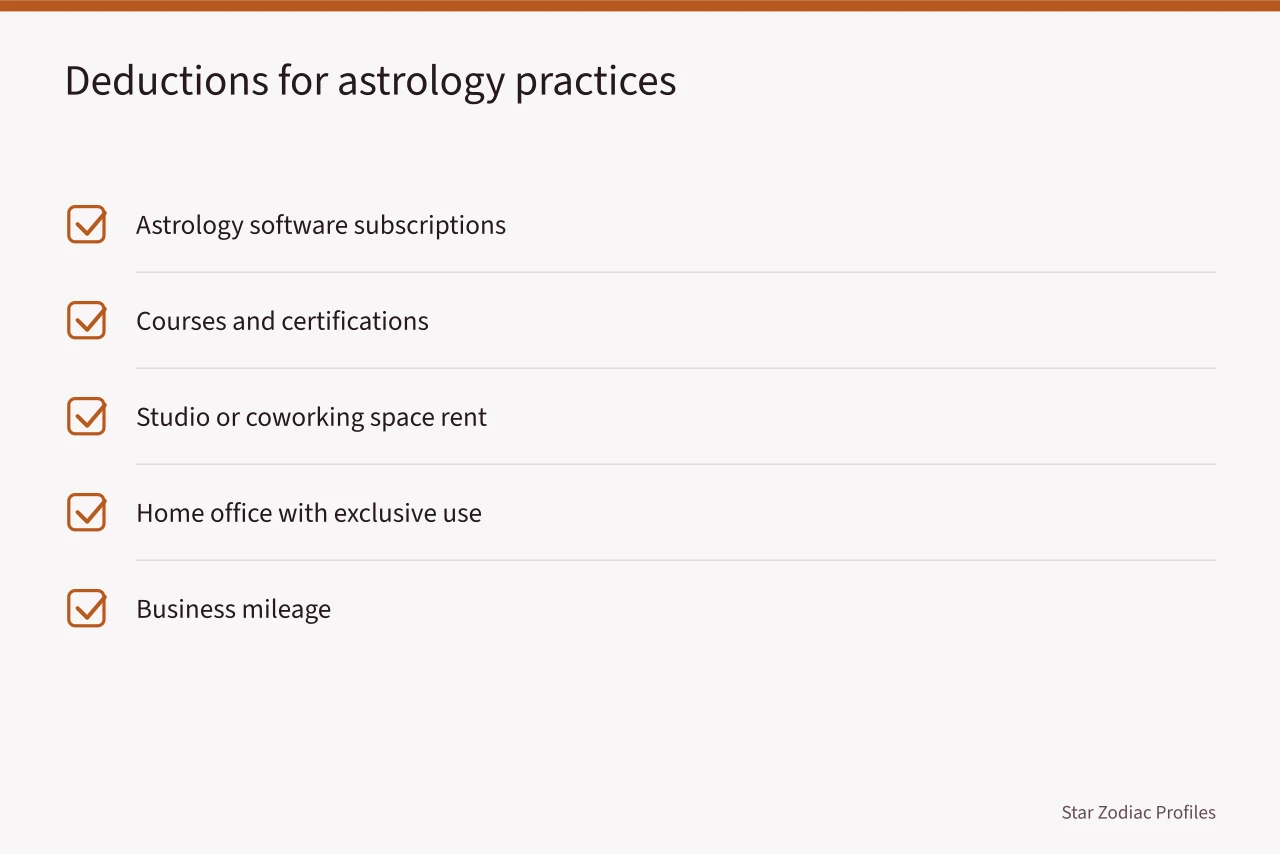
Astrology software is deductible. Subscriptions to chart calculation programs, ephemeris apps, and design tools count. If you pay monthly, deduct the total for the year.
Courses and certifications are deductible. Workshops on forecasting, counseling skills, or business marketing qualify. The IRS publication on business expenses covers education that maintains or improves skills in your current work.
You can read the agency's guidance on deductible business expenses for astrology businesses in Guide to business expense resources | Internal Revenue Service. It explains the ordinary and necessary test and lists common categories.
Studio space is deductible if you rent it. A dedicated room in a shared wellness center, a desk at a coworking space, or a private office all count. Keep the lease and proof of payment.
Home office deductions require exclusive use. A corner of your living room does not qualify if you also watch TV there. A separate room used only for readings does.
Mileage is deductible when you drive for business. That includes driving to a client's home, a fair, or a supply store. The IRS sets a standard mileage rate each year. You can also deduct parking and tolls.
Professional dues and subscriptions are deductible. Memberships in astrological associations, trade magazines, and online communities count. So do fees for a website host and email marketing service.
Insurance premiums are deductible. Liability insurance for your practice, or a rider on your homeowner policy for business equipment, belongs on Schedule C. Health insurance is handled differently, as a self-employed health insurance deduction on your 1040.
Bank and processing fees are deductible. Monthly account fees, wire fees, and payment gateway charges all reduce your profit. Keep statements that show these charges.
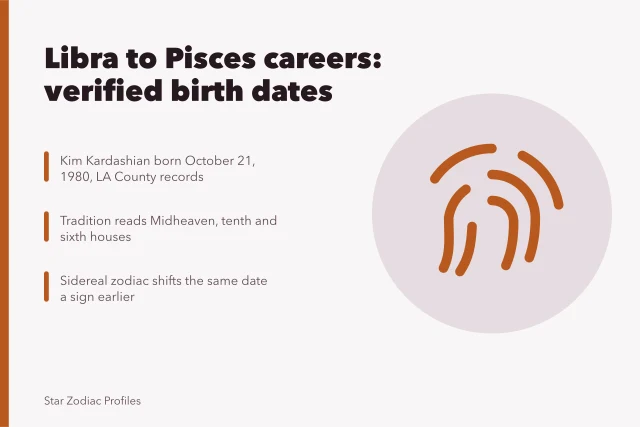
Marketing costs are deductible. Business cards, flyers, a logo design, and paid ads all count. If you pay a photographer for headshots used on your site, that is a business expense. Material that leans on Libra to Pisces celebrities for blog traffic is marketing, not a personal hobby, so the cost belongs on the schedule.
Here is a checklist for a clean deduction file.
- Separate business bank account and card
- Receipts for every software subscription
- Course and workshop invoices
- Studio lease or coworking agreement
- Mileage log with dates and destinations
- Professional dues and insurance statements
- Marketing and advertising receipts
Do not deduct personal expenses. Your groceries, personal travel, and everyday clothing are not business costs. If an item is used for both business and personal, deduct only the business percentage.
Getting an EIN and choosing a business structure
An EIN is a nine-digit number the IRS assigns to businesses. It works like a Social Security number for your practice. You need one to open a business bank account, hire an assistant, or file certain returns.
You can apply for an EIN online, by fax, or by mail. The online application is free and takes about fifteen minutes. The IRS explains the process on its Get an employer identification number | Internal Revenue Service page.
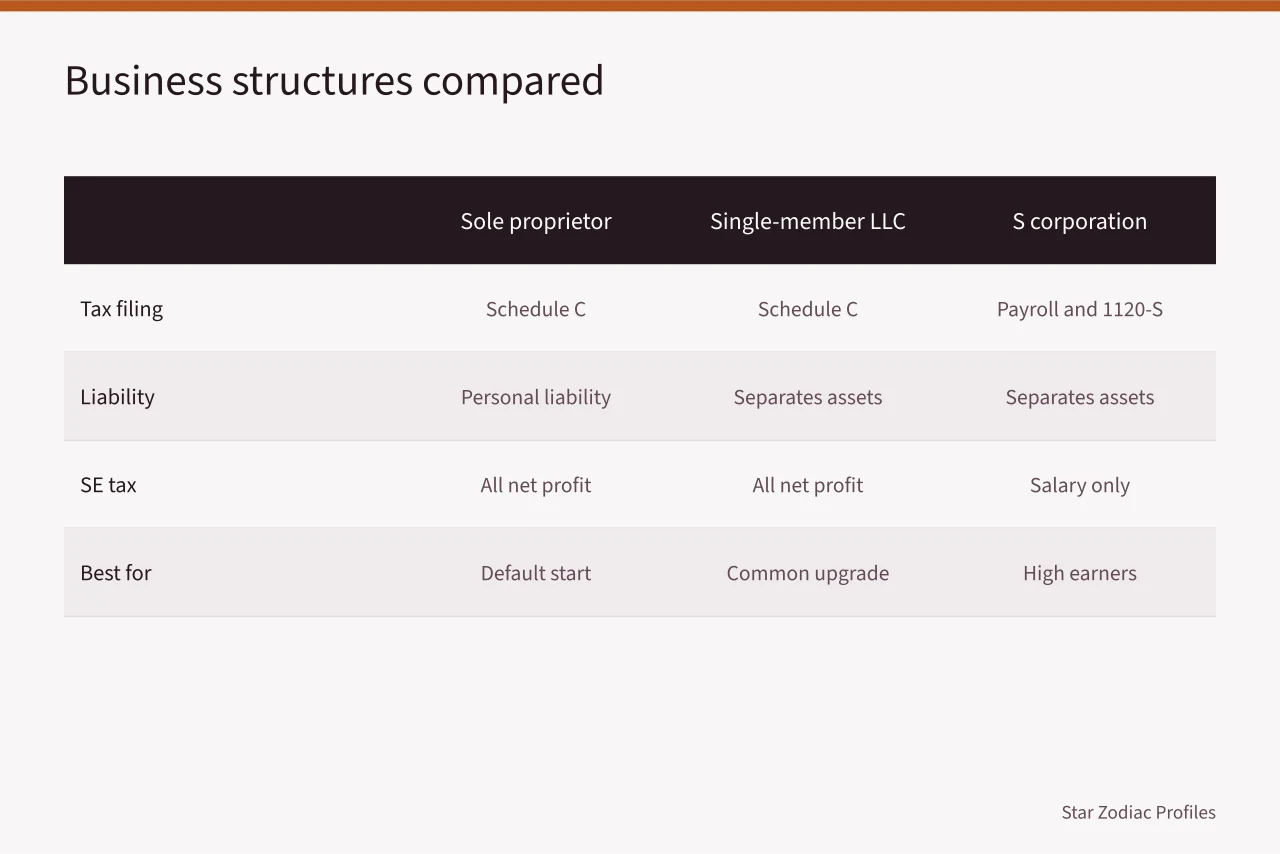
A sole proprietorship is the default structure. You do not file paperwork to become one, and you report income on Schedule C. The downside is that you are personally liable for business debts and lawsuits.
A single-member LLC is a common upgrade. It separates your personal assets from business liabilities in most cases. For federal tax purposes, it is usually treated as a disregarded entity, so you still file Schedule C.
An S corporation can reduce self-employment tax for high earners. You pay yourself a reasonable salary and take the rest as distributions. This adds payroll and filing costs, so it only makes sense above a certain profit level.
A partnership or multi-member LLC files Form 1065. Each partner receives a Schedule K-1. If you read charts with a business partner, this is the structure to discuss with an accountant.
Your business structure affects your state filings too. California charges an annual minimum franchise tax for LLCs. New York requires publication for some LLCs. Texas and Florida have their own fees and reports.
An EIN does not replace your Social Security number on your personal return. You still use your SSN on Form 1040. The EIN goes on business forms, bank accounts, and 1099s.
Keep your EIN letter in a safe place. Banks and payment processors often ask for a copy. If you lose it, you can request a replacement from the IRS. If you also write personality content, methods such as MBTI analysts use are worth learning, and any course you buy for that work is a deductible education cost.
Quarterly payments and where to send them
Self-employed readers pay tax as they earn. The US system is pay-as-you-go, so you make quarterly estimated payments if you expect to owe $1,000 or more. This avoids a penalty at filing time.
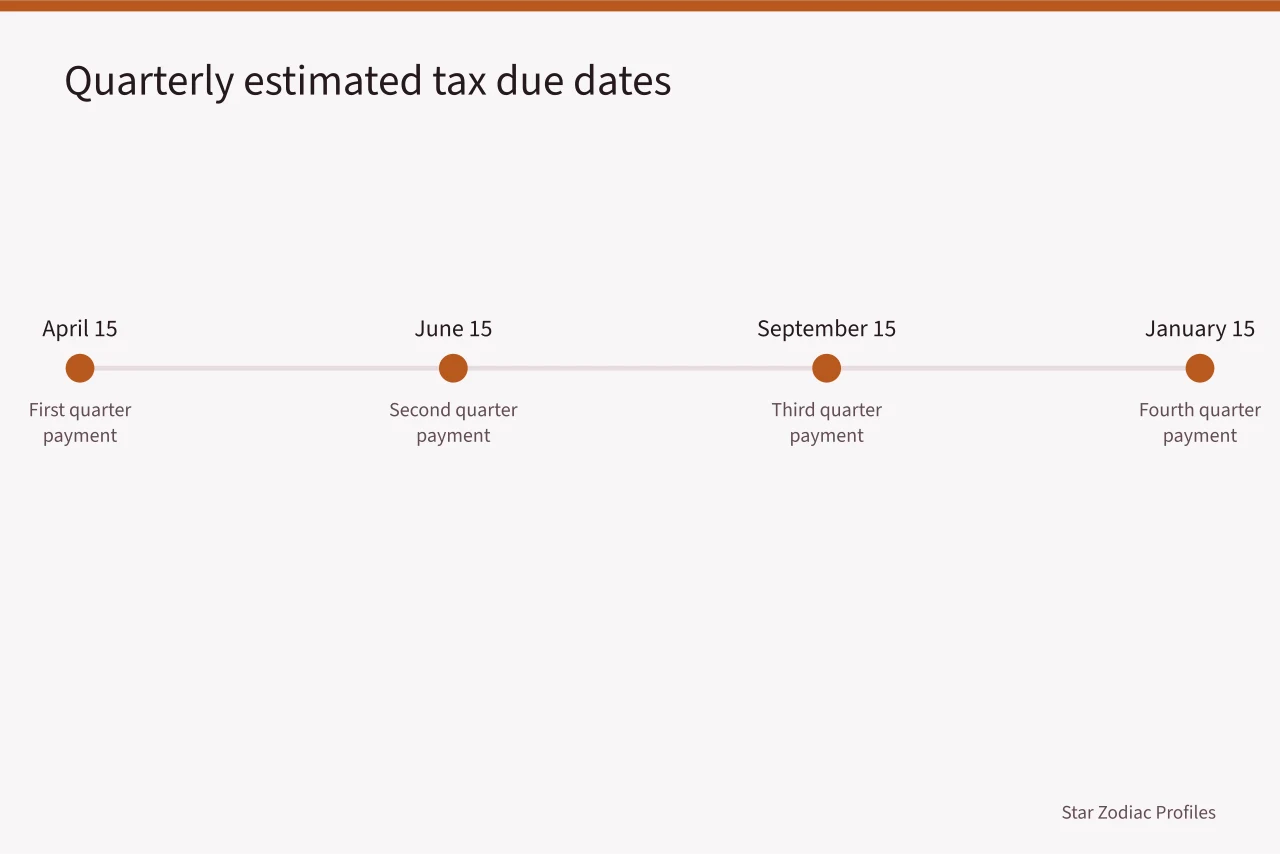
The four due dates are generally April 15, June 15, September 15, and January 15. Whenever a date lands on a weekend or holiday, it shifts to the following business day. For the 2026 tax year, the January payment is due in 2027.
You can make payments online using IRS Direct Pay or the Electronic Federal Tax Payment System. Both are free. You can also mail a check with Form 1040-ES.
Estimate your payment using last year's tax or 90 percent of this year's liability. The safe harbor rules protect you from penalties if you pay enough based on the prior year. An accountant can run the numbers.
If your income is uneven, you can use the annualized income installment method. This lets you pay less in quarters when you earn less. It requires Form 2210 and more recordkeeping.
State estimated taxes may be due on different dates. California, New York, and Illinois all have their own schedules. Check your state's franchise tax board or department of revenue.
Keep a separate savings account for taxes. Move a percentage of every payment you receive into it. Many self-employed workers set aside 25 to 30 percent of net income. If your offerings span enneagram types as well as charts, the same set-aside rule applies to every payment.
If you underpay, the IRS charges interest and a penalty. The penalty is based on how much you underpaid and how long you waited. Paying in the quarter you earn the income is the simplest way to avoid it.
Common questions
Do I need an EIN to read charts for money? No, a sole proprietor can use a Social Security number. An EIN is useful for privacy and for opening a business bank account. It is free from the IRS.
What if I only made $500 this year from readings? You still report the income on Schedule C. You owe self-employment tax only if net earnings reach $400. At $500, you are over the threshold, so file Schedule SE.
Can I deduct my astrology course? Yes, if it maintains or improves skills in your current business. A beginner course that qualifies you for a new line of work may not be deductible. Keep the syllabus and receipt.
What is the 1099-K threshold for 2026? The threshold has changed repeatedly, so check the current IRS rule for the tax year. Even below the threshold, you must report the income.
Can I use my home as a studio? Yes, if the space is used exclusively and regularly for business. Under the simplified method, you can claim $5 for each square foot, with a maximum of 300 square feet. Keep photos and measurements.