Features
Celebrity Big Five Traits: What You Can and Cannot Infer
Celebrity Big Five traits get inferred from interviews and red carpets. Here is what OCEAN scores can support, what they cannot, and where the evidence stops.
What to take away
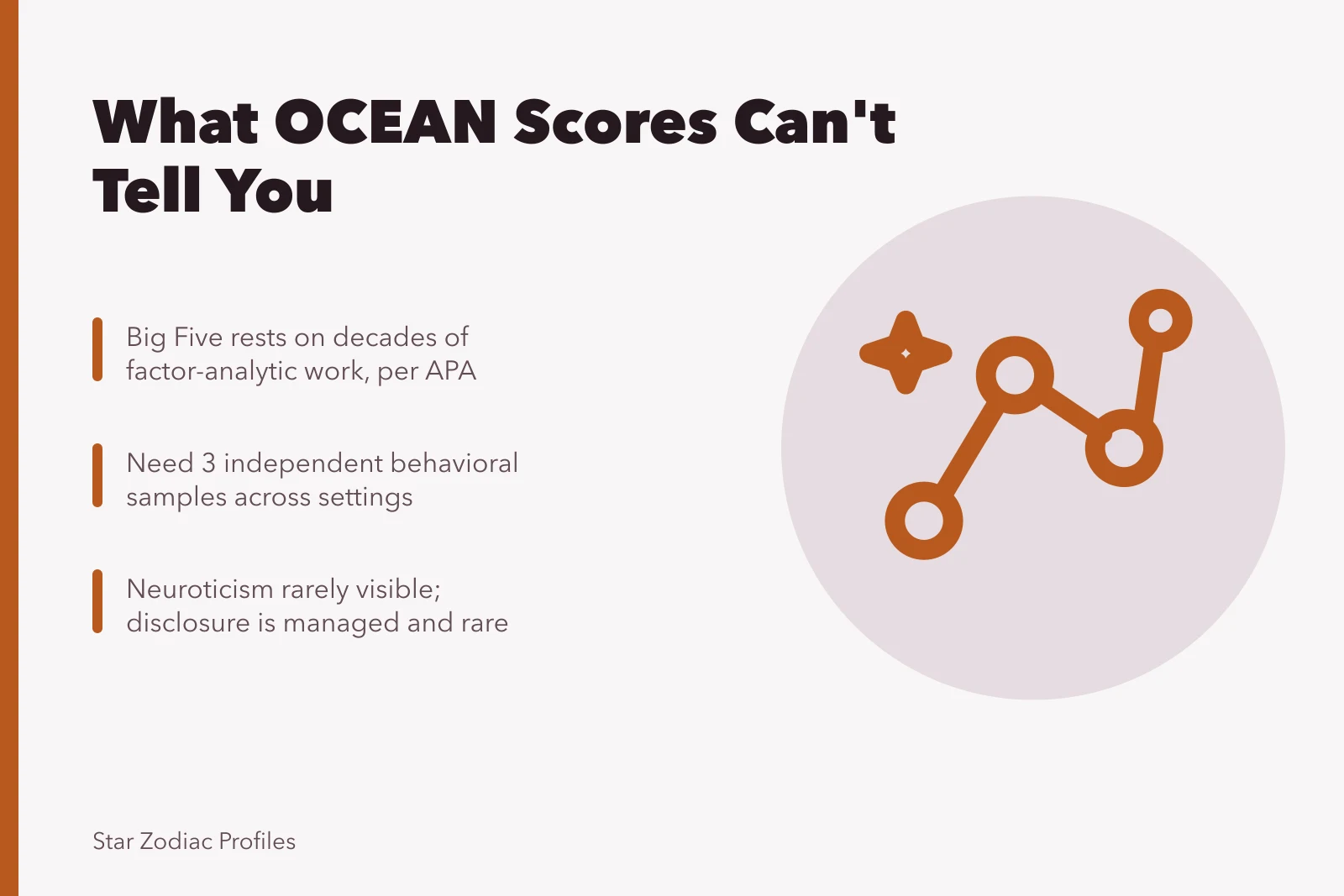
- The Big Five (OCEAN) rests on decades of factor-analytic work summarized by the American Psychological Association, so it outranks MBTI for describing personality structure.
- A usable inference threshold is rough: you need repeated behavioral samples, not one interview, before a trait claim holds up.
- Public figures give you curated behavior, so openness and extraversion are the easiest to guess and neuroticism is the hardest.
- Any single score you read about a celebrity is a hypothesis about a persona, not a measurement of a person.
Why OCEAN beats type codes for this job
The Big Five describes personality along five continuous dimensions: openness, conscientiousness, extraversion, agreeableness, and neuroticism. The Big Five personality traits entry lays out the factor structure and, usefully for this beat, the limits of inferring traits from public personas.
Typologies sort people into boxes. Trait models place people on scales. That difference matters when your only data is a press tour, because a scale lets you say "high on this dimension, uncertain on that one" instead of forcing a label.
The threshold that should stop you
Treat a trait claim as reportable only when you have at least three independent behavioral samples across different settings, ideally spanning six months or more. One awards speech is one sample. A single profile in a magazine is one sample, filtered by a publicist.
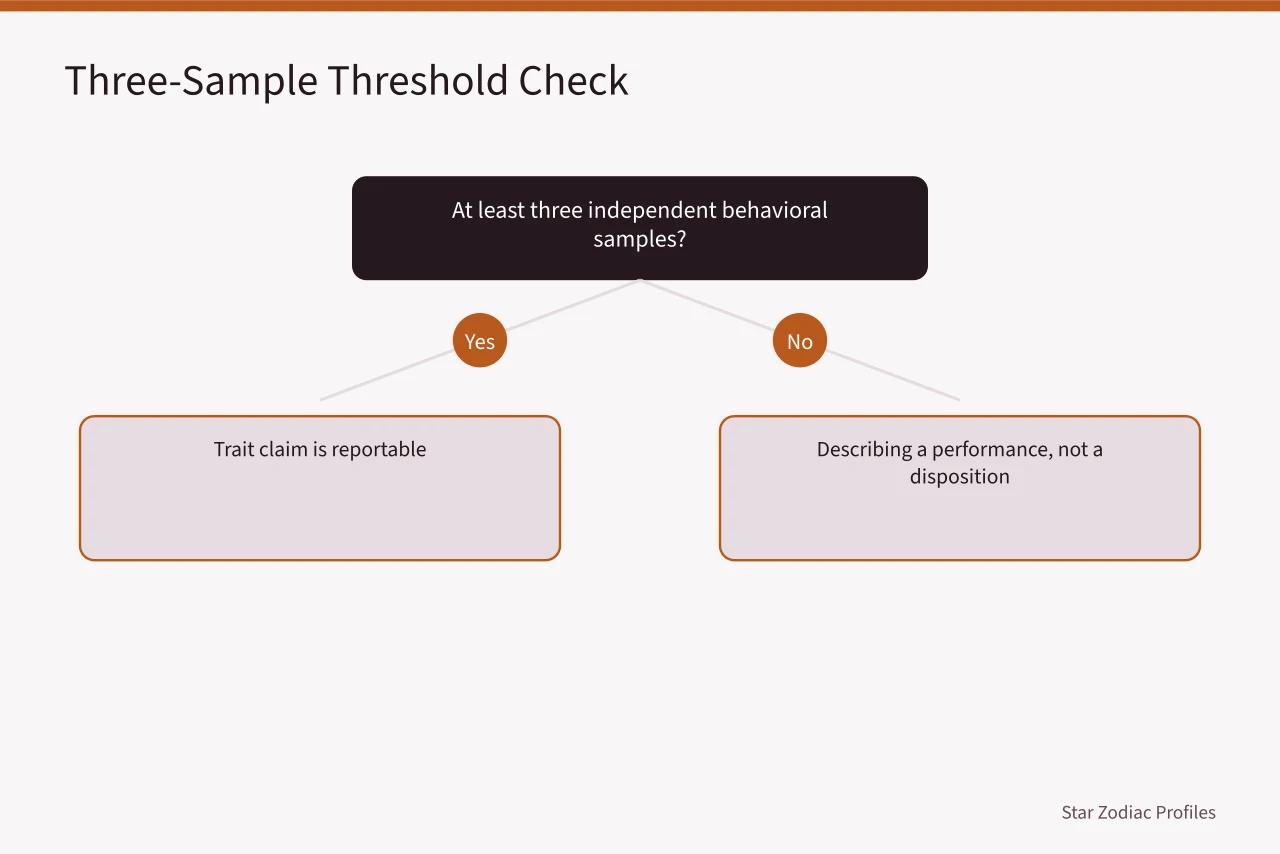
Below that threshold, you are describing a performance, not a disposition. The List of people from California is a reminder of how many careers you would need to sample before any pattern meant anything.
A trait score inferred from one interview is a guess with a decimal point attached.
What each dimension gives you
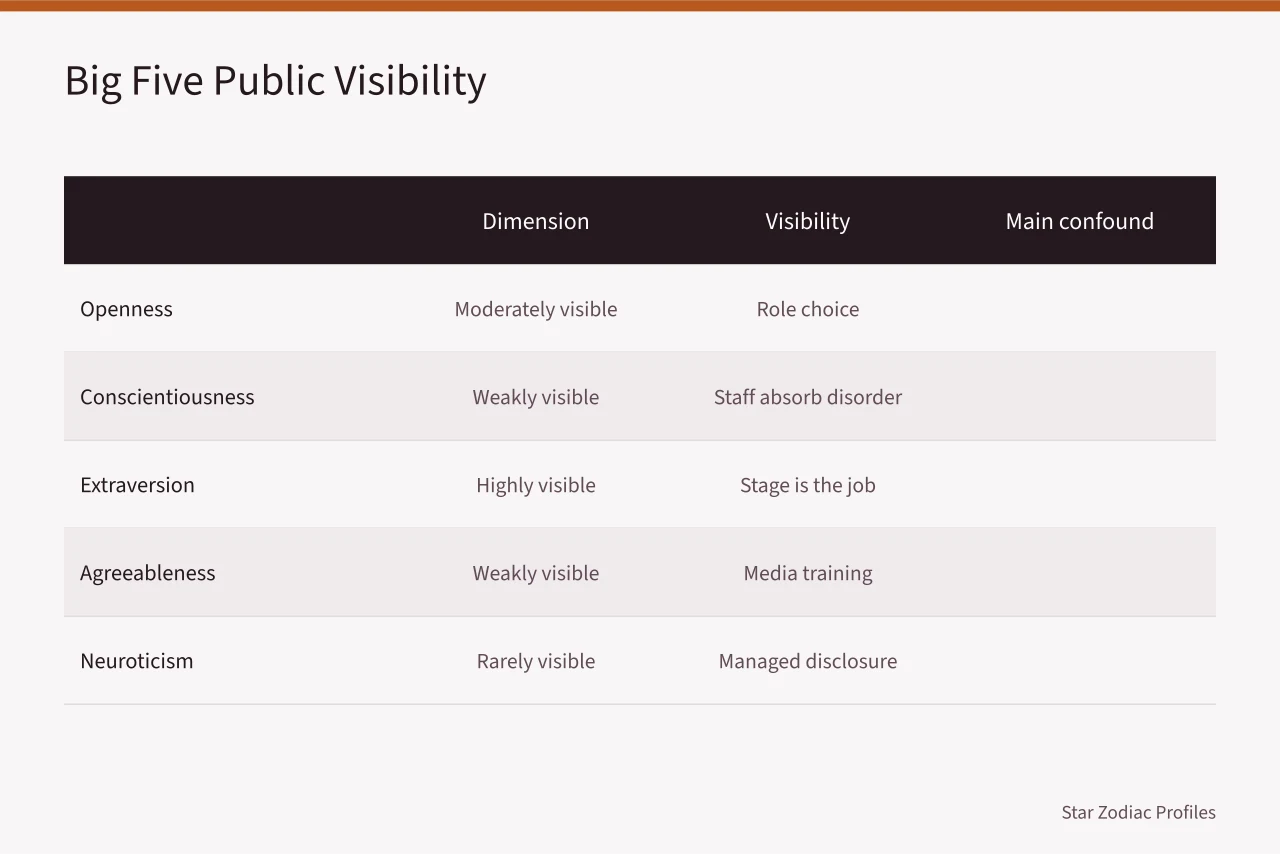
| Dimension | How visible in public life | Main confound |
|---|---|---|
| Openness | Moderately visible | Role choice reflects scripts, not preference |
| Conscientiousness | Weakly visible | Staff and handlers absorb the disorder |
| Extraversion | Highly visible | Stage behavior is the job |
| Agreeableness | Weakly visible | Media training suppresses friction |
| Neuroticism | Rarely visible | Disclosure is managed and rare |
Extraversion looks easy because performers perform. That is the trap. A stadium tour is evidence of a job requirement, not of sociability at a dinner table.
Example: reading a film and music career
Take a singer who releases confessional albums and gives few interviews. Openness looks high, but the songwriting may be a persona built with co-writers. Neuroticism looks high, but the lyrics are craft. Neither claim survives the three-sample threshold.
Take an actor with a long run of comedies, a documented theater background, and a decade of consistent charity work. Three settings and repeated behavior make a modest conscientiousness claim defensible.
That is the care Libra to Pisces celebrities traits: names, dates and context, updated for 2027 applies to sign claims. The same standard should apply here.
Where the research stops matching the results
The Big Five predicts broad life outcomes at the group level. It does not predict what one person will do on one Tuesday. Correlations in the literature are modest, and most samples are not celebrities.
Celebrity samples are also selected on the outcome. You are looking at people who succeeded, which truncates the range on every dimension. That selection alone can manufacture a pattern that would vanish in a random sample.
Astrology typing has its own documented status, covered in Astrology and science, and the comparison is not flattering to sign-based claims. The honest position is that OCEAN is a better instrument, not a magic one.
A checklist before you publish a trait claim
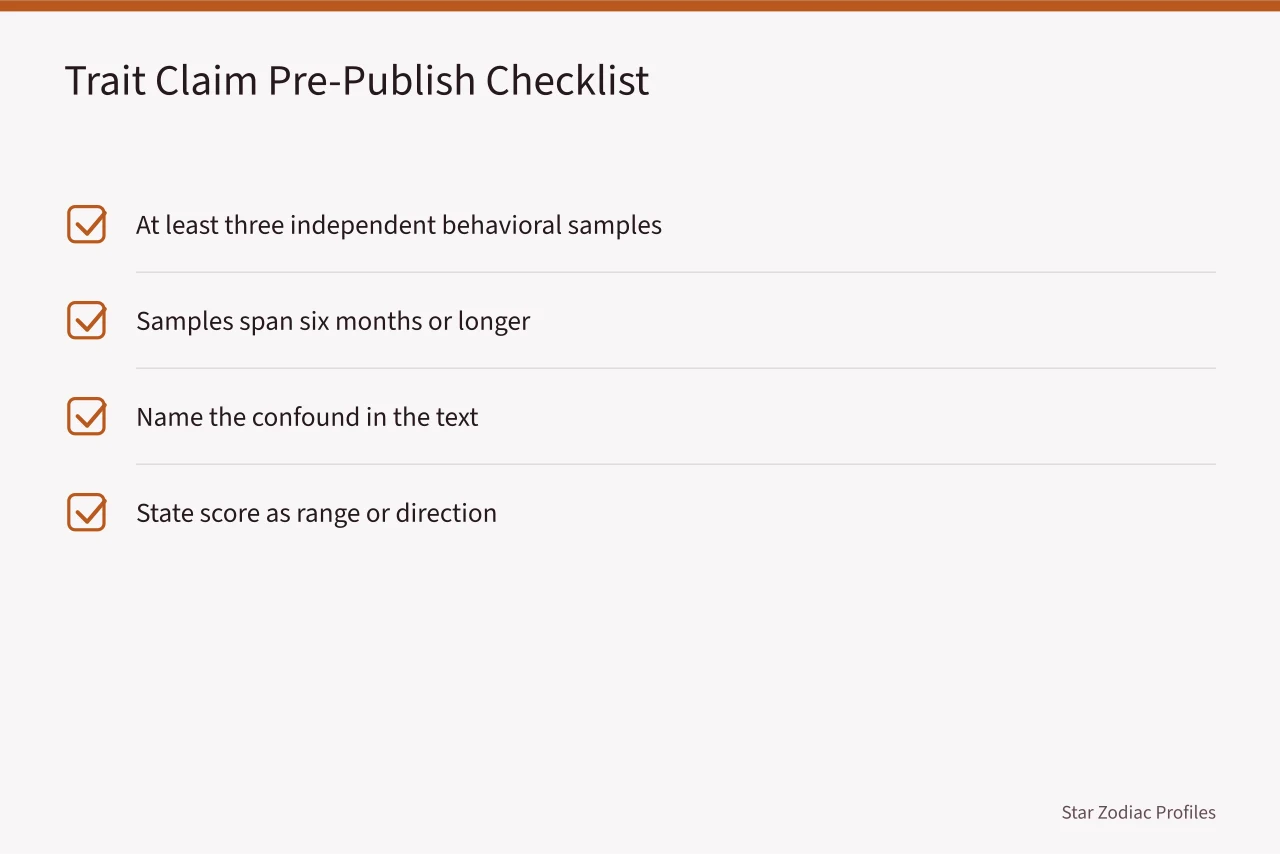
- At least three independent behavioral samples, in different settings.
- Samples span six months or longer.
- You name the confound (media training, role, handlers) in the text.
- You state the score as a range or a direction, never a precise number.
If a claim fails two or more boxes, cut it. Readers forgive uncertainty. They do not forgive invented precision.
How to write this without overclaiming
Use hedged verbs: appears, tends, reads as. Attribute every score to a named source and a date. Where a birth date or biography is disputed, say so, as How birth time alone can change a Libra to Pisces celebrity example does for chart data.
Keep one paragraph to one claim. If you cannot write the confound in the same paragraph, the claim is not ready. For a fuller picture of how these profiles get built, see Before you act on famous Libra to Pisces celebrities.
Common questions
Can you really score a celebrity on all five traits? Rarely with confidence. Extraversion and openness are the only two that public behavior supports even weakly. The other three usually need disclosure the person has not made.
Is the Big Five more scientific than MBTI? Yes, on structure and replication. The American Psychological Association's research summaries treat trait models as the mainstream framework. That still does not license guessing a stranger's neuroticism from a red carpet clip.
What is the single biggest error in celebrity typing articles? Treating a curated public persona as a personality sample. The second biggest is reporting a precise score when the underlying evidence is one interview.
Does a high score predict career success? Conscientiousness correlates with job performance in meta-analyses, but the effects are modest and measured on ordinary workers. Applying that to a Grammy winner is extrapolation, not evidence.