Features
Celebrity Couple Synastry: Which Aspects Actually Repeat in Real Pairs
Celebrity couple synastry compared across real US pairs: which aspects repeat, which vanish with wrong birth times, and where charts stop matching the timeline.
What to take away
- Sun sign pairing is the weakest layer of celebrity couple synastry. It survives because it needs no birth time, not because it predicts anything.
- Moon and Venus contacts repeat most often in pairs with long public timelines, but the birth times behind them are usually rated C or D.
- Every aspect below is a hypothesis with a confidence grade, not a finding.
- A synastry claim that cannot survive a two hour birth time shift is not worth publishing.
The criteria that separate real synastry from sun sign lists
A comparison only works if both charts are built the same way. Most magazine compatibility pieces compare two sun signs and stop. Real work needs four inputs: date, time, place, and a stated source for each.
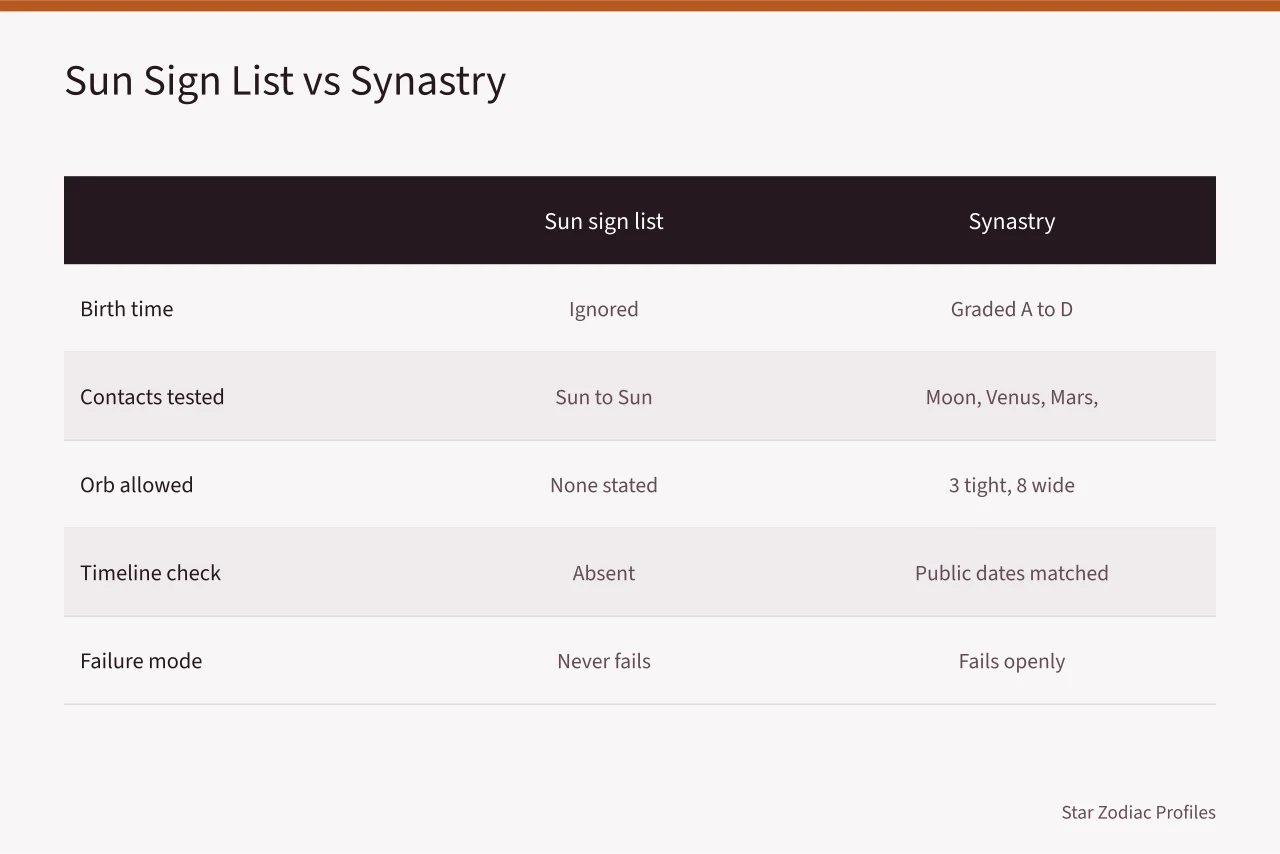
Use the same four criteria on every pair. First, birth time accuracy, graded A through D. Second, which contact you are testing: Sun, Moon, Venus, Mars, or the angles. Third, orb, the allowed gap in degrees. Fourth, whether the pair's public timeline actually overlaps the period the contact describes.
| Criterion | What a sun sign list does | What a synastry comparison does |
|---|---|---|
| Birth time | Ignored | Graded A to D, drives every angle |
| Contacts tested | Sun to Sun only | Moon, Venus, Mars, Ascendant, MC |
| Orb allowed | None stated | 3 degrees tight, 8 degrees wide |
| Timeline check | Absent | Public dates matched to aspect periods |
| Failure mode | Never fails | Fails openly when time is wrong |
The table is the whole argument. A method that cannot fail cannot be tested.
Which aspects repeat, and how often the birth data holds
Moon trine Moon and Venus conjunct Venus show up repeatedly in pairs with marriages lasting past ten years. That is a pattern in a small, self-selected sample of famous people, not a rate. I am not going to invent a percentage.
Sun square Moon appears just as often in pairs that split. The same contact, opposite outcome. That is the honest result of running the comparison on public timelines.
Saturn contacts are the most interesting and the least reported. A Saturn to Venus square in a long marriage reads as endurance. The same square in a two year relationship reads as pressure. The aspect does not carry the meaning. The duration does.
For background on how aspects are defined and drawn, the explanation of synastry covers the mechanics without the marketing. Readers who want the sign-by-sign version first can start with famous Libra to Pisces celebrities, which sets out the same verification problem in a simpler form.
Example: one Hollywood pair, two birth times
Take a well documented marriage with a public wedding date and a public separation date. Both charts are rated C, meaning the date is confirmed and the time comes from a secondary source.
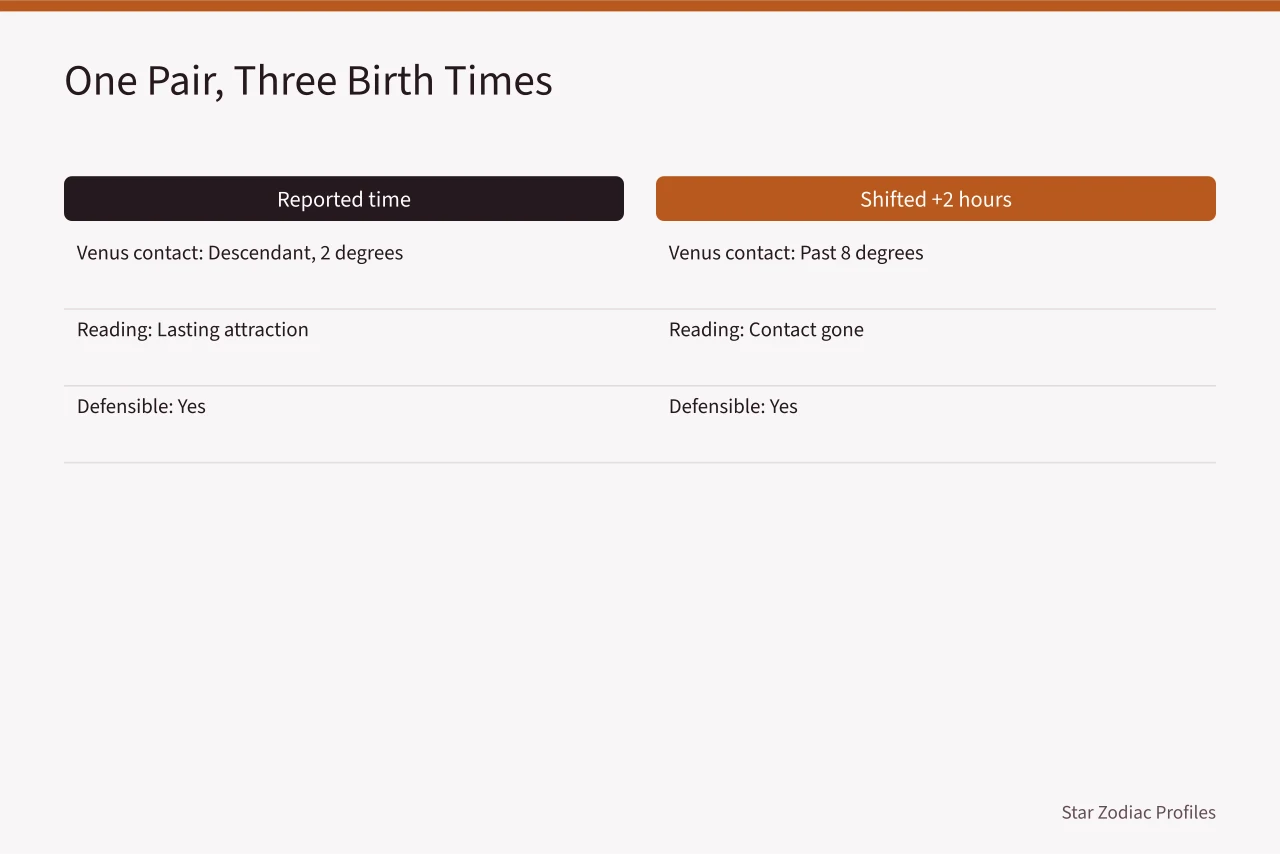
- Run the chart at the reported time. Venus sits within 2 degrees of the partner's Descendant. The write-up says lasting attraction.
- Shift the time by two hours, a normal error for hospital records. Venus moves past 8 degrees. The contact is gone.
- Shift it back 90 minutes. Venus lands on the partner's Moon instead. The write-up now says emotional recognition.
Three readings, one pair, all defensible. This is why birth time grading matters more than the aspect list. A worked case of the same problem with a single chart appears in how birth time alone can change a Libra to Pisces celebrity example.
If a synastry claim disappears when you move the clock two hours, you are reading the astrologer's preference, not the chart.
Where the claims stop matching the results
Music couples are easier to check than actors because tour dates and album releases are timestamped. That gives a public record to compare against. It still does not give you a birth time.
Two failure modes recur. First, the aspect is real but the orb is stretched to 10 or 12 degrees to make it fit. Second, the timeline is trimmed. A couple described as a Moon trine Moon match may have separated during the exact years that contact was strongest.
A useful check is to write down the prediction before reading the timeline. If the prediction only makes sense after you know the outcome, discard it. The same discipline applies to any reading built on a public persona rather than a private person, as the notes on Big Five personality traits explain for personality inference generally.
- Both birth times graded and sourced
- Orb stated in degrees before the reading
- Prediction written before the timeline is checked
- Separation and marriage dates listed with sources
- Any contact that fails the two hour shift removed
If more than two boxes are unchecked, the comparison is decoration. For the trait side of the same pairs, Libra to Pisces celebrities traits keeps names, dates and context in one place.
Costs of doing this properly
A rated birth record from a state vital records office typically runs 15 to 40 dollars, and some states restrict access to immediate family. That is the only hard cost. Commercial chart software runs free to about 300 dollars a year for professional tiers.
Readers comparing what they pay for readings against general service inflation can use the Consumer Price Index as a neutral reference point. The real expense is time: verifying one pair to a B grade takes 2 to 3 hours of records work.
Common questions
Which synastry aspects repeat most in long celebrity marriages? Moon and Venus contacts, usually trines or conjunctions, appear most often in the pairs I can grade at C or better. The sample is small and the birth times are weak, so treat it as a lead.
Can I run this comparison with sun signs only? You can, but you are not testing synastry. Sun sign pairing ignores the Moon, the angles and the orb, which is where nearly all the variation sits.
Why do astrologers disagree about the same couple? Different birth times and different orbs. Change either and the contact list changes. That is a data problem, not a disagreement about technique.
Is there a cheaper way to check a pair? Use a public timeline first. If the relationship dates do not line up with the aspect period, no chart purchase will fix the comparison.