Rules
What US law says about celebrity names and photos in zodiac profiles
Celebrity zodiac profiles sit where copyright, right of publicity, and FTC endorsement rules meet. Here is what US law allows and where the limits fall.
What to take away
- Celebrity zodiac profiles can use names freely, but photos and implied endorsements carry real legal risk.
- The U.S. Copyright Office Fair Use Index shows fair use is decided case by case, not by a fixed formula.
- Right of publicity is state law, so the same profile may be legal in New York and illegal in California.
- FTC endorsement rules apply when your profile suggests a celebrity uses or approves a product or service.
- DMCA takedowns target hosted photos, and a counter notice can restore content if you have a good fair use case.
What US copyright law protects in a celebrity zodiac profile
Original expression that is fixed in a tangible form is protected by copyright. A celebrity's name is not copyrightable. A birth date is a fact. A zodiac sign is an idea. None of those get copyright protection on their own.
What does get protection: the photo you found on a fan site, the magazine cover you scanned, the paragraph you copied from another blogger. Those are original works owned by a photographer, publisher, or estate.
The Copyright Law of the United States | U.S. Copyright Office sets the baseline: reproduction, distribution, and derivative works belong to the copyright owner unless an exception applies.
Your profile text is your own copyright the moment you write it. Your chart graphic is your own if you drew it. That matters later when someone scrapes your work.
Names and short phrases are not protected. You can write "Beyonce is a Virgo" without a license. You can build a whole post around a celebrity's sun sign. Copyright does not stop you.
Photos are different. A single photo can be worth more than the whole article. Getty, AP, and individual photographers enforce aggressively. Using a red carpet photo without a license is the most common copyright mistake in this niche.
Public domain photos exist. Works published before 1930 are generally in the public domain in the US. Government works, like NASA portraits, are also free to use. For living celebrities, those options are thin.
Fair use under the Copyright Office Fair Use Index
The U.S. Copyright Office Fair Use Index tracks court decisions on the four fair use factors. It is a searchable database, not a permission slip. It shows how judges have ruled, not what you can do.
The four factors are purpose of use, nature of the work, amount used, and market effect. A zodiac profile that comments on a celebrity's public persona leans toward transformative use. A profile that just decorates a page with a headshot leans toward infringement.
Factor one: commentary, criticism, and news reporting favor fair use. A post analyzing why a celebrity's stated sign conflicts with their birth time is commentary. A post that copies a paparazzi photo to illustrate a sign trait is decoration.
Factor two: unpublished and creative works get more protection. A leaked private photo is harder to defend than a published publicity still.
Factor three: using a small portion matters. Cropping a photo is not automatically safe, but using a thumbnail rather than a full-resolution scan helps.
Factor four: if your use substitutes for a market for the photo, fair use fails. If a reader would have licensed the photo but got it from you instead, you lose.
The Index shows outcomes vary by circuit. The Ninth Circuit, which covers California, is generally more protective of celebrities and photographers than the Second Circuit in New York. That split matters if you publish nationally.
Document your reasoning. Write down why you used a particular image and what you added. If a takedown or lawsuit arrives, contemporaneous notes help.
Cross-check birth data before you build a profile around a photo. The process in verify celebrity birth times keeps you from repeating a disputed date that a celebrity's team may object to.
Right of publicity: why the rules change by state
Right of publicity is a state law doctrine. It gives a person control over commercial use of their name, image, and likeness. There is no federal right of publicity. That means a profile that is fine in one state can be a problem in another.
California has one of the strongest statutes. Civil Code section 3344 covers living persons, and a separate law covers deceased personalities for decades after death. Using a celebrity's name or photo to sell a product without consent can trigger damages and profits.
New York has a narrower statute, sections 50 and 51 of the Civil Rights Law. It covers living persons and requires use "for advertising or purposes of trade." Editorial and newsworthy use is generally exempt. A zodiac analysis is more likely to be treated as editorial than a product ad.
Texas, Florida, Illinois, Georgia, Washington, and Massachusetts each have their own versions. Some cover only name and likeness. Some include voice. Some have post-mortem rights, and some do not. Terms range from twenty years to a century.
Newsworthiness is the main defense. Courts ask whether the use relates to a matter of public interest. Celebrity culture, entertainment news, and even astrology commentary can qualify. A profile that reports a celebrity's stated sign and discusses their public statements is closer to news than a T-shirt with their face on it.
Commercial context cuts the other way. If your profile page sells a paid reading, a subscription, or a sponsored placement, the use looks more commercial. That does not automatically make it illegal, but it weakens the editorial defense.
Deceased celebrities are a trap. Marilyn Monroe, Elvis Presley, and Prince all have active estates. Some states protect post-mortem publicity rights, and estates enforce them. A retro zodiac profile of a dead star can draw a demand letter.
Check the state where the celebrity lives, the state where you publish, and the state where your readers are. The strictest one tends to drive the risk.
FTC endorsement rules when a celebrity is named or implied
The Federal Trade Commission governs advertising, not editorial content. If your zodiac profile is pure commentary, the FTC is not your main concern. If it promotes a product or service, the rules apply.
The core rule: endorsements must be truthful and not misleading. If you write that a celebrity uses your astrology app, and they do not, that is a deceptive endorsement. If you imply it with a photo and a caption, that is also deceptive.
The Advertising FAQ's: A Guide for Small Business | Federal Trade Commission explains the basics for small publishers. It covers testimonials, disclosures, and the difference between advertising and editorial.
Material connections must be disclosed. If a celebrity paid you, gave you a free reading, or has a business relationship with your site, say so clearly. A buried disclosure does not count.
Fake testimonials are prohibited. Do not invent a quote from a celebrity about your zodiac service. Do not write "this app changed my life" and attribute it to a star who never said it.
Implied endorsements are the gray area. A photo of a celebrity next to your product can imply they endorse it, even without words. Use a disclaimer if the context is ambiguous, and keep editorial content visually separate from ads.
Astrology services can trigger FTC scrutiny if they promise specific outcomes. Saying a reading will bring wealth or fix a relationship can be a deceptive claim. Keep claims about entertainment and self-reflection.
State consumer protection laws add another layer. The Better Business Bureau tracks complaints about paid chart-reading services, and state attorneys general can act on deceptive practices. The FTC is not the only enforcer.
DMCA takedowns for celebrity photos in zodiac articles
The Digital Millennium Copyright Act gives copyright owners a fast way to remove infringing material from the internet. It also gives you a way to respond. The The Digital Millennium Copyright Act | U.S. Copyright Office explains the notice and counter-notice process.
A takedown notice goes to your host, not to you directly. The host must act expeditiously to avoid liability. In practice, that means your photo disappears and you get an email.
The notice must include specific elements: identification of the work, identification of the infringing material, contact information, a good faith statement, and a statement under penalty of perjury that the information is accurate. A defective notice can be challenged.
If you believe your use is fair, you can file a counter notice. It must include your contact information, identification of the removed material, and a statement under penalty of perjury that you have a good faith belief the material was removed by mistake.
Filing a counter notice consents to jurisdiction in your federal district. The copyright owner then has about two weeks to file a lawsuit. If they do not, your host can restore the content.
Repeat infringers lose their accounts. If you get three strikes, your host may terminate your site. Keep records of every notice and response.
Penalties for lying cut both ways. A false takedown notice can expose the sender to damages under section 512(f). A false counter notice can expose you.
Use licensed or public domain images when you can. When you cannot, keep the use minimal and document your fair use reasoning. A takedown is not a lawsuit, but it is a warning.
Registering your own chart artwork and profile text
Your original chart artwork and profile text are protected by copyright from the moment you create them. Registration is not required for protection, but it changes what you can recover.
The Circulars | U.S. Copyright Office explain registration, deposit, and fees. Circular 1 covers the basics. Circular 40 covers works of the visual arts, which is where chart graphics usually fall.
Timely registration matters. If you register before infringement or within three months of publication, you can seek statutory damages and attorney's fees. Without registration, you are limited to actual damages, which are often hard to prove.
Group registration can save money if you publish often. The Copyright Office offers options for short online literary works and for contributions to periodicals. Check current rules before filing.
Your chart graphic is a derivative work if it is based on a standard wheel. The underlying idea is not protected, but your specific expression is. A competitor who copies your exact layout and colors may infringe.
Your profile text is a literary work. Copying a distinctive paragraph is infringement. Copying the fact that someone is a Leo is not.
Keep a publication log. Note the date, URL, and first publication. That log supports your registration and your takedown notices.
If you sell readings, you are running a business. The IRS expects self-employed income to be reported, and the Bureau of Labor Statistics tracks self-employment in this space. Registration of your content is separate from tax registration, but both matter.
Where celebrity zodiac profiles cross the line
The line is not one rule. It is a set of overlapping rules. Copyright, right of publicity, FTC endorsement, and DMCA each draw a different boundary.
A blogger publishes a profile of a singer, uses a licensed press photo, analyzes the singer's stated Virgo sun sign, and links to a paid reading. The name and analysis are fine. The licensed photo is fine. The paid link is fine if the FTC disclosure is clear and the singer has no connection to the service.
Now change one thing. The blogger swaps in a paparazzi photo without a license. Copyright risk appears. The blogger adds a caption saying the singer uses the blogger's app. FTC and right of publicity risk appear. The blogger crops the photo to hide the watermark. That can be a separate violation.
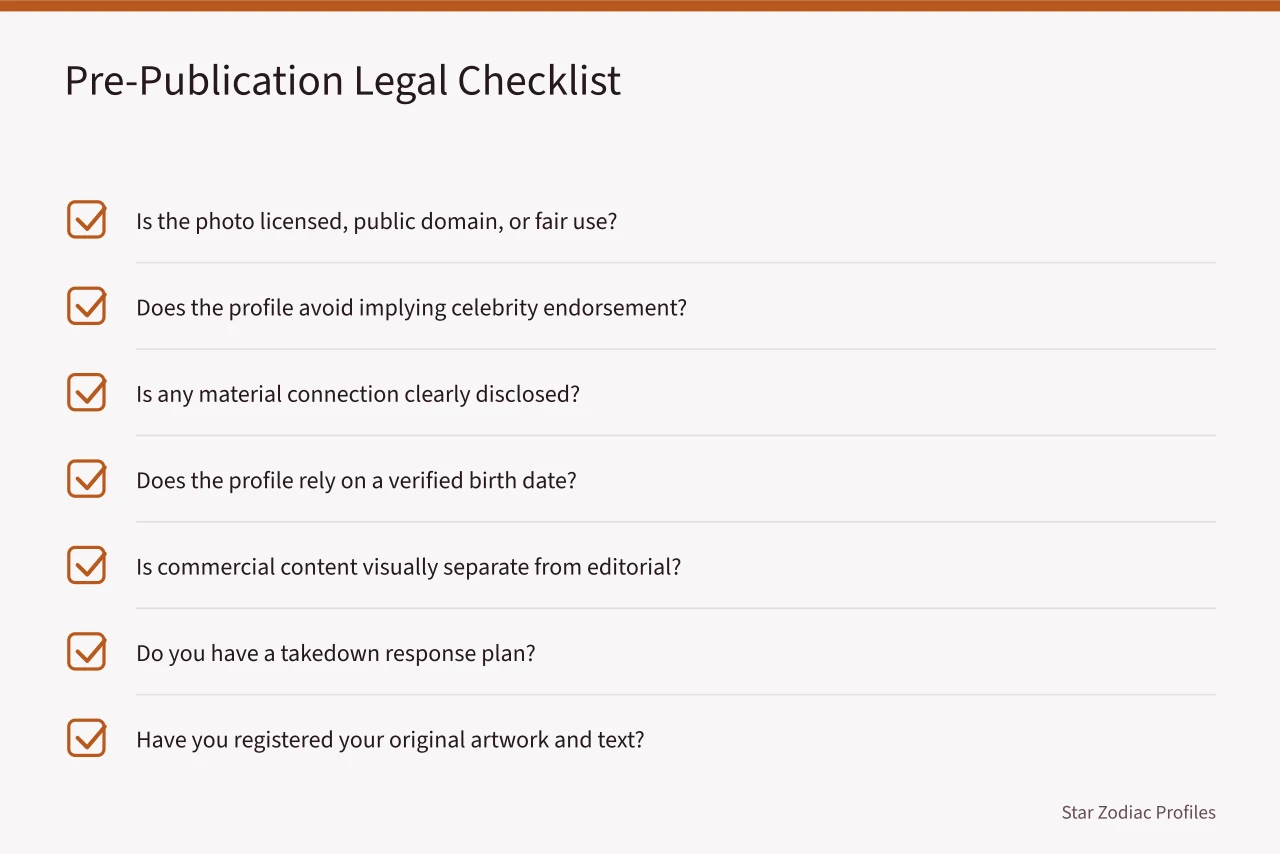
Use this checklist before you publish.
Numbered steps for handling a takedown:
- Read the notice and identify the exact URL and work named.
- Check whether you have a license, a public domain source, or a fair use argument.
- If you lack a defense, remove the material and reply to your host.
- If you have a defense, file a counter notice with the required statements.
- Log the notice, your response, and the outcome for your records.
Disputed birth data adds a different risk. If you build a profile on a date that the celebrity or their team disputes, you may face a correction demand. The patterns covered in zodiac sign disputes show how quickly a wrong date becomes a public argument.
Personality claims can also invite complaints. Saying a celebrity has a specific trait is opinion. Saying they have a disorder is a factual claim. The limits discussed in celebrity big five traits apply to any personality framework you use.
Typing a celebrity into an Enneagram or MBTI system is guesswork unless they have spoken publicly. The caution in canadian celebrity zodiac signs is worth repeating: an outsider cannot verify a private type. The same applies to the analysts covered in famous MBTI analysts, where public statements are the only solid ground.
Astrology is entertainment in the eyes of most regulators. Keep it that way. Do not promise outcomes, do not fake endorsements, and do not use other people's photos without a plan.
The safest profile uses a licensed or self-made image, a verified birth date, original analysis, and a clear separation between editorial and any paid offer. That combination keeps copyright, publicity, and FTC risk low.
Common questions
Can I use a celebrity's name in a zodiac profile without permission? Yes, in most cases. Names are not copyrightable, and editorial use of a public figure's name is generally protected. The risk rises if the name is used to sell a product or imply an endorsement.
Can I use a celebrity photo I found on Google Images? Not safely. Most images are copyrighted, and a search result is not a license. Use a licensed photo, a public domain work, or a documented fair use analysis.
Does fair use protect my zodiac profile? It can, if your use is transformative and does not substitute for the original market. The U.S. Copyright Office Fair Use Index shows outcomes vary by circuit and by facts.
What happens if I get a DMCA takedown notice? Your host removes the material. You can file a counter notice if you believe the removal was a mistake. The copyright owner then has a short window to sue.
Do FTC rules apply to my astrology blog? They apply when you advertise or promote a product or service. Pure editorial content is outside the FTC's advertising rules, but disclosures are required when there is a material connection.
Which state's right of publicity law applies to me? Usually the state where the celebrity lives, where you publish, or where readers are located. The strictest relevant state tends to drive the risk.