Guides
Cross-border celebrity charts, US and Canadian birth-time records
Cross-border celebrity charts rest on two record systems. US state offices and Canadian provincial registries release different details at different speeds.
What to take away
- A US state vital records office treats a birth certificate as a protected document, so a time of birth often stays out of public view even when the date is certain.
- A Canadian provincial registry or archives index usually confirms a name, a year and a province, and almost never a time.
- Rank sources by provenance: certified copy, then index entry, then newspaper notice, then fan wiki, then family memory. Never average two that disagree.
- A date is enough for a Sun sign. Only a recorded time supports a rising sign or house cusps.
- Historical daylight saving offsets differ by state and province, so a correct certificate can still produce a wrong chart.
Why the two systems split
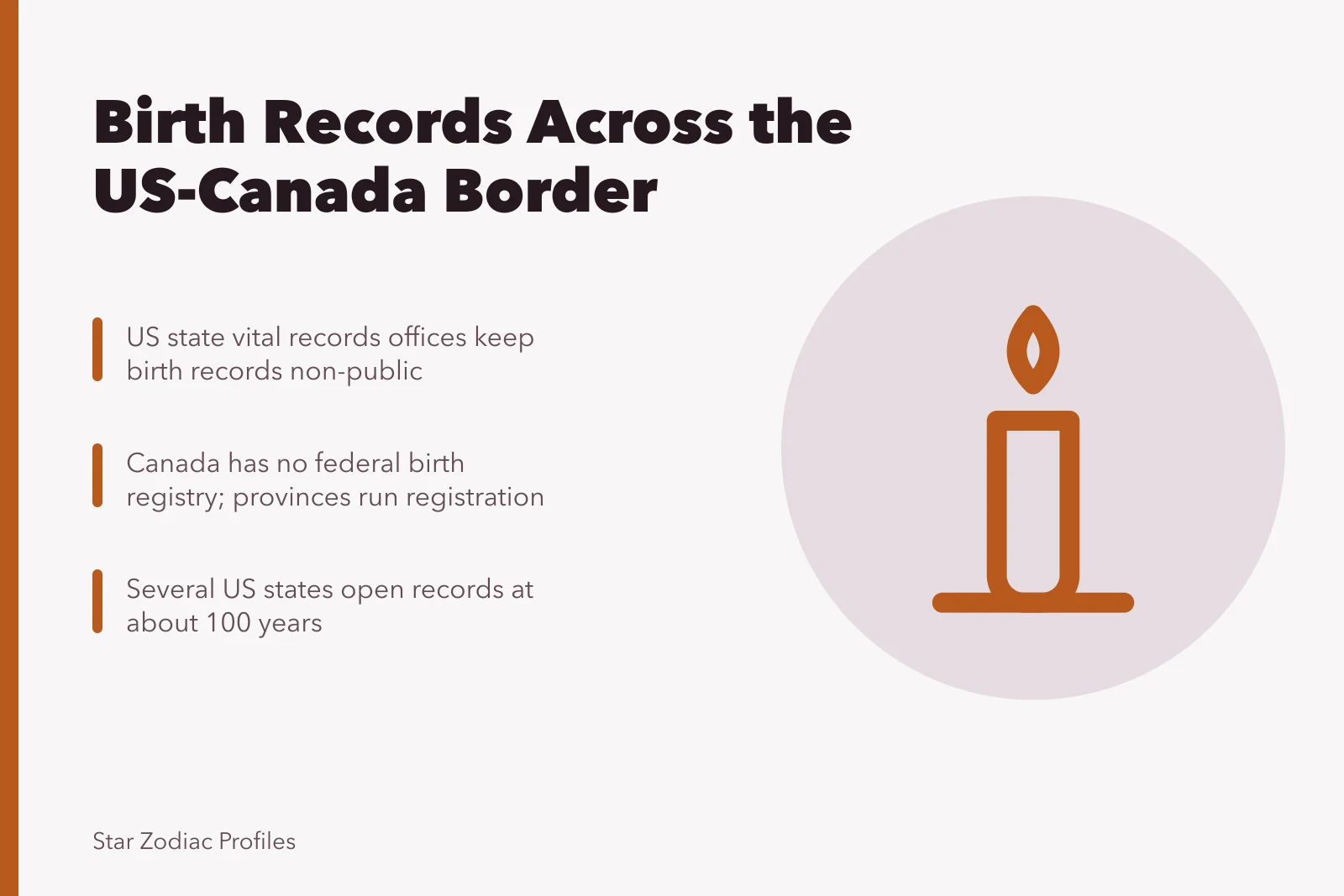
The border separates two ways of keeping birth records. In the United States, birth registration grew state by state, and each state wrote its own rules for who may see a record and what a copy contains. In Canada, provinces and territories run registration, and there is no federal birth registry.
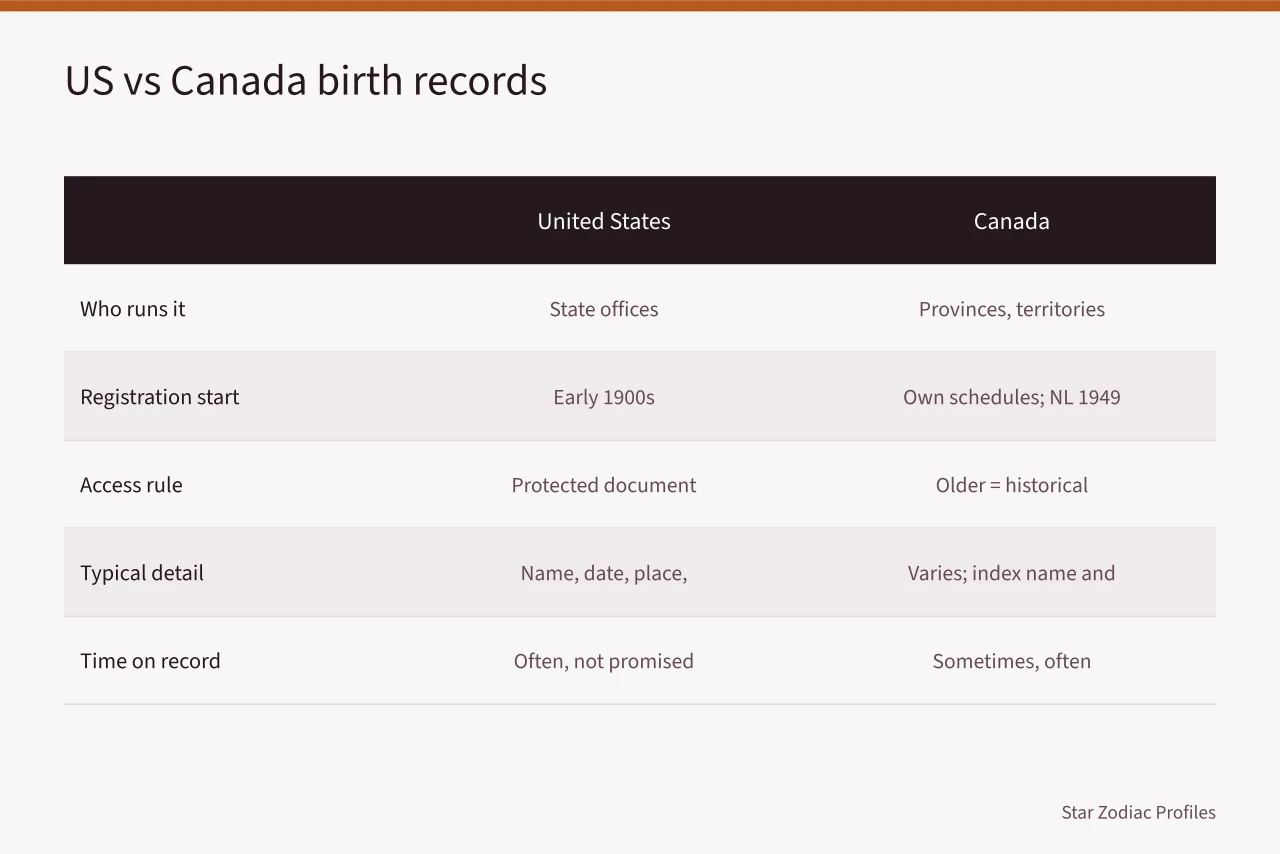
That split decides what a cross-border celebrity chart can claim. A chart needs a date, a place and a time. A record may supply one, two or all three.
Timing is the first difference. Most US states began statewide registration in the early twentieth century, though some cities kept records earlier. Canadian provinces started on their own schedules, and Newfoundland and Labrador joined the Canadian system in 1949.
Access is the second. US state offices treat birth records as protected documents. Canadian provincial registries often treat older records as historical documents. A Canadian star born in the 1920s may have a public index line; a US star born the same year has a record only a direct relative can order.
Detail is the third. A US certified copy normally shows the child's name, date and place of birth, and both parents' names. A time appears on many certificates, but not all. Canadian records vary more: some show a time, some do not, and some public indexes show only a name and a year.
Those three differences explain why a fan site can post a time for one star and leave another blank without being lazy.
What a US state office actually releases
Every state and the District of Columbia runs a vital records office, and all of them share one rule: a birth record is not a public document. Who may order a copy depends on the state. Some limit copies to the person named or a close relative. Others open records to any requester once the record is old enough.
The hundred-year line is the common pattern. Several states open birth records to anyone at about 100 years, and some use 75. California keeps recent records restricted and moves older ones to county archives and state indexes.
New York is two systems, not one. New York City holds its own birth records, and the state office outside the city follows separate rules. Texas, Florida, Illinois and Georgia each publish their own fee schedule and eligibility list.
A certified copy normally shows the child's full name, sex, date of birth, place of birth, and the parents' names including the mother's maiden name. A time of birth is often printed because hospitals record it, but it is not promised on every certificate. A delayed registration, filed years after the birth, may show less.
That is the practical point. A US record settles a date and a place with high confidence. It settles a time with medium confidence unless the certificate image is in hand.
Ordering rules also shape what anyone can publish. A state office may refuse a copy to a journalist or a fan while releasing an index entry that confirms a name and a year. That entry is enough for a date, not for a time.
One more layer is the Social Security application, the SS-5. It can show a date and place of birth, and sometimes a time, but it is a secondary source, not a birth certificate. It helps when a state record is sealed.
Official state paperwork has a defined format and a defined fee, and vital records follow the same discipline. You can see how one state structures its forms at Forms, Samples and Fees :: California Secretary of State.
Canadian provincial registries and their access rules
A record search in the United States and Canada follows two paths because Canada has no federal registry. Ontario, Quebec, British Columbia, the Prairie provinces and the Atlantic provinces each run their own system. For a province-by-province view of Canadian stars, see Canadian celebrity zodiac signs.
Older records are usually the most open. Several provinces transfer old birth registrations to a provincial archives, where they become searchable.
Ontario keeps a searchable index of births, marriages and deaths by name and year. British Columbia has a historical birth index with a similar structure.
Those indexes are gold for a date and a place, and they rarely show a time.
Newer records are restricted. A province may release a birth record only to the person named or to a parent, and the waiting period varies.
Some provinces use 100 years, some 95, and some keep the record closed until the person would be very old.
A celebrity born in Canada in the 1980s will not have a public birth record, however famous they are.
Quebec is its own case. Civil records there are held by the Directeur de l'état civil, and access rules differ from the rest of the country. A Quebec birth record may be available to the person named, a spouse, a close relative or an heir, and older records can be consulted under archive rules. That matters for French-Canadian stars.
Delayed registrations are common in Canadian provincial registries. A person born at home or in a remote area might be registered months or years later, and careless sources mistake the registration date for the birth date. A chart built on the registration date will be wrong.
Provincial indexes also show the limits of public data. A line may read "Jean Tremblay, born 1923, registration 1924." That places a birth in a year and a province. It does not support a rising sign.
How record detail changes what a chart can claim
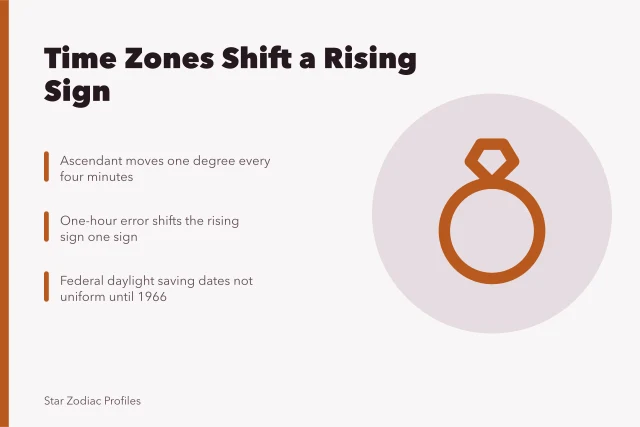
A birth chart is a map of the sky at a moment and a place. The date sets the Sun sign. The place sets the horizon. The time sets the rising sign and the house cusps. Move the time by an hour and the rising sign can change; move it by four and the Moon can enter another sign.
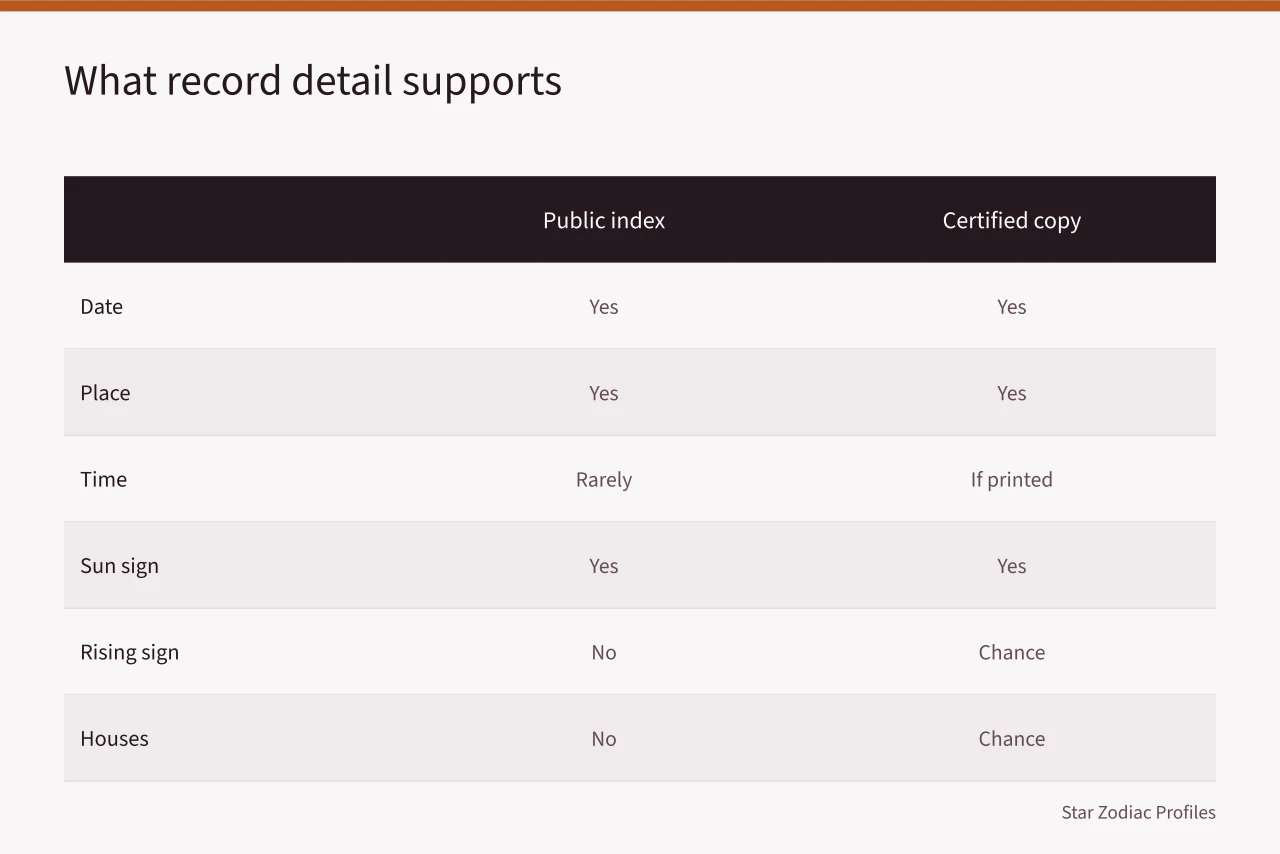
Record detail matters more than record access. A public index entry gives a date and a place, which is enough for a Sun sign and nothing more. A certified copy with a time gives a chance at a full chart, but only if the time is recorded to the minute and the place is exact.
Time zones and daylight saving add a second problem. A birth in Ontario in 1955 may fall under a different daylight saving rule than a birth in New York the same year, and Saskatchewan may not observe daylight saving at all. A wrong offset shifts the chart even when the certificate is correct.
Official time standards exist for this reason. The National Institute of Standards and Technology keeps the US time scale and publishes the rules behind time zones and daylight saving. Its Time and Frequency Division | NIST explains how the national time standard is maintained, and the NIST page on timekeeping rules covers the work behind historical offsets.
A third problem is source mixing. A fan wiki may list a time from a magazine interview, a provincial index may list a year, and a US certificate may list a time but stay sealed.
Blend those without labels and the result looks precise and is not. The guide on how to verify celebrity birth time sets out that source hierarchy step by step.
A simple test helps. Ask what the weakest link is. If the time comes from a family memory and the date from a certificate, the chart is a date chart with a guessed time. Label each link, and state which level of accuracy the chart claims.
Worked example: New York against Ontario
Take two stars, one born in New York and one born in Ontario. Both are famous enough to have fan charts. Neither has a fully public birth certificate with a time.
A birth in Manhattan is held by the New York City Department of Health and Mental Hygiene. A birth in Buffalo or Albany is held by the New York State Department of Health.
Both restrict copies to the person named or a close relative, so a fan cannot order the record, and a time on the certificate stays out of public view.
Fan charts for New York-born stars often lean on a newspaper birth announcement, which may give a date and a hospital but not a time.
Ontario birth records are held by the provincial registrar, and older records move to the Archives of Ontario, which keeps an index of births. A search confirms a name and a year.
The index does not carry a time, and a living person's record is restricted.
A fan chart for an Ontario-born star may cite the index for the date and then guess the time, and the guess can be wrong by hours.
The two systems land in the same place. The US system gives a strong date and a protected time. The Canadian system gives a public date and a protected time. In both countries the time is the weak link.
A border case adds a third pattern. A star born in Windsor or Niagara Falls, Ontario may have family ties on the US side, and a US newspaper may carry a birth announcement.
That announcement is a secondary source: it can confirm a date and a hospital, and it can occasionally mention a time. Label it as a newspaper source, not a vital record.
When two sources disagree, the disagreement is often about the date, not the time. A delayed registration in a Canadian provincial registry can create a second date, and a US certificate can correct a family memory.
Follow the record with the strongest provenance and say which one you followed. For a directory that sorts stars by dated, sourced entries, see Libra to Pisces celebrities.
What to cite when the two systems disagree
Do not average a US record and a Canadian record that point to different dates or times. Rank them. A certified copy from a state vital records office or a provincial registry outranks an index entry, which outranks a newspaper notice, which outranks a fan wiki, which outranks a family memory.
In both countries, the record you can obtain is often not the record you most want. When birth dates contradict each other, the access rule usually explains why. State the rank of your source in the note, and say when a time is missing rather than guessed.
| Claim | Source type | Office or registry | What it proves |
|---|---|---|---|
| Date of birth | Certified copy | US state vital records office | Date, place, parents |
| Date of birth | Public index | Canadian provincial registry or archives | Name, year, province |
| Time of birth | Certified copy | US state vital records office | Time, if printed |
| Time of birth | Newspaper notice | US or Canadian paper | Date, hospital, sometimes time |
| Time of birth | Family memory | Interview or memoir | Weak, label as such |
Cite the access rule alongside the record. If a record is sealed, say so. If a province releases an index but not the record, say so. The reader needs to know why a time is missing, not just that it is missing.
Separate the date claim from the time claim. A chart can be confident about the date and open about the time, and that is honest and useful.
Check the calendar last. A birth on a daylight saving transition day can be recorded in standard time or daylight time, and the certificate may not say which. Note the ambiguity. The explainer on how birth time alone can move a chart from Libra to Pisces shows why the time is worth the trouble.
Common questions
Why do US and Canadian birth records differ so much?
The United States runs birth registration through state vital records offices, and Canada runs it through provincial and territorial registries. Each jurisdiction sets its own access rules, so detail and openness vary by state and province.
Can I order a celebrity birth certificate?
Usually not. Most US states and Canadian provinces limit copies to the person named or a close relative. Older records may open after a waiting period, often around 75 to 100 years.
Does a public index entry give a birth time?
Rarely. Canadian provincial indexes and US state indexes normally show a name, a year and a place. A time, when it appears, usually comes from a certificate or a newspaper notice.
How much can a wrong time change a chart?
It can change the rising sign and the house cusps, and in some cases the Moon sign. An hour can be enough to move the ascendant by a full sign.