
Guides
How to Verify Celebrity Birth Times Without Trusting One Source
To verify celebrity birth time, treat records as claims with confidence levels, not facts. Here is the US paper trail, its costs, and where it stops.
What to take away
- No single source settles a celebrity birth time. A hospital record, a state vital record, and a news obituary can disagree by hours.
- The strongest US evidence is a certified birth certificate or a state vital records index, not a Wikipedia entry or an aggregator profile.
- Most states seal birth records for 75 to 125 years, so living celebrities are usually out of reach. Work with what is public and label the rest as estimated.
- A birth time is useful only if you can say how precise it is. Treat every chart as a range until a document narrows it.
Why one source is never enough
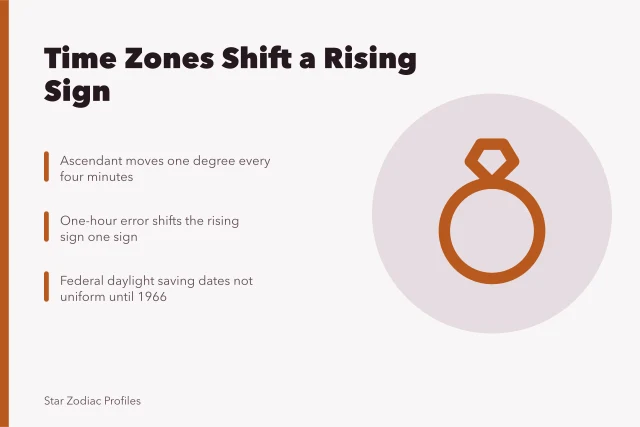
Astrology depends on the exact minute of birth. The rising sign shifts roughly every two hours, and the houses shift with it. A birth time off by 30 minutes can move the Ascendant into the previous sign.
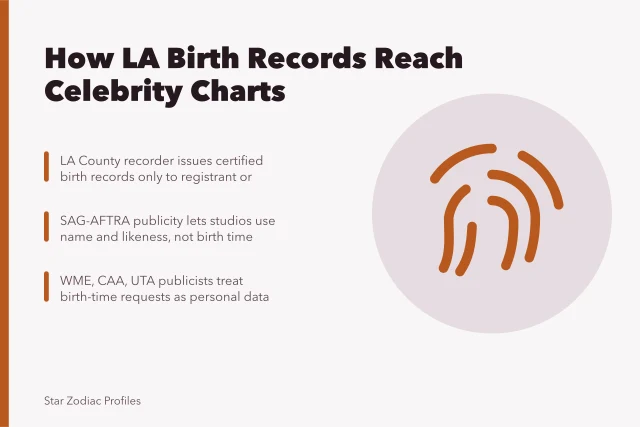
Most celebrity birthday articles copy the same date from the same aggregator. That aggregator often copied a fan site. The chain has one origin and no document behind it.
US sources add a second problem. A publicist may name the city where the family lived, not the hospital where the birth happened. Different outlets then cite different states for the same person. The chart changes with the coordinates.
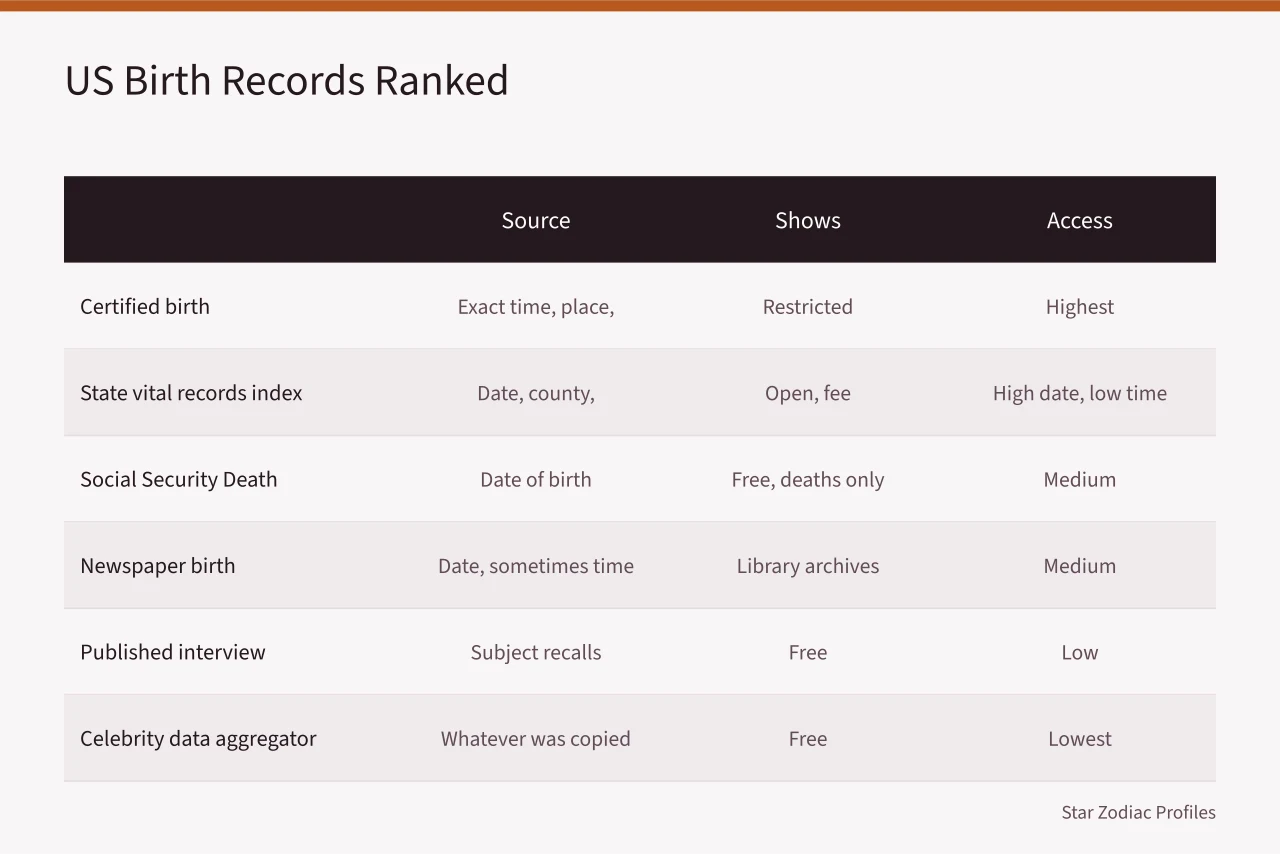
The US paper trail, ranked
| Source | What it shows | Access | Confidence |
|---|---|---|---|
| Certified birth certificate | Exact time, place, parents | Restricted to the person or close family | Highest |
| State vital records index | Date and county, sometimes time | Open in some states, fee applies | High for date, low for time |
| Social Security Death Index | Date of birth | Free, deaths only | Medium |
| Newspaper birth announcement | Date, sometimes time | Library archives | Medium |
| Published interview | Whatever the subject recalls | Free | Low |
| Celebrity data aggregator | Whatever was copied before | Free | Lowest |
A birth certificate is the only US document that normally records the hour. Everything else is a claim about a claim.
How to run the check
- Write down the date, time, city, and state that each source gives. Keep them in separate rows.
- Find the earliest published source you can date. A 1975 magazine profile outranks a 2019 listicle.
- Request or search the state vital records index for the birth county. Fees typically run $10 to $30 per search, and some states charge more.
- Compare the place across sources. If two outlets name different hospitals or cities, the chart is not settled.
- Record a confidence level for the time: documented, reported, or estimated.
A reader who follows these steps can spot a copied date in minutes. The same habit applies to sign claims, which is why an overview of astrological signs helps when two sources disagree about a cusp date.
- Date confirmed by two independent sources
- Time traced to a document, not an interview
- City and state confirmed against a record
- Confidence level written down before you build a chart
Example: the cusp problem
Take a subject born on a day when the Sun changes sign. One outlet lists the earlier sign, another lists the later one. Neither cites a document.
If the birth time is unknown, both signs remain possible. The honest output is a range, not a pick. A birth chart explanation shows how much the Ascendant and house placements depend on that missing hour.
This is also where sign-level claims break down. Traits assigned to a Sun sign often come from a chart the writer never had. The same gap appears in Aries trait breakdowns, where a single symbolic root is asked to carry several unrelated behaviors.
A date without a document is a rumor with a calendar.
What it costs and where the claims stop
A certified copy of a birth certificate for a living person is usually restricted to that person, a parent, or a legal representative. A researcher cannot simply buy one. What is purchasable is a search of a state index, often $10 to $30, and sometimes a copy of a death record for a deceased subject.
Library archive access is free. Newspaper databases often run through a public library card at no cost. Genealogy subscriptions run roughly $20 to $50 a month, which is a wide illustrative range, not a fixed price.
Where the claims stop: no public method confirms a living celebrity's birth minute unless the person or family released it. Astrologers call the fix for this rectification, which works backward from known events to guess a time. It is a guess with math attached.
The scientific status of astrology is a separate question, but it is worth knowing that the time problem sits underneath both. For readers checking personality claims rather than charts, the Big Five traits overview explains why public personas are weak evidence for any inner trait.
Common questions
Can I get a celebrity's birth certificate? Usually no. Most states restrict records for living people to the subject, immediate family, or a legal representative. You can often search a public index for the date and county instead.
What if two sources give different birth times? Treat the time as unknown and use a range. Note which source came first and whether either cites a document. A copied time is not a second source.
Is a birth time from an interview good enough? It is better than nothing and worse than a record. People misremember hours, and publicists sometimes adjust details. Label it reported, not documented.
Does the state matter for the chart? Yes. Coordinates set the Ascendant and house cusps. If sources disagree about the state or city, the chart is not settled even when the date is.