Guides
Part of MBTI diplomats: the parts worth your attention
Where MBTI diplomat claims run out, mapped through four invented scenarios
MBTI diplomats examples should be situations, not people: four invented cases showing where the model claims something and where the claim runs out.
An example of a personality type should be a moment, not a person. The moment can be examined: the situation, what someone did, and why two types might have done the same thing.
A person used as an example cannot be examined. That is especially true of a public figure, whose visible behavior is a professionally edited performance and whose inner preferences no observer can access.
So this page works the other way round. The four types grouped as diplomats, then a set of invented situations that show what the model is actually claiming and where the claim runs out.
What to take away
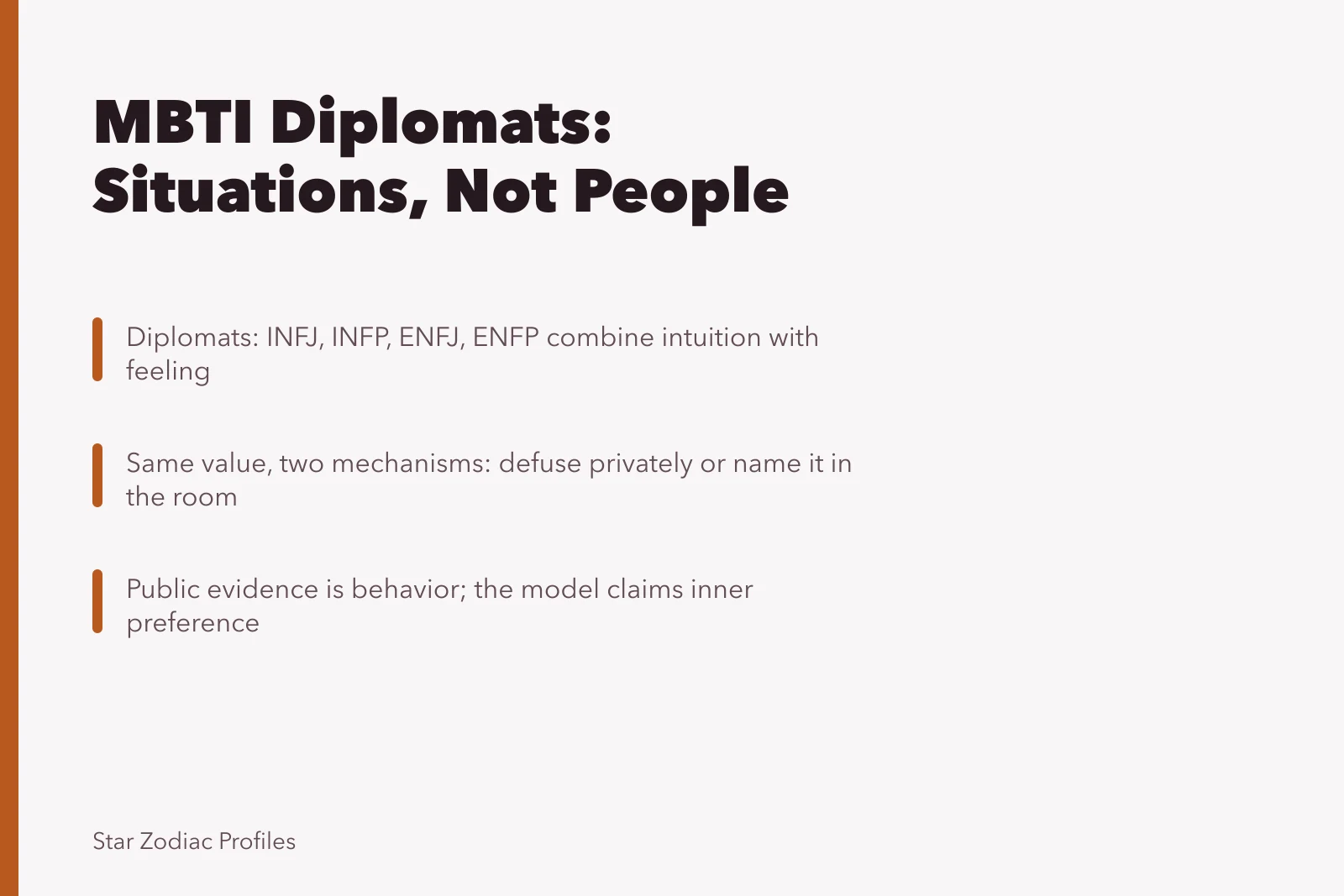
- An example of a type should be a situation, not a person. A situation can be examined from both sides; a person used as an example cannot be examined at all.
- Four invented situations are enough to show the model's central claim and where it runs out: the same behavior is reachable from several types and from no type at all.
- "Examples with public evidence" is a contradiction, because public evidence is behavior and the model's claims are about preference.
The group and its structure
"Diplomats" is a nickname for the four of the sixteen types that combine intuition with feeling: INFJ, INFP, ENFJ and ENFP. In the function-based version of the framework, each type is described by an ordered stack of mental processes.
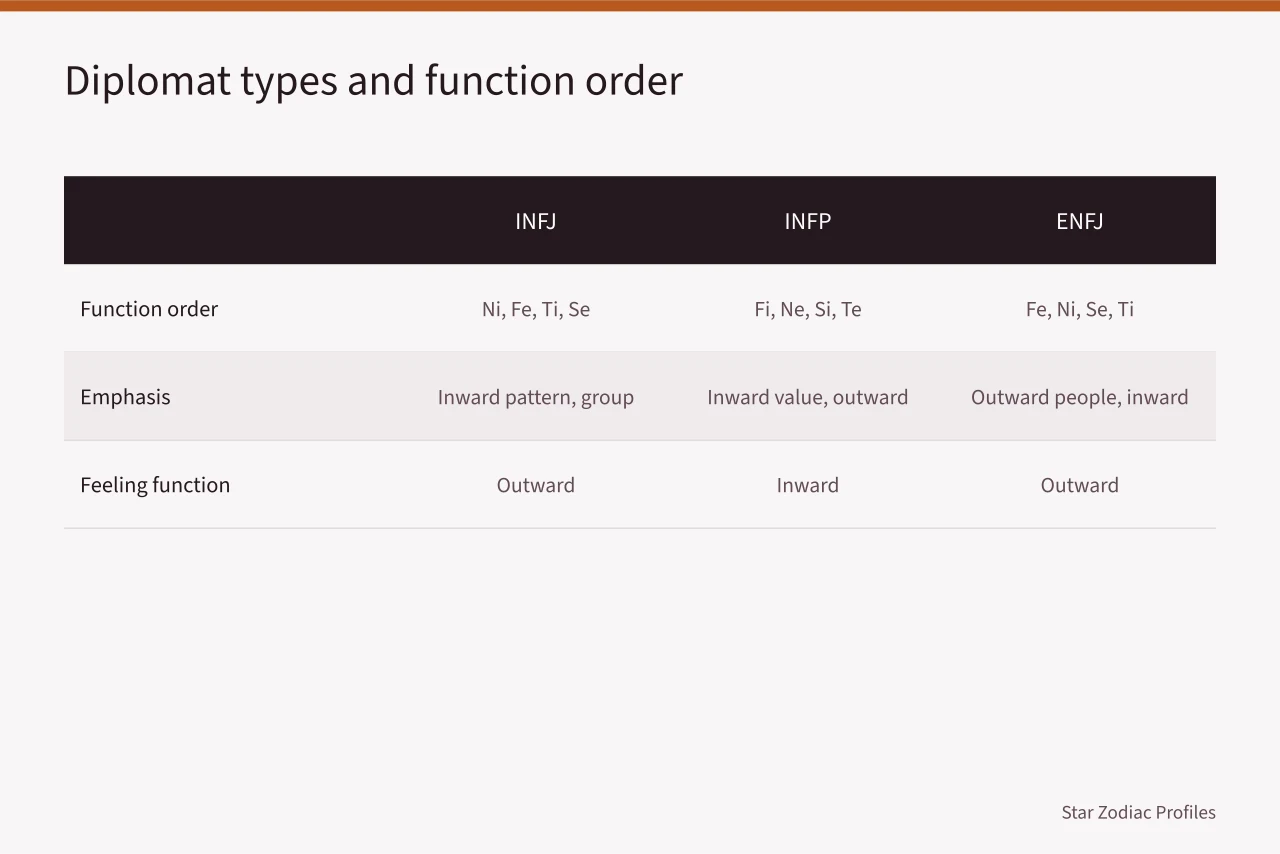
| Type | Function order | Where the model puts the emphasis |
|---|---|---|
| INFJ | Ni, Fe, Ti, Se | An inward pattern, expressed through attention to the group's needs |
| INFP | Fi, Ne, Si, Te | An inward value standard, opened outward into possibilities |
| ENFJ | Fe, Ni, Se, Ti | Outward attention to people, organized by a long inward read |
| ENFP | Ne, Fi, Te, Si | Outward possibility-seeking, checked against a private value standard |
The real divide in this group is not intuition, which all four share; it is the two feeling functions, a split the group overview works through in full.
One feeling function points outward, tracking what a room needs and what keeps it in good repair. The other points inward, tracking whether an action meets a private standard, no matter the room. Two equally considerate people can be doing entirely different things.
Four situations, and what they show
A meeting where something unfair is said. One person redirects the conversation, defuses it, and raises it privately afterwards. Another names it in the room immediately. The framework would read the first as outward-oriented feeling protecting the group's functioning, the second as inward-oriented feeling refusing to let the standard slide.
What it shows: the same value, two mechanisms. Neither is the kinder one. This is the distinction most type descriptions blur.
Someone who cannot start a project. Read through the framework, an intuition-dominant profile might stall because every version of the idea is still live and choosing one kills the others. A different profile might stall because the first step is unclear and no precedent exists. What it shows: an identical symptom, two different accounts. Behavior underdetermines type, which is why observation is a poor typing method.
A person described by colleagues as "warm but hard to know." Consistent with a type whose outward-facing function is feeling and whose primary process is private. Also consistent with someone who is tired, new, going through something, or simply not close to these colleagues. What it shows: type explanations compete with ordinary situational ones, and the ordinary ones are usually better bets, which is why the trait grammar of these descriptions is worth auditing before it is believed.
A questionnaire result that changes. Someone reports as INFP one year and INFJ the next after a change of job. Both results sat near a cut point. What it shows: scores in the four-pair instrument cluster around the middle rather than at two poles, so a small shift in self-perception moves the letter. The reported type is a hypothesis, and in proper administration the respondent, not the report, decides which type fits best.
Why "examples with public evidence" is a contradiction
Public evidence is behavior: what someone said in an interview, how they carry a room, what a profile writer noticed.
The framework's claims concern preference and inner process: which function a person reaches for first, which one is least developed. Those are not visible, and the instrument that assesses them is a self-report questionnaire only the person can answer.
Add the editing. A public figure's visible behavior is shaped by media training, by an agent, by the genre of the interview, by what sells. Typing from it is like grading handwriting from a printed poster.
And it produces a published assertion about a real, named person's inner life on the basis of nothing. It is easy to do, easy to share, and there is no version of this framework that supports it.
What the model is good for
Two things, mostly.
- Naming a preference without pathologizing it. "I think by talking and you think by writing" resolves a whole class of friction that otherwise gets read as rudeness or evasion.
- Making room for the other option. Reading a description of a preference you do not share is a cheap way to notice that a colleague's approach is a different setting, not a defect.
And two things it is bad for: deciding who gets hired or promoted, and telling someone what they are. The framework's own guidance advises against selection use, which is worth repeating because it is so widely ignored.
Common questions
Can you type someone from interviews and public appearances?
No. The framework assesses inner preference by self-report; public appearances show edited behavior. The same behavior is available to several types for different reasons.
Are the diplomat types the empathetic ones?
The nickname invites that reading and the model does not support it. A feeling preference describes what a person weighs when deciding, not how much they care. Thinking-preference types are not short of feeling.
Why do the descriptions fit me so well?
Type descriptions are written to be recognized, and broad statements about character tend to be accepted by nearly everyone who reads them attentively: an effect with a long research history, covered in the notes on quiz design.
Is there a better-evidenced way to describe personality?
Academic personality research generally works with continuous trait dimensions rather than either-or types. The four-letter framework survives because it is a good conversational tool, which is a real thing to be.
Where can I read about the other groupings?
The sensing-judging group is set out alongside the history of the four pairs and what a reported result does and does not establish.