Rules
Part of Aries celebrities: the record, kept honest
Aries traits: one symbolic root behind decisive and impatient, and its counterweights
Aries celebrities traits are one symbolic claim written twice: decisive and impatient share a derivation, and the tradition supplies the counterweights.
Here is a thing most trait lists hide: in astrology every keyword is double-sided by construction. "Decisive" and "impatient" are not two findings about a sign. They are one symbolic claim written in two registers, and which register gets printed depends on whether the page is selling flattery or a warning.
Aries is the clearest place to watch this happen, because the tradition supplies the counterweights explicitly and popular trait lists strip them all out.
What to take away
- In this tradition every keyword for the sign is double-sided by construction. The flattering word and the unflattering one are the same claim, written twice.
- The tradition surrounds a sign with structures that qualify it: the axis it belongs to, the ratings for each planet in it, and the rest of the chart. Popular lists keep the adjectives and drop all three.
- Attaching a temperament to a named living person because of their birthday states something about their character that the person stating it cannot possibly know.
One claim, two registers
Take the derivation. The sign is cardinal, which in the scheme means it opens a season; it is fire, the element of expenditure rather than storage; and it is assigned to Mars, the planet the tradition associates with conflict and appetite. That produces a single symbolic idea: energy released early, before the situation has settled.
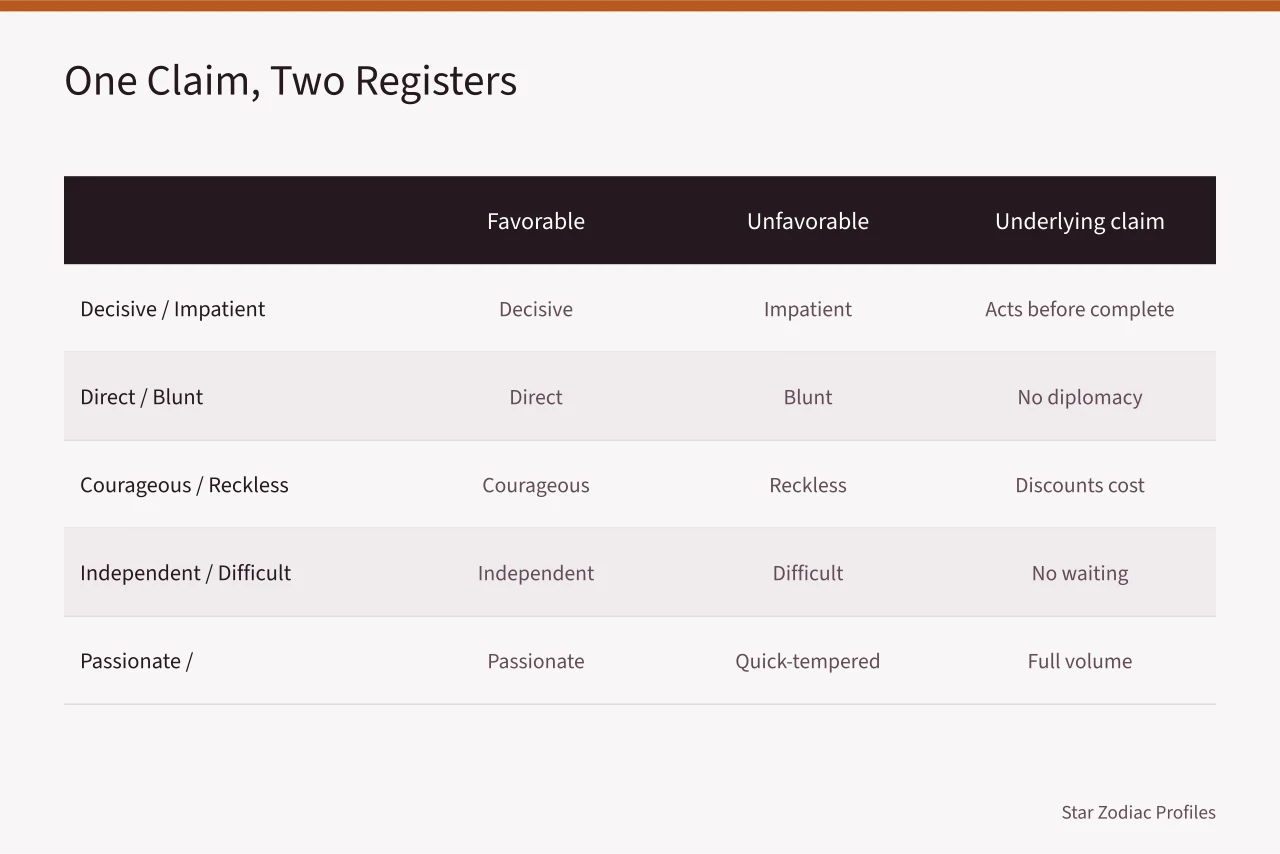
Now watch the same idea written twice.
| The favorable register | The unfavorable register | The underlying claim |
|---|---|---|
| Decisive | Impatient | Acts before the picture is complete |
| Direct | Blunt | Does not route through diplomacy |
| Courageous | Reckless | Discounts the cost of being wrong |
| Independent | Difficult to work with | Prefers not to wait for agreement |
| Passionate | Quick-tempered | Responds at full volume |
Nothing was added between the columns. The middle claim generated both. A trait list that gives you only the left column is not a description of a sign; it is a description of a sign with the price removed.
The counterweights the tradition builds in
Classical astrology never treated a sign as a flat list of adjectives. It surrounded each one with structures that qualify it, and those structures are the part that gets lost in translation.
The opposition. Every sign is paired with the one across the circle, the widest of the angular relationships the tradition reads, and the pair is treated as a single axis rather than as two rival options. Aries sits opposite Libra, self-assertion against negotiated agreement, which is why the second half of the wheel carries the vocabulary this sign lacks. The doctrine is that neither pole is complete, and that what one lacks is described by the other. Any writing that presents a sign as a self-sufficient personality has dropped half of an axis.
The dignities. The classical scheme rates how each planet is said to operate in each sign, a ledger set out under essential dignity, and the ratings for a single sign point in different directions.
| Placement in Aries | Classical term | What the scheme says about it |
|---|---|---|
| Mars | Domicile | The planet is in its own sign; the scheme reads it as unconstrained here |
| The Sun | Exaltation | A placement of honor; the sign is where the Sun's expression is said to be raised |
| Venus | Detriment | Opposite its own sign; the scheme reads it as working against the grain |
| Saturn | Fall | Opposite its exaltation; associated with limit and patience finding no purchase |
That table already contradicts any single-adjective summary. Within the same sign, one factor is described as amplified and another as obstructed. A chart in which Saturn sits in this sign is not read the way a chart with the Sun there is.
The rest of the chart. The Ascendant, the Moon, the houses and the angles between planets all require a birth time, and all of them modify how a sun sign is read. Practitioners consider a reading built on the sun alone a sketch, and say so.
Why the flattering version is the one that circulates
Because it is what gets read and shared. A description that tells you your impatience is courage in disguise is pleasant. A description written broadly enough to cover everyone born in a month will feel accurate to nearly anyone who reads it attentively, an effect studied for decades as the Barnum effect.
The commercial logic pushes in one direction, and the tradition's own logic pushes the other way. Older texts are noticeably harsher and more conditional than modern sun-sign copy, precisely because they were writing for a client with a chart rather than for a magazine column.
How to read a trait list well
- Ask what the derivation is. If a keyword cannot be traced back to element, modality and ruling planet, someone made it up on the way to publication.
- Look for the cost. A description with no downside has been edited for palatability.
- Notice the grammar. "This sign is associated with directness" is a claim about a symbol. "You are direct" is a claim about you, and the tradition has no way to get from one to the other from a birth date.
- Treat it as a prompt, not a verdict. The question worth asking is whether the description names something you recognize, and what you want to do about it, which is a use nobody needs to defend.
Why lists of famous people belong nowhere near this
Attaching a temperament to a named living person because of their birthday states something about their character that the person stating it cannot possibly know. It is not a claim the tradition supports either: no astrologer working properly would offer a reading of someone they have never spoken to, from a birth time they cannot verify, published for strangers.
It is also uninformative. Any sign can be stocked with well-known names, because birthdays are spread across the year and every field has people from every month. The list looks like evidence and contains none. The same reasoning applies to Aries celebrities careers advice, which borrows its vocabulary from old planet-to-trade tables.
Common questions
Is there a definitive list of this sign's traits?
No, and the variation between sources is the tell. What is stable is the derivation (cardinal, fire, Mars), and the keywords are one writer's rendering of it.
Why do the descriptions contradict each other?
Often they do not; they are the same claim in a different register. Where they genuinely conflict, it usually reflects a difference of school, or a modern rewriting of an older, blunter text.
Does the trait list apply to everyone born in that month?
The tradition itself says no. It routes character to a whole chart, meaning the rising sign, the Moon, the houses and the aspects, none of which follow from a date alone. The outline of the sign sets out what a birth date can and cannot fix.
Where does the sign begin and end?
At the March equinox, in tropical practice: the sign is a thirty-degree stretch of the year rather than a constellation, and the fixed earth sign that follows it is the next such stretch. The notes on the equinox and precession explain why the two came apart.