Maintenance
Part of Libra to Pisces celebrities: a dated, sourced directory
Libra to Pisces celebrities quiz: signal versus noise
Libra to pisces celebrities quiz results feel accurate by design: the five writing moves behind that, and how to build a quiz that claims less.
A "which sign are you" quiz is a strange object when you think about it. Your sign is already fixed by your birthday. So the quiz is not finding anything out: it is testing whether the twelve descriptions are distinguishable enough that people land on their own. Run one honestly and you learn something genuinely interesting about how self-description works.
What to take away
- A quiz that guesses your sign is not finding anything out. Your birthday already fixed it. What the quiz tests is whether the twelve descriptions are distinguishable at all.
- Five writing moves make any description feel personal. Once you can name them you can read a horoscope, a personality profile or a cold reading with a clear head.
- An honest quiz is still enjoyable. What changes is what it claims, and whether it shows the reader the description they matched least.
The result almost every quiz gets
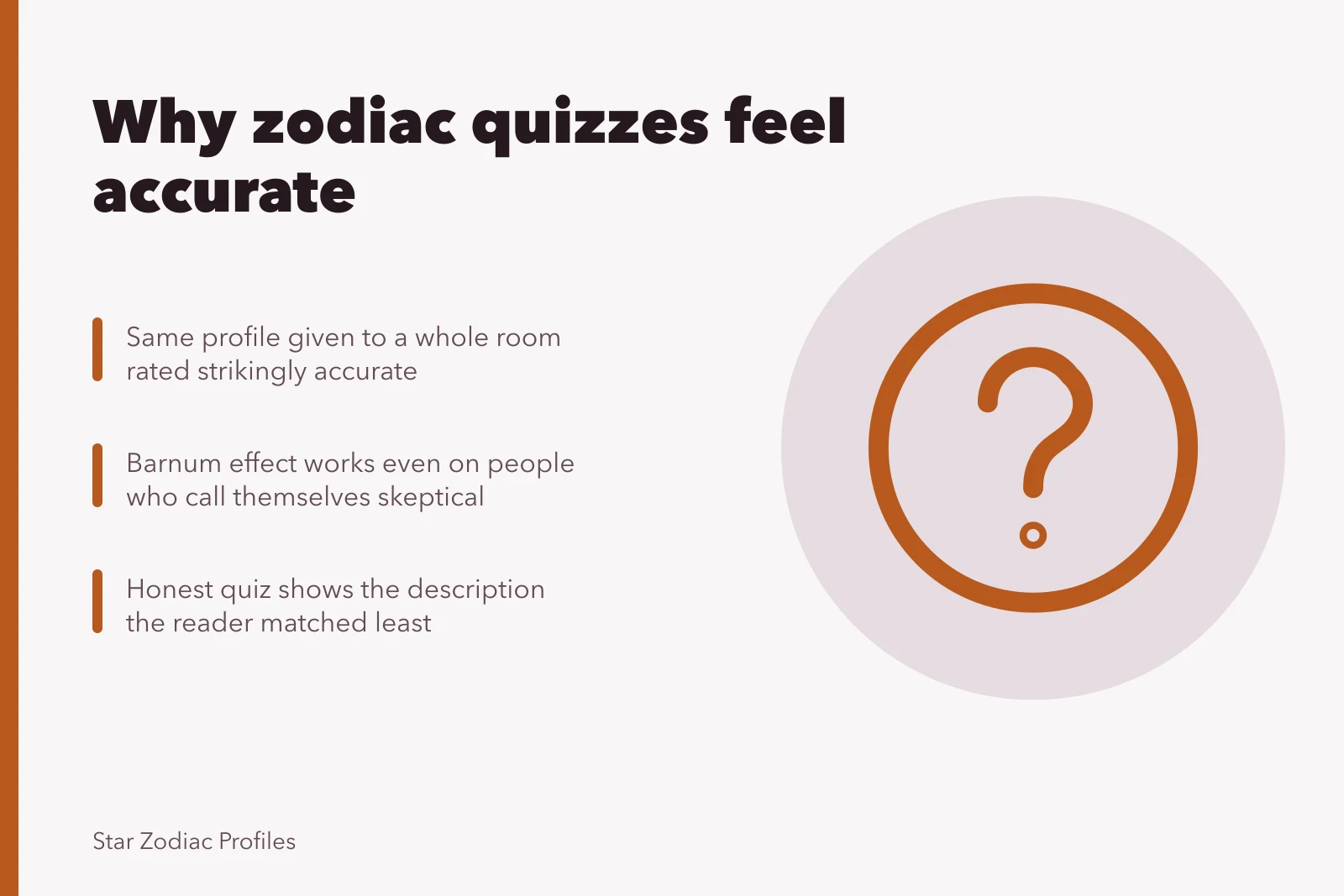
Psychologists have known since the middle of the last century what happens when you hand people a personality profile and ask how well it fits. Give a whole room the same profile, say it was prepared for each person individually, and most rate it as strikingly accurate.
It works with flattering statements and with unflattering ones. It works on people who say beforehand that they are skeptical.
The effect is called the Barnum effect, and it is not about gullibility but about how readers process sentences about character.
A statement like "you have a great deal of unused capacity you have not turned to your advantage" is true of nearly everyone, and each reader supplies a personal instance. The reader interprets the sentence, then credits it. This process is called subjective validation.
This matters for a zodiac quiz because it sets the bar. If your six Libra-to-Pisces descriptions all feel right to everyone, your quiz has not measured anything. Knowing that, you can build one that is still fun and is honest about what it does.
The five moves that make a description feel personal
Learn to spot these and you can read any horoscope, personality quiz or cold reading with a clear head.
| Move | How it looks | Why it lands |
|---|---|---|
| The two-sided statement | "Sociable, though you need real solitude to recharge" | Both halves are true of most people; whichever one you recognize confirms it |
| The near-universal | "You are harder on yourself than anyone knows" | Almost nobody reads that and thinks: not me |
| The flattering frame | "Your standards are the reason you are misunderstood" | Accepted faster because it is pleasant to accept |
| The unfalsifiable | "You are drawn to depth, even when you hide it" | Any evidence against it can be read as the hiding |
| The second person | "You..." rather than "this sign is associated with..." | Grammar turns a statement about a symbol into one about the reader |
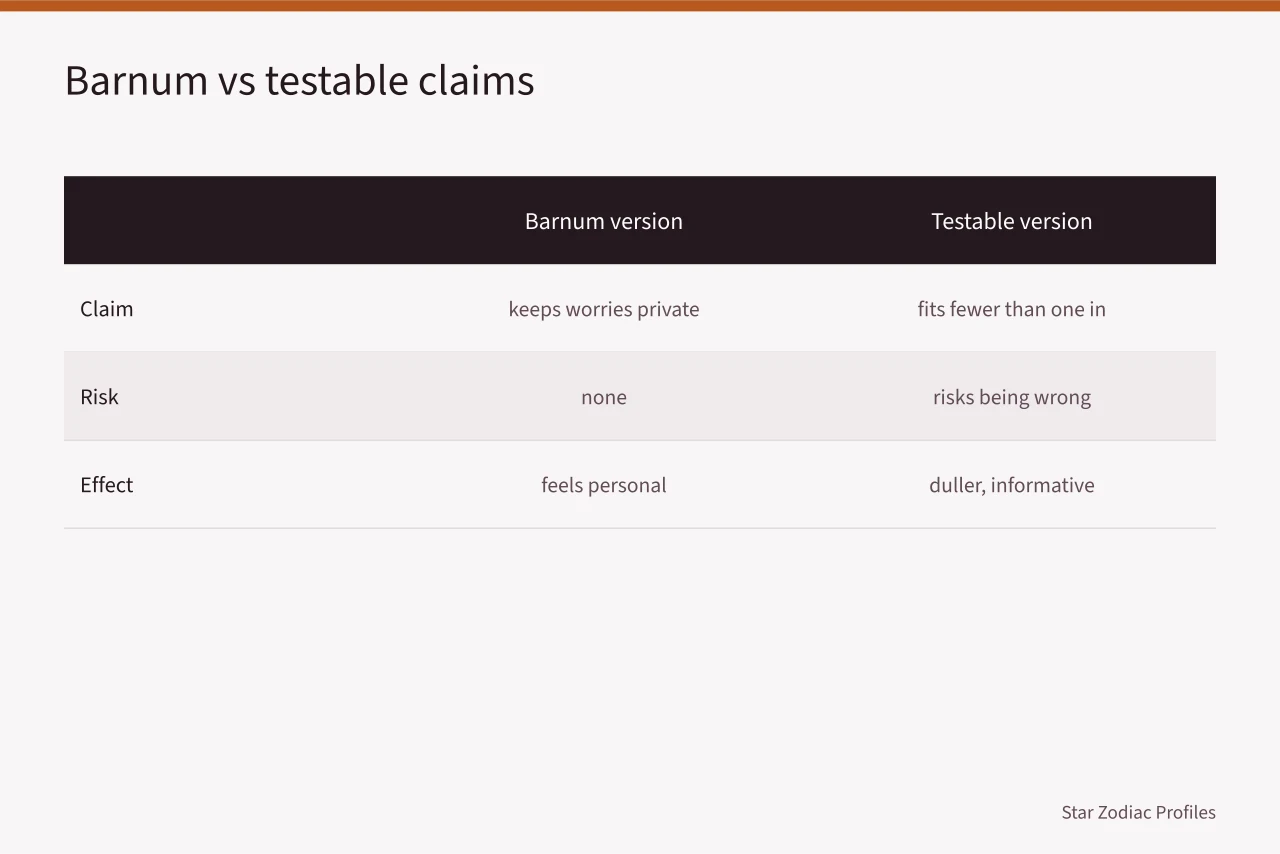
Now compare a claim built from those moves with one that risks something:
- Barnum version: "Capricorn keeps its worries private and works harder than it lets on."
- Testable version: "This description should fit fewer than one reader in six. If it fits everyone, it is not describing a sign."
The second is duller and far more informative.
Designing an honest zodiac quiz
You do not have to strip the pleasure out to make it truthful. You have to change what the quiz claims.
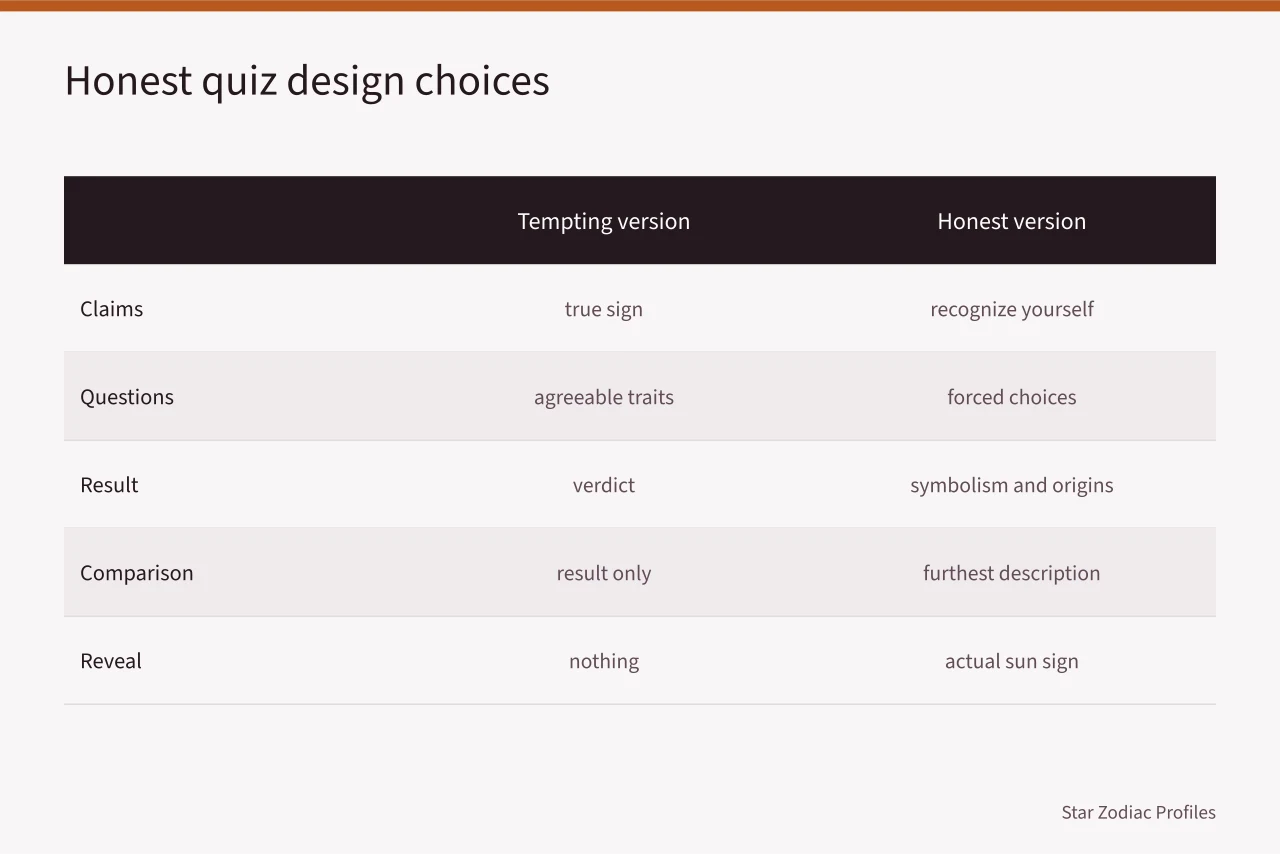
| Design choice | The tempting version | The honest version |
|---|---|---|
| What it claims | "Discover your true sign" | "See which of six descriptions you recognize yourself in" |
| Questions | Traits that everyone will agree with | Genuine forced choices between two appealing options |
| Result page | A verdict about who you are | The sign's symbolism, its ruling planet and element, and where they came from |
| Comparison | Your result only | Your result alongside the description you were furthest from |
| The reveal | Nothing | Show the reader their actual sun sign and how often the two match |
That last row turns the quiz into the demonstration. Any reader can see for themselves whether the descriptions sort people the way the labels claim.
Good question design, for the six signs
Every question should offer two options a reader would genuinely be torn between. If one answer is obviously nicer, everyone picks it and the question is dead weight.
- "A plan changes at the last minute. Are you more annoyed by losing the plan, or relieved to be out of it?"
- "You are given an hour with no obligations. Do you want company, or the door shut?"
- "A friend asks for advice you know they will not take. Do you give the honest version anyway?"
- "Something is nearly finished and slightly wrong. Do you ship it or fix it?"
Then hold yourself to a rule: do not write a result that describes the reader as admirable in every clause. A description that no one could object to is a description that measures nothing.
What the tradition itself says about this
Astrologers are often the harshest critics of the twelve-descriptions format, for reasons that come from inside the practice. In their terms a sun sign is a fragment of a chart, and reading character from it alone ignores the rising sign, the houses, the aspects between planets and everything that requires a birth time, as the invented cases show.
The structure of the six signs is what a quiz is compressing. A quiz sorting people into six or twelve boxes is not a compressed version of the tradition. It is a different, much cruder thing wearing its vocabulary.
Which is also why the celebrity-matching format is best left alone. Pairing a well-known living person with a sign and describing what they are supposedly like publishes a claim about someone's character on the strength of a birthday. It is not a claim the tradition licenses, and quizzes do not need it.
Common questions
Why did the quiz get my sign right?
If it asked for your birthday, arithmetic. If it did not, check how many of the descriptions you would have accepted: most readers accept several, which is the effect described above rather than a hit.
Is it wrong to enjoy this stuff?
No. Enjoyment is not a claim. It goes wrong when a result is treated as information about someone (you, a partner, a job applicant), rather than as a prompt for thinking.
Can a quiz be evidence for astrology?
Not on its own. To count for anything, the descriptions would have to sort people better than chance and better than a set of statements everybody accepts, which is the comparison quizzes are built to avoid. The question of what a quiz can be scored against goes further into it.
What is a better use for a quiz?
Teaching the vocabulary. Elements, modalities, rulerships and houses are the interesting machinery, and a quiz is a painless way to meet them. The notes on where sign keywords come from set out the derivation.