Reviews
Part of Gemini celebrities: reading half an axis that runs all the way to Sagittarius
Most Gemini quizzes have no answer key, but one property can still be tested
Gemini celebrities quiz pages have no answer key: what a sign quiz can be scored against, the one property you can test at home, and how to run it.
A quiz asking which sign the twins belong to has a right answer. A quiz that tells you which sign you are most like does not, and cannot be given one.
That difference decides what such a quiz can be checked against. Almost every complaint about zodiac quizzes is really a complaint that the second kind gets presented as the first.
What to take away
- A quiz needs a criterion before it can be scored. Knowledge quizzes have one; personality-style quizzes about signs have nothing to check an answer against.
- Without a criterion, the only property left that can be tested is whether the quiz agrees with itself when the same person takes it twice.
- That test is easy to run at home, it is almost never reported, and it separates a carefully built quiz from a decorative one.
Two kinds of quiz, and only one of them has a key
| Kind | The question | What settles a right answer |
|---|---|---|
| Knowledge | Which planet does the tradition assign to this sign? | The tradition's own texts; checkable |
| Preference | Which sign are you most like? | Nothing outside the quiz itself |
The first kind is straightforward. The tradition is a body of written material with stated assignments, so a question about which sign is described as mutable air has an answer, and a quiz can be marked. Scoring is meaningful because there is something to be right or wrong about.
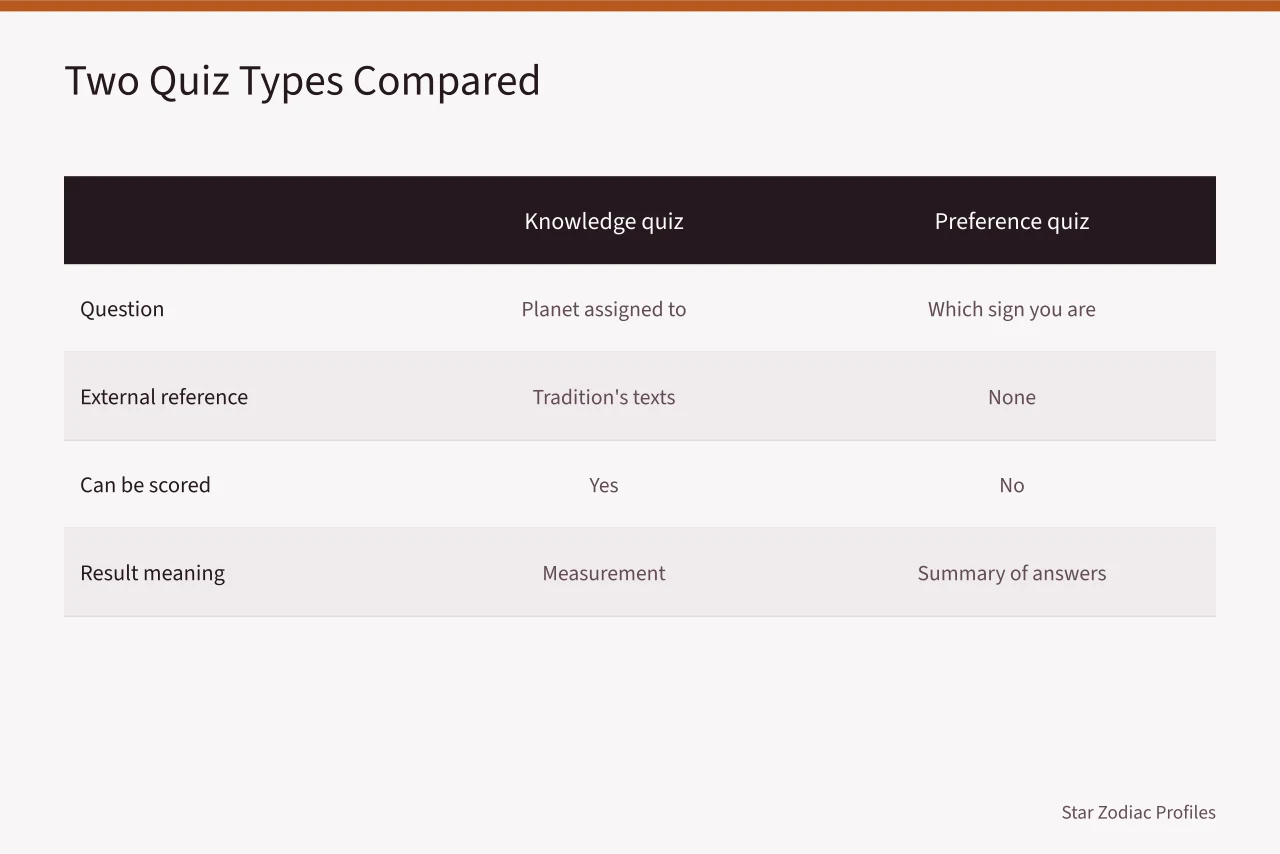
The second kind has no such external reference. Whatever result the quiz gives, no fact outside the quiz can contradict it, because the thing it claims to measure is defined by the quiz's own items. The result is not a measurement of a hidden quantity. It is a summary of the answers, restated in different words.
That is not a scandal, and it does not apply only to signs. It applies to any instrument with no criterion. But it does mean the results page cannot honestly say the quiz revealed anything.
What can still be checked
Two things, and the second is the useful one.
Internal consistency. Do the items that supposedly point the same way actually move together? If a quiz has five questions meant to detect the same quality and they show no relationship to each other, they are not detecting one thing.
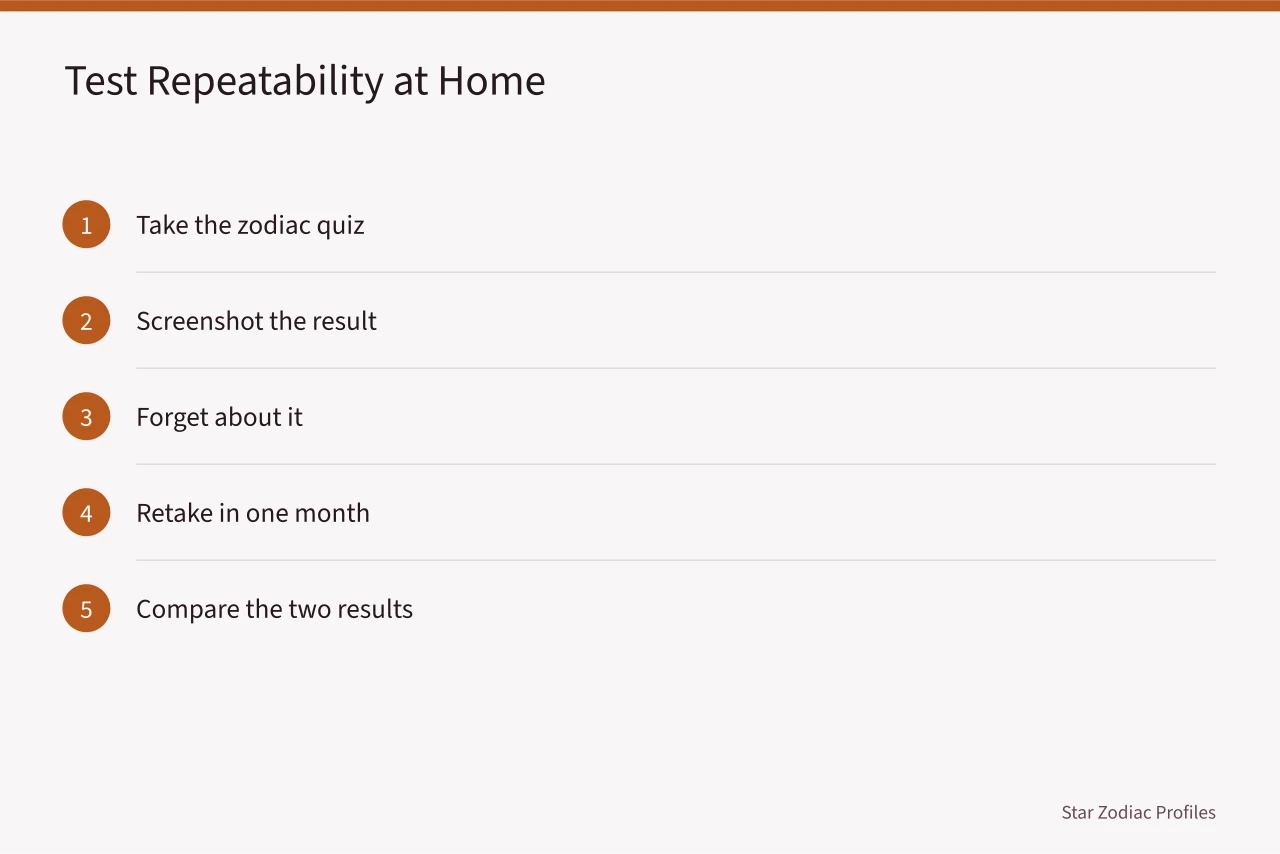
Agreement over time. Give the same person the same quiz six weeks apart. This is repeatability, and it is the minimum any measurement has to clear. A quiz whose results move around is not slightly imprecise. It is not yet measuring anything.
Run it yourself on the next zodiac quiz you meet. Take it, screenshot the result, forget about it, take it again in a month. Most will not survive. The ones that do usually have more items and blander questions, which is a real tradeoff rather than a fault.
The result almost nobody notices they got
There is a second reason the second kind of quiz cannot be checked by feel: the results paragraph will feel accurate whatever it says. Descriptions written in general terms are recognized as personal by nearly everyone who reads them about themselves, an effect studied as the Barnum effect. A sign description is an unusually good example of the genre.
The test is quick and slightly deflating. Get the result, read it, then read the description for the sign opposite yours on the wheel. If both feel largely true, the paragraph was doing the work rather than the questions. The pattern behind misreadings of a cardinal fire sign covers why the recognition arrives so reliably.
Designing a quiz that can be scored
There is one honest way to build a zodiac quiz with an answer key: make it about the tradition rather than about the reader.
Good questions have checkable answers, and there is plenty of material. Which two signs did the older scheme assign to one planet. What the difference is between a mode and an element. Which body part the medieval body map gives a particular sign.
Why a sign's start date shifts by a day between years. These are facts about a documented system. The layered derivation of a fixed earth sign's vocabulary is the kind of material that makes them interesting rather than trivial.
Such a quiz teaches something and can be marked. What it cannot do is tell the reader anything about themselves, which is why it will always be less popular than the other kind.
What the popular format is actually doing
Sorting a reader into a category they already knew, or one that flatters them, then handing over a description that would have fit either way, is entertainment. Nothing is wrong with it as entertainment.
The problem appears when someone treats the output as a finding: their sign is wrong, the tradition is confirmed, or a friend's answers have revealed something about them.
The tradition's own practitioners are usually clearer about this than the quiz pages are. A sun sign is one placement out of many in a chart, and reading a personality from it alone is a compression that the practice itself treats as coarse. The outline of the third sign and the derivation of its keywords both set that out.
Common questions
Can a quiz work out my sign from my answers?
Only by chance. A sign in this tradition is determined by a date, not by preferences, so a quiz guessing it from answers is testing whether you resemble the description rather than looking anything up.
Is a longer quiz more accurate?
More items reduce random variation, which improves agreement over time. Accuracy needs a criterion, and there is none.
Why do the results feel so right?
Because general descriptions are read as personal, and because most quiz results are written to be pleasant. Both effects push the same way.
What should a quiz page tell me that they never do?
How many items it has, what each item contributes, and whether the same person gets the same result twice.
Is there any point taking one?
As a prompt for thinking about how you would describe yourself, yes. As a measurement, no, and no amount of polish changes that.