Reviews
Part of MBTI analysts: the one typing step no outside observer can perform
MBTI analysts misconceptions and where they come from
MBTI analysts misconceptions divide into vocabulary, structure and status: eleven common slips, where each one enters, and the repair for each one.
The four codes that pair intuition with thinking attract more misreading than any other group in the system, and most of it enters through ordinary English rather than through the model. The words the model borrowed already meant something, and readers keep the everyday meaning. Eleven of those slips are worth separating, because each one has a different repair.
What to take away
- Most misconceptions here are vocabulary problems. Four technical terms were given common English words, and the common meanings never went away.
- A second group comes from structure: the code looks like four independent switches, and the model does not treat it that way.
- A third group comes from status: adoption by large organizations gets read as evidence, and rarity gets read as distinction.
The vocabulary group
One: intuition means insight or foresight. In the model it names a habit of attending to patterns, implications and possibilities rather than to what is directly present. It carries no claim about being right. The term is inherited from the 1921 book that supplied the underlying scheme, where it was one of four ways of taking in or judging information, all of them fallible.
Two: thinking means intelligent, and feeling means emotional. Thinking names a decision weighed by impersonal criteria; feeling names a decision weighed by its effect on people and by what matters to them. Both are decision processes. A feeling preference is not a shortage of logic, and a thinking preference is not a shortage of feeling.
Three: introversion means shy. It names where attention is restored and where it goes first, inward or outward. Someone with an introverted preference can be socially fluent and enjoy company; the model's claim is about the direction of the flow, not about comfort.
Four: judging means judgmental. It names a preference for closure in dealings with the outside world: deciding, settling, planning. Its opposite names a preference for keeping options open. Neither is about being critical of people.
The structure group
Five: the four letters are four separate traits. They are reported that way and used that way in the model as a single pattern. Two codes that share three letters can be described with entirely different orderings of the underlying functions, which is why INTJ and INTP descriptions read so differently despite looking almost identical on paper. The group overview sets out the four orderings side by side.
Six: a percentage is a strength. The figure on a results page reports how consistently you answered a pair, not how much of the preference you have. A person reported at a high figure is not more intuitive than a person reported at a low one, as the scoring notes work through.
Seven: two people with the same code will behave alike. The code describes preferred routes, not outcomes. Two people can share four letters, work the same problem, and arrive at opposite answers while both behaving exactly as their descriptions would suggest.
Eight: the group nicknames come from the instrument. They do not. Grouping the sixteen into four families with names like analyst, diplomat, sentinel and explorer is a later organizing layer, closest in spirit to the temperament sorter tradition, which built its own four-way grouping on different reasoning. The nicknames are useful shorthand and they are not part of the four-pair scheme.
The status group
Nine: rare types are special. Published distributions vary by sample and by country, and the model attaches no meaning to frequency. A preference pattern is not a rank, and a rarer pattern is not a better one. The appeal of rarity is what keeps the public-figure lists skewed toward this group in the first place.
Ten: large organizations use it, so it must be validated. Adoption is a fact about purchasing, not about measurement. The publishers themselves advise against using type to select or screen people, so wide use in hiring would be evidence of the instrument being used against its own guidance rather than evidence of its accuracy.
Eleven: a consistent public manner reveals a type. This is the most confident error and the least supportable. Observers systematically overweight disposition and underweight situation when explaining what someone does, a tendency documented as the fundamental attribution error. A public figure's manner has been shaped by training, feedback and the incentives of their work. The model locates type in the reasons behind behavior, and reasons are not visible from outside.
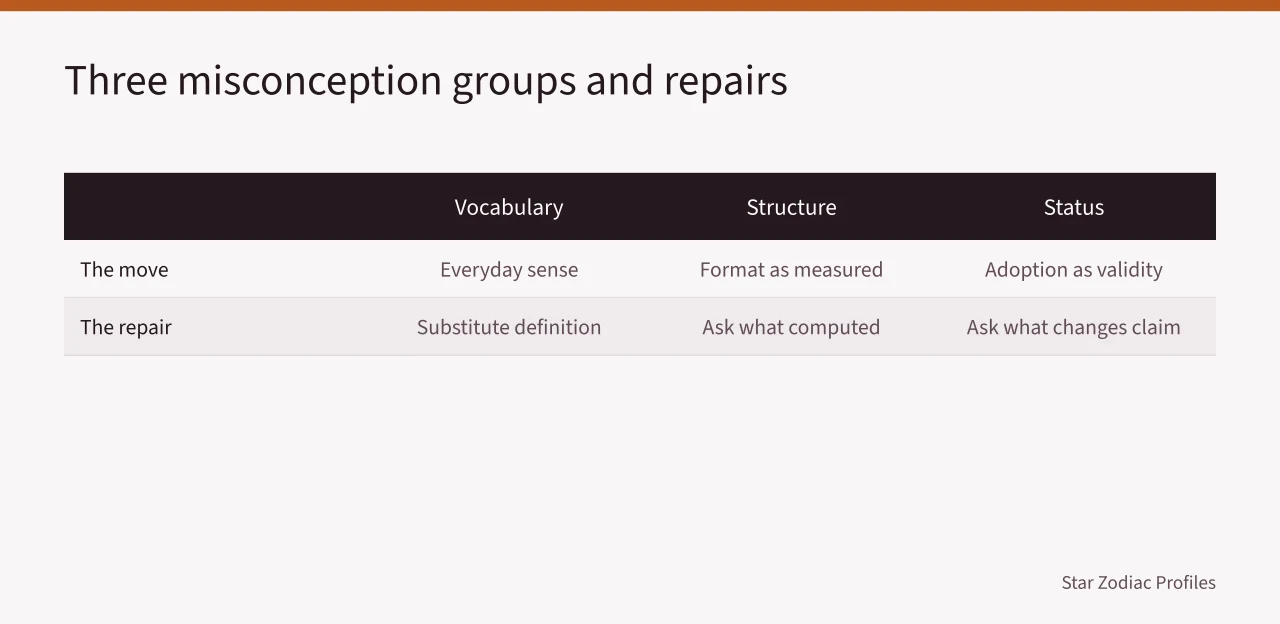
What the eleven have in common
| Group | The move being made | The repair |
|---|---|---|
| Vocabulary | An everyday word is read in its everyday sense | Substitute the model's definition and reread the sentence |
| Structure | A summary format is read as the thing measured | Ask what the number or letter was computed from |
| Status | Adoption or rarity is read as validity | Ask what evidence would change the claim |
None of the eleven is a fringe misunderstanding. They appear in articles by people who like the model and want to explain it well. That shows the vocabulary itself does the damage.
The same pattern shows up in the nine-point system. Words like helper and achiever carry their English meanings straight into the descriptions, as the notes on that model describe.
One misconception that is not on the list
That the model is worthless. It is a self-description tool with a documented procedure and a clearly stated scope. Inside that scope it does useful work: giving a person vocabulary for their own preferences and giving two people a neutral way to name a difference.
The complaints on this page are about uses outside that scope, almost all of which involve applying a label to somebody who did not choose it. A free questionnaire result is a fine place to start that self-description, provided the gaps in the free format are understood before the letters are adopted.
Common questions
Which of the eleven causes the most trouble in practice?
The vocabulary group, because it is invisible. A reader who thinks thinking means clever will misread every description in the system without noticing.
If the nicknames are not official, why use them?
They are convenient and widely understood. The point is only that they carry no separate authority, and that their connotations leak into the descriptions.
Is the intuition preference related to intuition in the everyday sense?
Loosely, and the overlap causes more confusion than it resolves. The model means attention to patterns and implications, not a faculty for being right without reasons.
Can a type be wrong?
The reported type from a questionnaire can be a poor fit. The model's remedy is for the person to read the descriptions and choose, which makes the person the authority rather than the score.
Do practitioners agree about all of this?
On the vocabulary and the scope, broadly yes. The function orderings and the group nicknames are where practitioners and online communities differ most.