Rules
MBTI diplomats: the parts worth your attention
MBTI diplomats discussion runs on two different models at once: a four-pair questionnaire and a theory of function order, with different origins and claims.
Two different things go by "MBTI," and the four types grouped as diplomats show the widest gap between them.
One is a questionnaire sorting on four either-or pairs. The other is a theory of eight mental functions in a fixed order for each type. The first produces a code; the second explains what that code means.
Most online discussion of INFJ, INFP, ENFJ and ENFP runs on the second while assuming the authority of the first. A reader who cannot tell the two apart will be misled by both.
What to take away
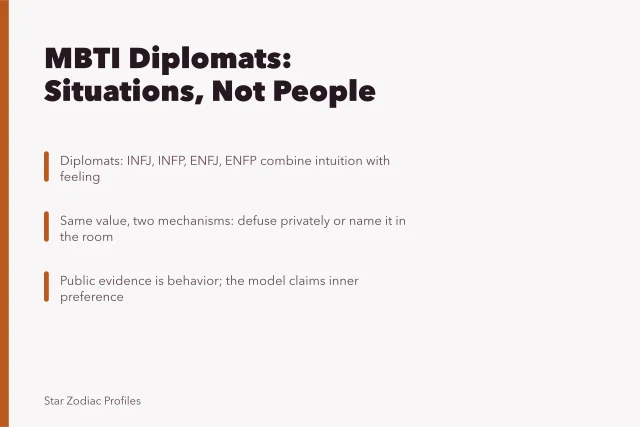
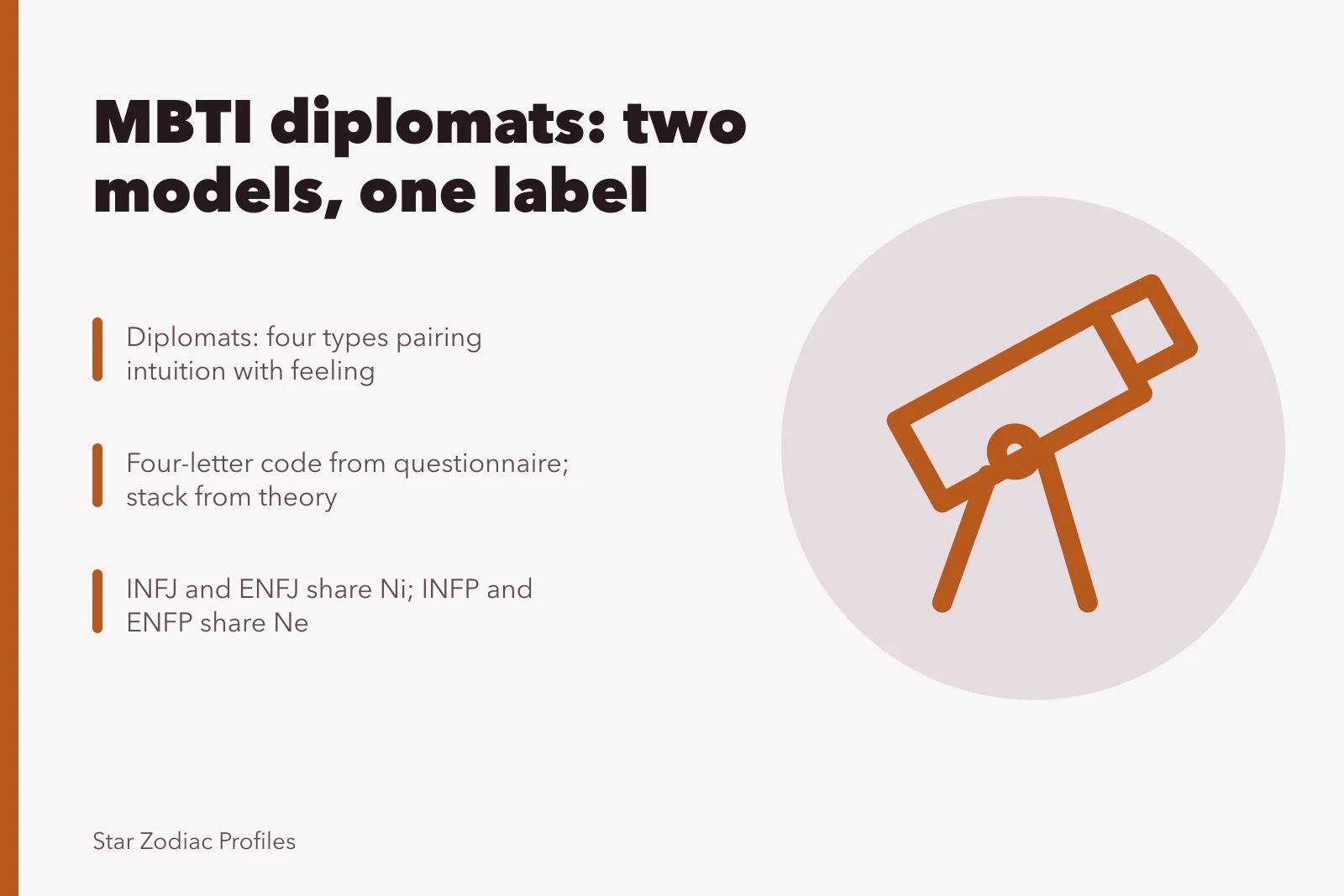
- "Diplomats" names the four types that pair intuition with feeling. In the function model they split into two pairs that share no function in the same position.
- The four-letter code and the function stack are different claims with different origins. The code comes from a questionnaire; the stack comes from a theory built on top of it.
- Both claims are about inner preference, established by self-report and confirmed by the respondent. Neither can be read off a public figure's behavior, and the function model makes that harder rather than easier.
Three layers, three sources
| Layer | Where it comes from | What it claims |
|---|---|---|
| The eight functions | Jung's 1921 theory of psychological types | People differ in a preferred way of perceiving (sensing or intuition) and of judging (thinking or feeling), each turned inward or outward |
| The four-letter code | The questionnaire built on that theory in the 1940s and after | A respondent can be sorted on four pairs, with the fourth letter (J or P) added to indicate which function faces outward |
| The function stack | Type dynamics, elaborated by later writers | Each of the sixteen codes corresponds to a fixed ordering of four functions: dominant, auxiliary, tertiary, inferior |
The layers are not equally supported, even inside the tradition. The questionnaire has been studied for repeatability and its publishers have data on it. The function stack is a theoretical extension: an argument about what the letters imply, not something the questionnaire measures directly.
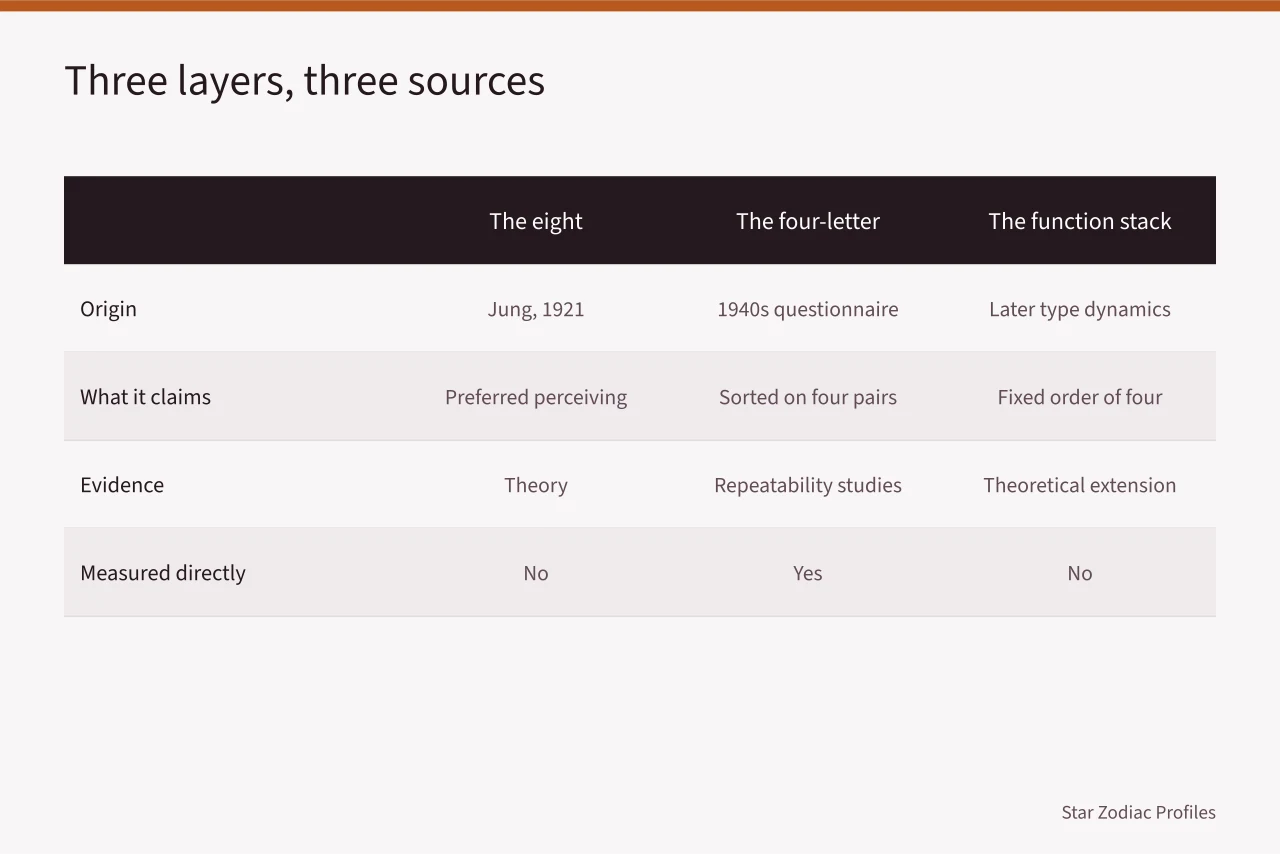
Someone who says "as an Fi-dominant" is speaking the language of the third layer as though it were a test result, and it is not. A source that does not say which layer it is quoting cannot be checked, the same difficulty as a sign description that never names its ruler.
The four types in the function model
| Type | Stack | The description in brief |
|---|---|---|
| INFJ | Ni, Fe, Ti, Se | A private sense of where things are heading, expressed through attention to people |
| INFP | Fi, Ne, Si, Te | A private set of values, explored through possibilities |
| ENFJ | Fe, Ni, Se, Ti | Attention to people and the group's mood, guided by a long view |
| ENFP | Ne, Fi, Te, Si | Possibilities pursued outward, anchored to private values |
Read the stacks and the group splits in two: INFJ and ENFJ share Ni and Fe in their top two, while INFP and ENFP share Fi and Ne.
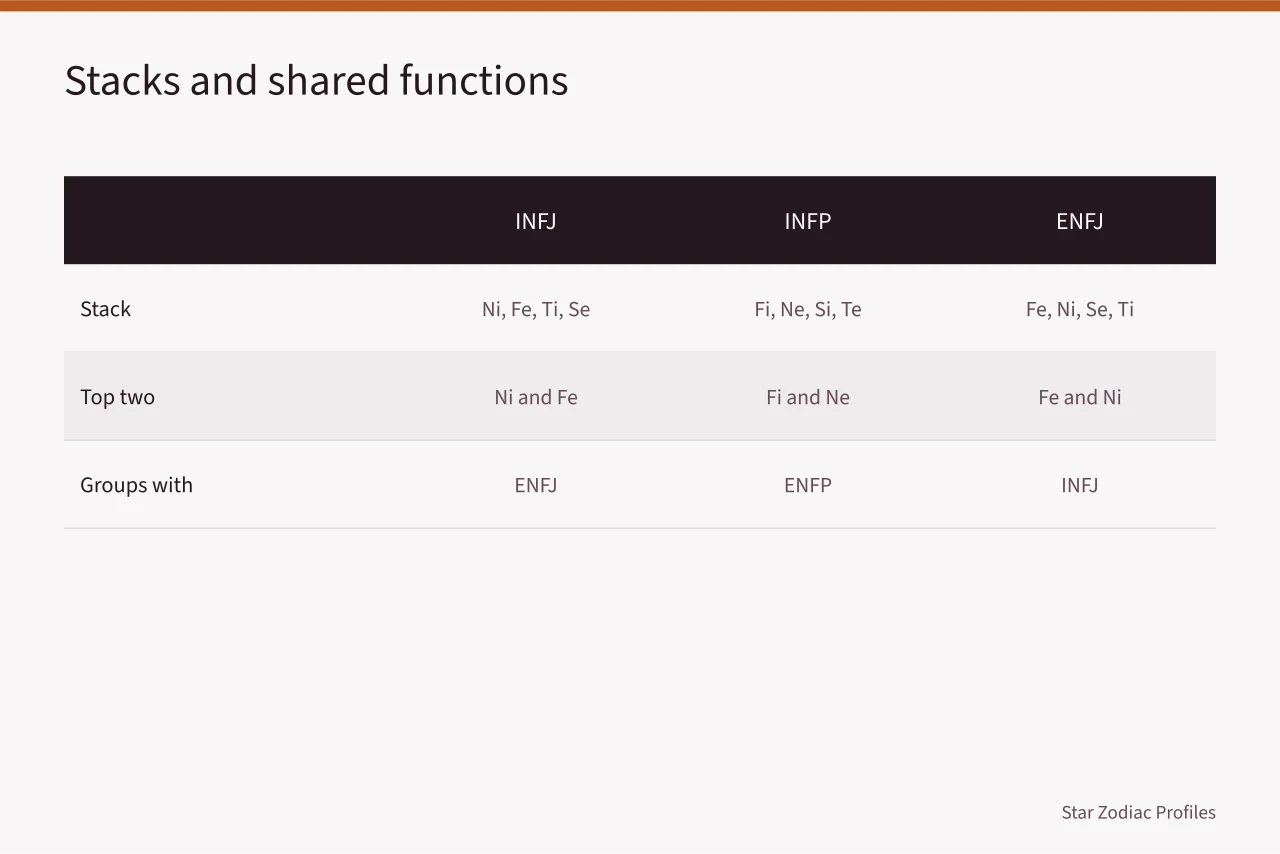
INFJ and INFP share three letters but no function in the same position. In the model, INFJ sits closer to ENFJ than to INFP.
Nicknames group by letters; theory groups by functions, so the two groupings cut across each other.
This matters because it shows what kind of thing the code is. Four letters look like four settings on four dials. In the function model they are a single pattern, and changing one letter reorders the whole stack.
Why the function model makes third-party typing harder
A common assumption is that the function model gives an observer more to work with: eight functions to spot instead of four letters. It does the opposite.
The questionnaire's claim is at least about something a person can report: which of two options they prefer. The function model's claim is about the order in which mental processes operate, including a dominant function the theory says is so habitual the person may not notice it, and an inferior function it says is largely unconscious.
No observer has access to that. The person barely does, which is why the model's own guidance treats the stack as something to explore over time rather than to read off a result.
With a public figure, the gap widens again: visible behavior is edited for an audience.
The same public warmth could be Fe in the dominant position, or Fi expressed carefully. It could be a thinking type who has learned to work a room, or a professional manner. The model offers no test to separate these from outside, since it never claimed to apply from outside.
The notes on the intuitive-thinking group set out the best-fit step that makes this explicit: the type is confirmed by the respondent, and that step cannot be performed on someone else's behalf.
The free tests that borrow the letters
Much of what circulates about these four types comes from free online questionnaires. They use the sixteen four-letter codes, add a fifth letter for a trait like assertiveness, and attach illustrated character profiles.
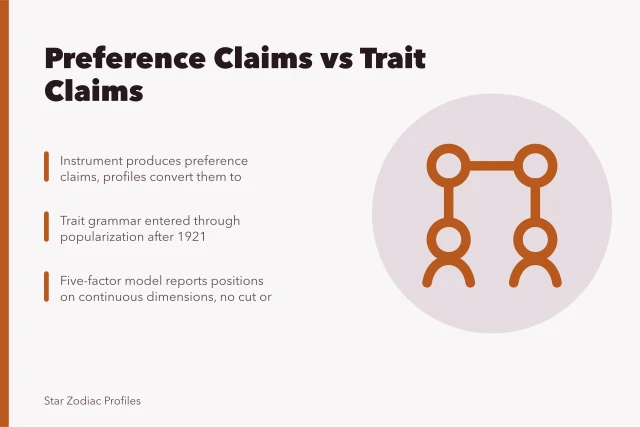
They are not the original instrument, and several say so in their small print. Their items typically measure continuous traits of the kind academic personality research uses, then convert scores into a four-letter code because the code is familiar.
Two consequences follow. First, a type from one of these tests and a type from the original instrument are not the same measurement, even when the letters match.
Second, the character profiles these tests attach are written to be recognized, and most people who read them attentively accept broad descriptions of character. A profile that feels accurate is doing what profiles do; it is not confirming anything.
None of this makes the free tests worthless. They give people a vocabulary and a reason to reflect. It does mean that a public figure "typed" from such a profile has been matched to an illustration, which is what a list of names under a sign also amounts to.
What the group's descriptions are actually about
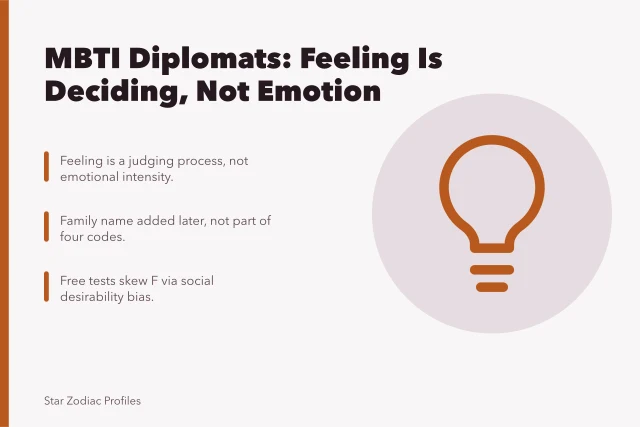
Strip away the stereotype and the four descriptions are about two things: a preference for reading situations in terms of patterns and possibilities, and a preference for deciding in terms of values and effects on people. Neither is a measure of warmth, empathy or idealism, although the popular descriptions are full of those words.
A feeling preference describes what a person weighs when deciding, not how much they care; a thinking type is not short of compassion, and a feeling type is not short of logic. The distinction is the same one the grid behind the twelve signs forces between a symbol and a person.
The model's own descriptions are more balanced than the stereotypes. Each names the cost of the preference: criticism read as a verdict on the self, unfinished work while every version stays live, and reading the room until one's own position disappears.
A description without those costs is a compliment. Compliments are what most public-figure typing is made of.
Common questions
Is the function stack part of the official instrument?
The four-letter code is what the questionnaire reports. The function ordering is a theoretical model that the instrument's publishers describe and teach, but it is an interpretation of the code rather than a separate measurement.
Can two people with the same letters have different stacks?
Not within the standard model; each code maps to one ordering. Different writers do disagree about the details of the model, particularly the lower positions.
Why do INFJ and INFP feel so different in the descriptions?
Because in the function model they share no function in the same position. The letters suggest near neighbors; the theory says otherwise.
Are the diplomat types the empathetic ones?
The model does not rank types on empathy or on anything else. A feeling preference is a way of deciding, and every type description includes what the preference costs.
How does this differ from the sensing-judging group?
Different functions in the top positions, and, in the group descriptions, an emphasis on possibility and values rather than on precedent and reliability. The mechanics, self-report and the best-fit decision, are the same for every group.
In this guide
- MBTI diplomats traits from the ground upMBTI diplomats traits are written as trait claims when the instrument supports only preference claims: how to spot the swap and audit a profile.
- Where MBTI diplomat claims run out, mapped through four invented scenariosMBTI diplomats examples should be situations, not people: four invented cases showing where the model claims something and where the claim runs out.
- Clearing up MBTI diplomats misconceptionsMBTI diplomats misconceptions start with one word: feeling names a way of deciding, not a level of emotion. Eleven slips and the repair for each.