Maintenance
Part of Aries celebrities: the record, kept honest
Aries celebrities misconceptions corrected
Aries celebrities misconceptions are true statements about the scheme moved one step too far: eight of them, and exactly where each gap opened.
Most misconceptions about the first sign are not errors about astrology. They are correct statements about the scheme, moved one step too far: from symbol to person, or from rule to fact about the sky.
This page takes the most common ones and does the same thing to each. It states the claim, states what the tradition holds, and traces where the gap opened.
What to take away
- Nearly every popular claim about the sign is a true statement about a position in a scheme, misread as a statement about people born in a month.
- The tradition itself supplies most of the corrections. Its own texts are more conditional, more double-sided and more dependent on a full chart than the sun-sign versions.
- Lists of famous people under the sign are a misconception in their own right: they look like evidence for the descriptions and are not.
"Aries is the angry sign"
What the tradition holds. The sign is assigned to Mars, which the classical scheme treats as the planet of heat, iron, contest and effort. Anger is one thing Mars was said to signify; so were courage, surgery and the forge.
Where the gap opened. A planet's list of significations was compressed to a single emotion, then attached to everyone with the sun in the sign, dropping the counterweights the trait derivation sets out. The scheme reads Mars's expression from where Mars sits in a chart and what it contacts. A sun in Aries with Mars in Pisces is not read as the paragraph reads.
"Aries is first because it is the strongest"
What the tradition holds. The sign is first because tropical practice measures the zodiac from the March equinox, and the thirty degrees following it carry the sign's name. First is a position, and the scheme does not rank the twelve.
Where the gap opened. Ordinal became superlative. The tradition attaches "beginnings" to the sign because of where it sits, and beginnings became leadership, and leadership became a claim of superiority the scheme never made. The notes on why the sign comes first trace the decision that put it there.
"Aries runs between two fixed dates"
What the tradition holds. The sign begins when the sun crosses the equinox point and ends thirty degrees later. Because the year and the sun's motion do not divide evenly, the boundary moves by about a day between years.
Where the gap opened. Printed tables need fixed dates, so they round. Anyone born near a boundary has been assigned a sign by the rounding, and a chart calculated for their date, time and place can disagree with the table.
"Fire signs are extroverts"
What the tradition holds. The elements are a classification of symbolic style: fire as expenditure and visibility, earth as substance, air as exchange, water as feeling. They predate the modern vocabulary of introversion by many centuries and were never a measure of sociability.
Where the gap opened. A twentieth-century psychological term was mapped onto a classical one because both sounded like "outward". The tradition's own remark about fire is closer to "spends rather than stores", which is not a claim about how anyone behaves at a party.
"Aries and Libra can't get along"
What the tradition holds. The two signs are opposite, sharing the cardinal mode across compatible elements. The tradition reads the opposition as the two ends of one axis, self and other, and describes the ends as complementary.
Where the gap opened. Opposition was read in its everyday sense. In the scheme it is the mirror, not the enemy, and the older texts pair the two rulers, Mars and Venus, as the image of attraction. The outline of the six signs from Libra onward sets out the other end of the axis.
"Your sign changed because the constellations moved"
What the tradition holds. Tropical practice defines the sign by the equinox, not by the constellation. The constellations have drifted against the equinox point over centuries, a motion astronomers call axial precession, and the sign's boundaries are unaffected because they were never tied to the stars.
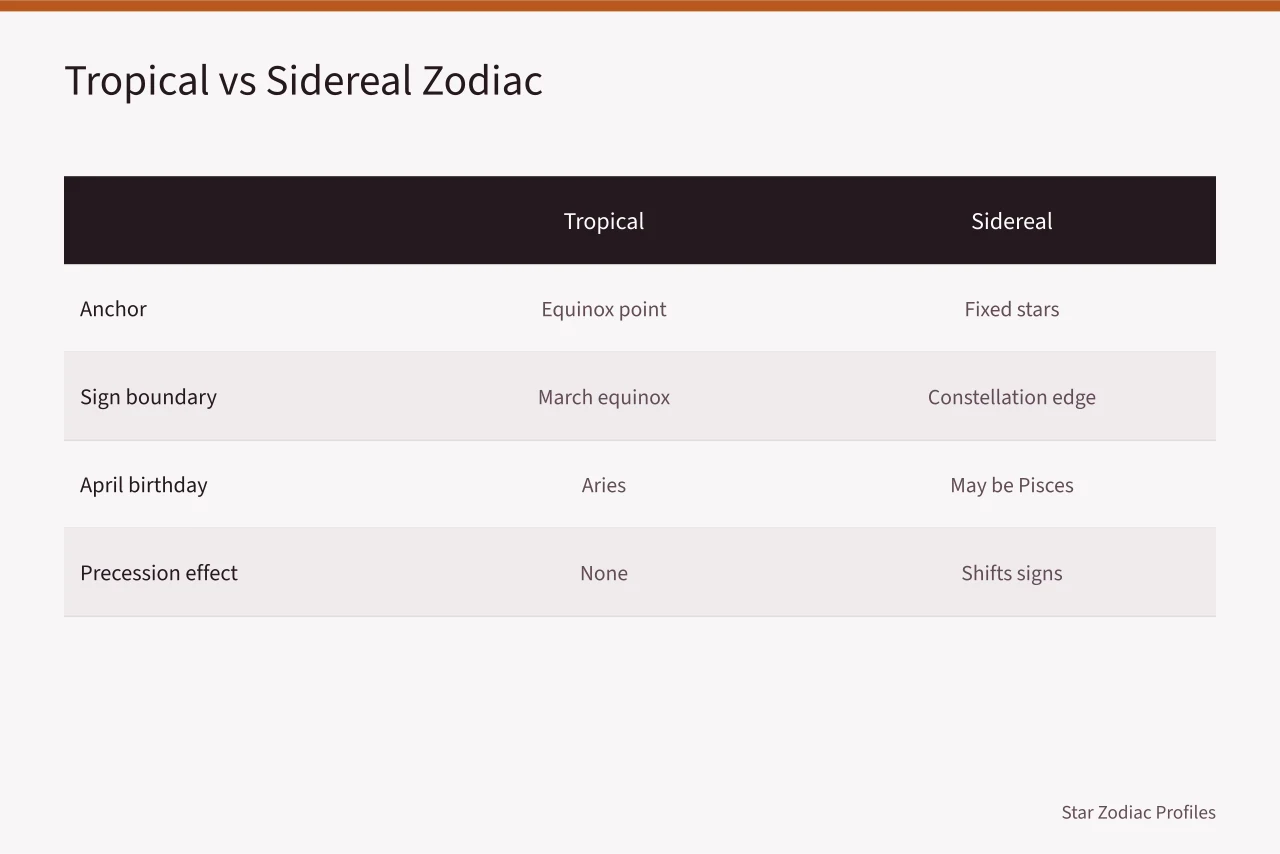
Where the gap opened. Two different zodiacs were confused. Sidereal practice does tie signs to the stars, and in that system a birthday in early April can fall in the previous sign. Neither system is a correction of the other; they are answers to different questions.
"The description fits me, so it must be right"
What the tradition holds. The sun sign is one factor among many and is treated as a sketch. A description written for a twelfth of the population is necessarily broad.
Where the gap opened. Broad descriptions of character are accepted by most people who read them attentively. That effect has a long research history under the name of the Barnum effect, and it is not a finding about astrology in particular; it is a finding about how sentences about character are read. The tradition's own method, a full chart and a conversation, is the thing it offers instead of the paragraph.
"Famous Aries prove the sign's traits"
What the tradition holds. Nothing about any named person from a birthday. A practitioner would want a birth time and a conversation before saying anything, and would not publish a reading of someone they had never met.
Where the gap opened. A hook became an argument. Names are concrete and symbols are not, so the celebrity roundup became the standard format for sun-sign writing, and the format began to look like evidence. It is not: birthdays are spread across the year, every field has people from every month, and any sign can be stocked with recognizable names. The list demonstrates that people are born all year round.
The pattern behind all of them
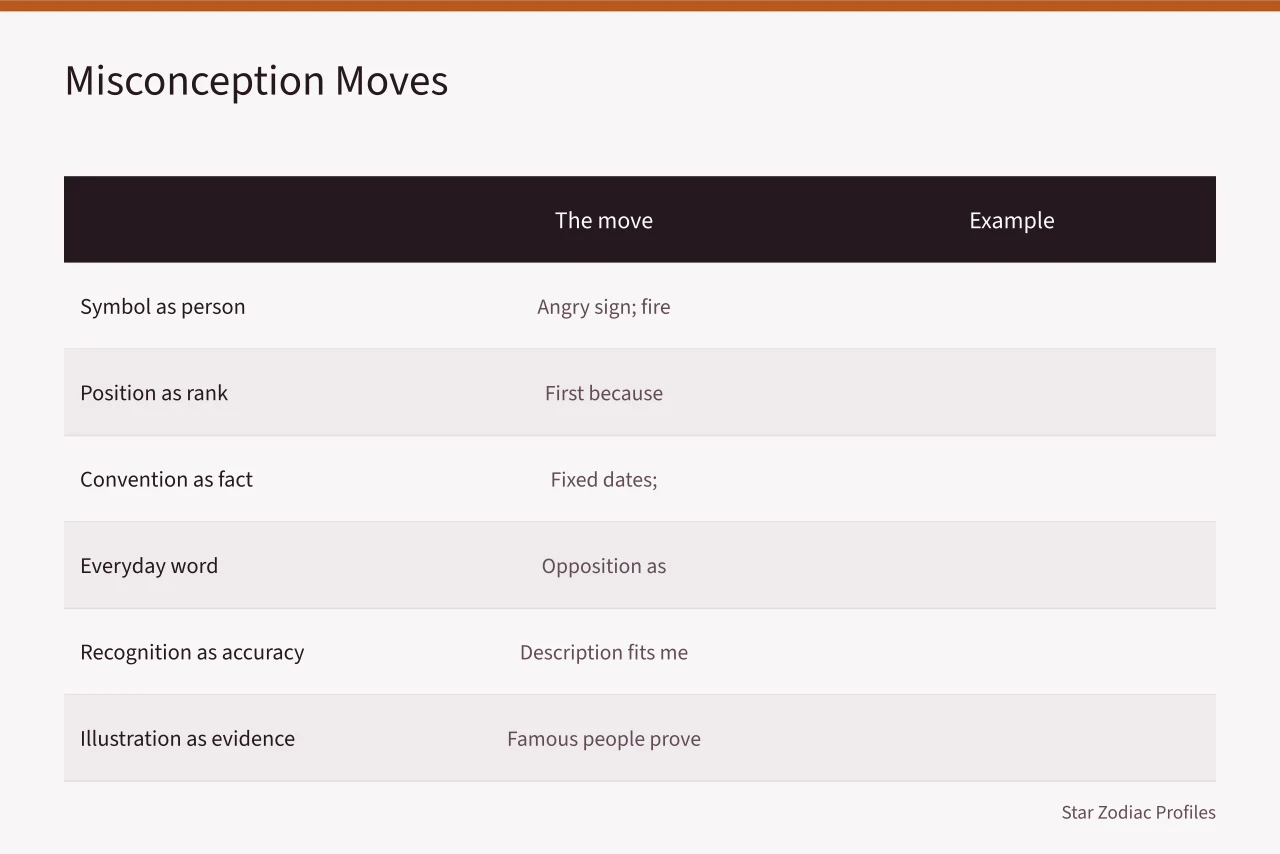
| The move | An example above |
|---|---|
| Symbol read as person | The angry sign; fire signs are extroverts |
| Position read as rank | First because strongest |
| Convention read as fact | Fixed dates; the constellations moved |
| Everyday word read for a technical one | Opposition as hostility |
| Recognition read as accuracy | The description fits me |
| Illustration read as evidence | Famous people prove the traits |
Every row is a true statement about the scheme, moved one step past what the scheme supports.
Corrections are internal to the tradition, so this page is not a debunking. It is the tradition's own account of itself, set beside the popular one. The grid of elements and modes is the scheme those corrections are checked against.
Common questions
Is the sun sign useless, then?
No. It fixes the sun's position in the band and gives a practitioner a first note. What it cannot do is carry the weight a column puts on it.
Are the older texts kinder or harsher about the sign?
Harsher, and more conditional. They were written for readers who would go on to cast a chart, so they had no need to be pleasant, and they qualify every keyword with the rest of the scheme.
If the dates shift, how do I know my sign?
A chart calculated for your date, time and place. Only a birthday near a boundary is affected, and for that case the table cannot settle it.
Why is this page not a debunking?
Because every correction on it comes from inside the tradition. The scheme has an account of what a sun sign is and is not, and the popular version departs from that account, not from anything outside it.