Maintenance
Part of MBTI analysts: the one typing step no outside observer can perform
The honest guide to MBTI analysts traits
MBTI analysts traits come from a cut applied to four continuous tallies: what the letters hide, what a clarity figure means, and how to read a profile.
Every published description of INTJ, INTP, ENTJ and ENTP is written in the language of kinds. This type does, this type prefers, this type struggles with.
The scoring underneath is not written in the language of kinds at all. It produces numbers on four scales, applies a cut, and almost everything that goes wrong with trait descriptions for this group goes wrong at that seam.
What to take away
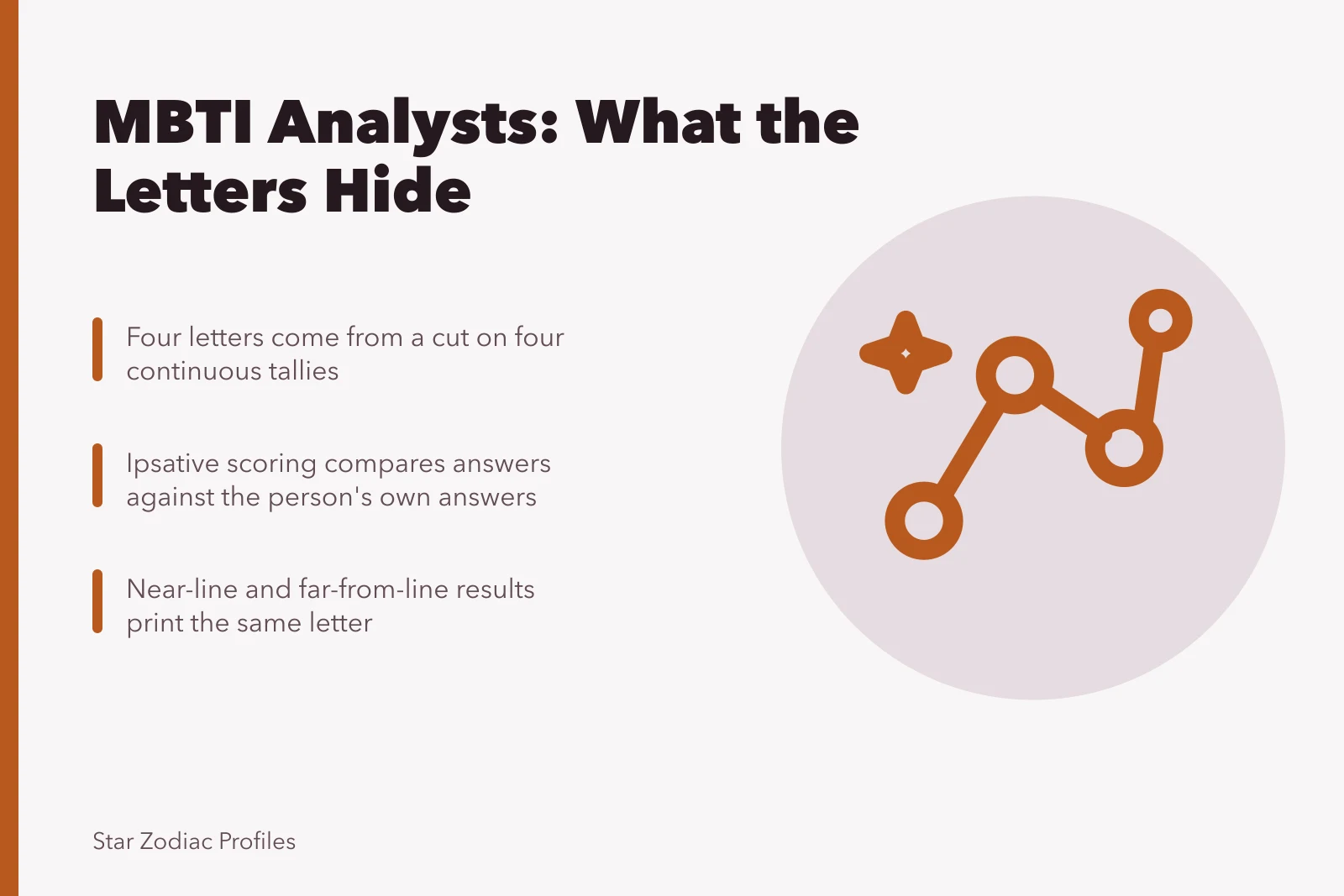
- The four letters are the output of a cut applied to four continuous tallies. A code is a summary of where someone fell relative to a line, not a category found in nature.
- A result near the line and a result far from it print the same letter. The reported clarity of a preference is not a measure of how strongly it is held, and it is certainly not a measure of ability.
- Trait descriptions inherit the vocabulary of kinds from the code and drop the qualification that came with the number. That is where a preference turns into a personality claim.
What the scoring actually does
Items are forced choice: two options, each intended to be equally acceptable, and the respondent picks one. Answers accumulate on four separate tallies, one per pair. When the questionnaire ends, each tally sits somewhere on its scale, and the reported letter is whichever side of the midpoint it landed on.
This is ipsative scoring: a person's answers are compared against their own other answers, not a population. The result, rarely noticed, tells you the relative ordering inside one person, not how that person compares with anyone else.
Two people can report the same code while differing from each other more than either differs from someone with a different code.
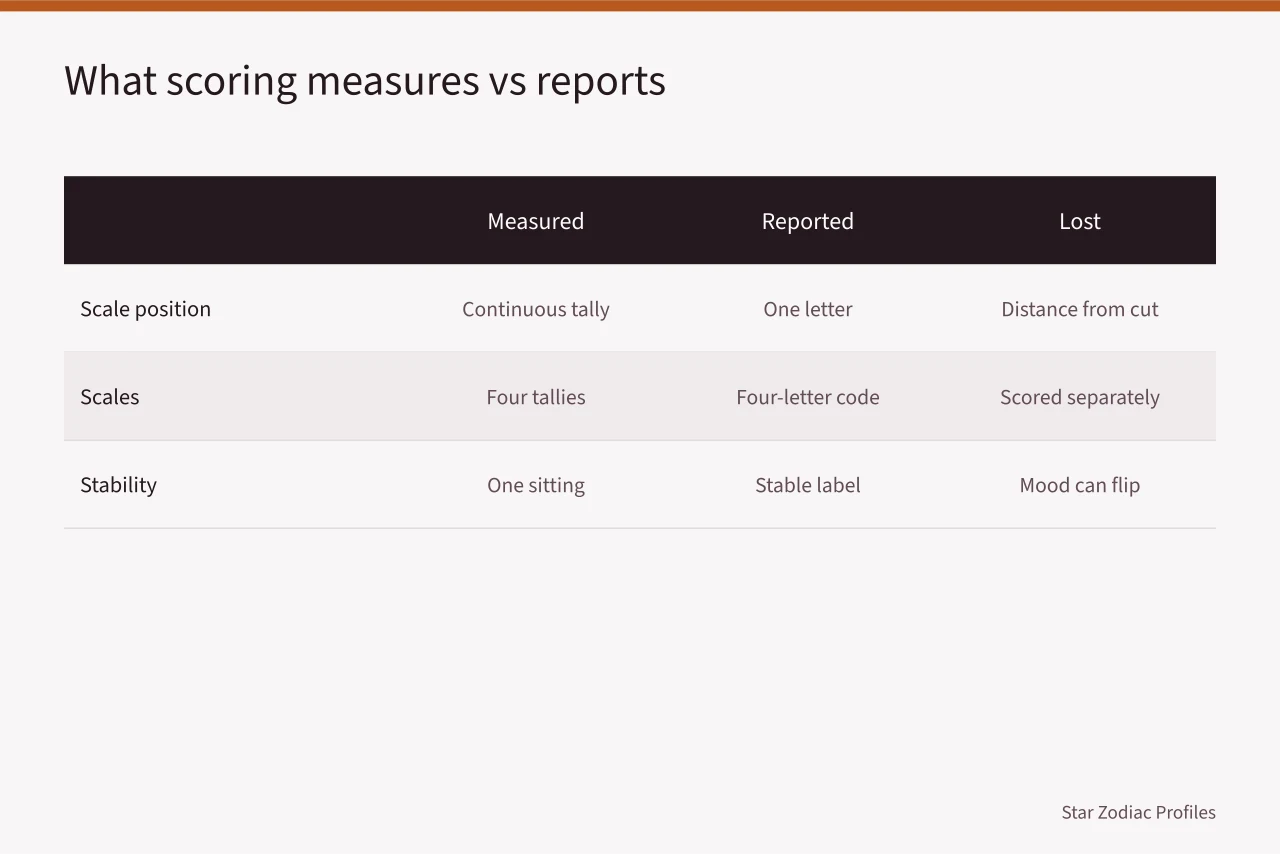
| What is measured | What is reported | What is lost in between |
|---|---|---|
| A tally on a continuous scale | One letter per pair | How far from the cut the tally sat |
| Four independent tallies | A four-letter code | That the four scales were scored separately |
| One sitting, one mood, one set of answers | A stable-sounding label | That a second sitting can land on the other side of a line |
The line, and the people sitting on it
Consider two hypothetical respondents, invented to make the arithmetic visible. One answers nearly every thinking-versus-feeling item the same way. The other splits them almost evenly, ending one item on the thinking side.
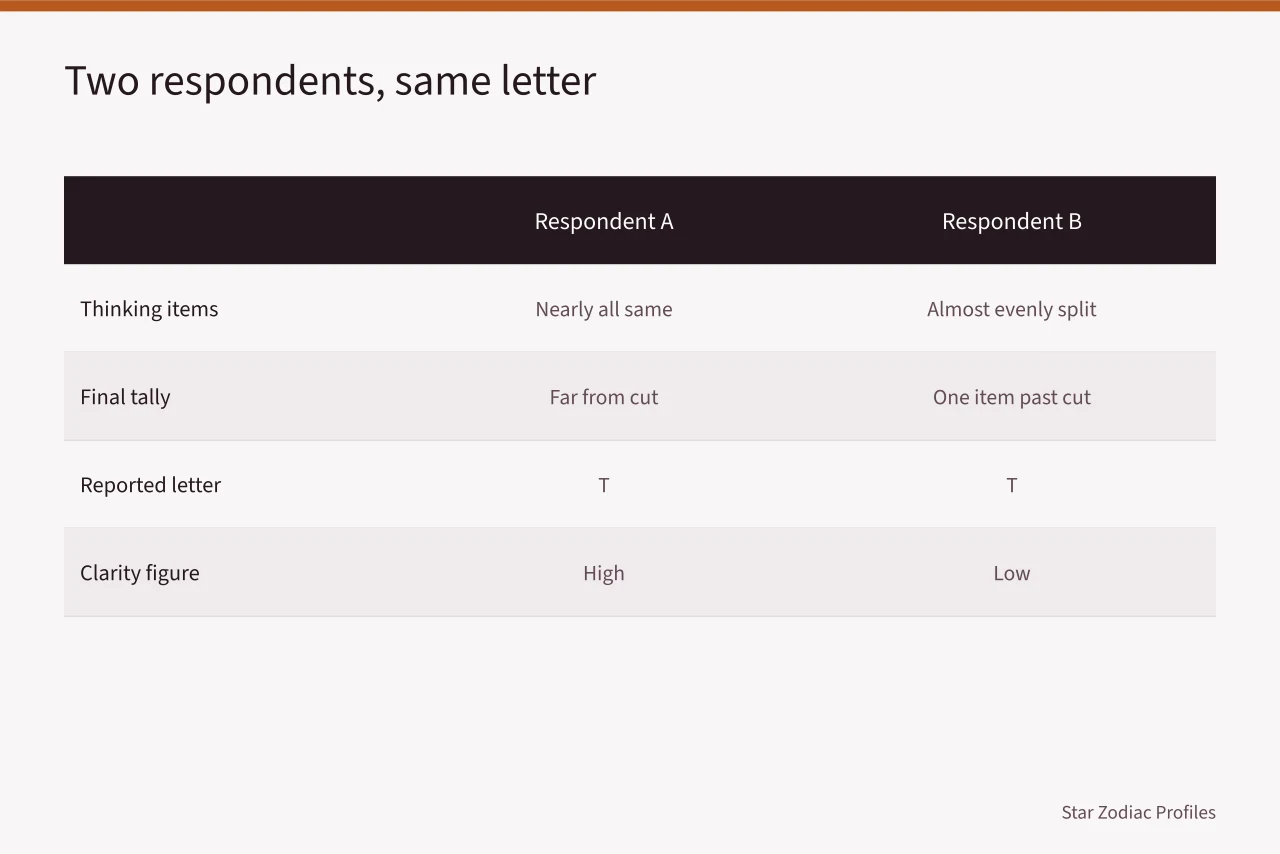
Both print a T. Both read a description written for people who decide by impersonal criteria. One will find it a poor fit for reasons the code cannot express.
The instrument's own documentation reports a clarity figure alongside the letter for exactly this reason, and popular versions of the test almost always drop it. The clarity figure answers the question "how consistently did you answer this pair", and nothing more. It is not a strength. It is not a score.
A person with high clarity on thinking is not better at thinking than a person with low clarity. A right-handed person who never uses their left hand is not a better writer than one who is close to ambidextrous.
Why continuous scoring makes the group descriptions read strangely
The four analyst descriptions come from the ends of the scales, where wording can be vivid. If all four tallies fall near the midpoint, the code is built from four coin flips, and the description discusses four strong preferences.
It will feel partly right and partly foreign. People conclude they got the wrong type, not that the reporting format flattened four measurements into four letters.
Models that report numbers instead of letters avoid this by construction. The five-factor approach gives a position on each dimension rather than a side, so a middling result is reported as middling.
That is the substantive difference between the two traditions: output format, not subject matter, and neither measures what the other cannot see.
Reading a trait paragraph for this group
Three habits make the exercise honest.
Translate every "is" back into a "tends to prefer". A description that says the type is strategic is reporting that people who answered a certain way tend to describe themselves in that vocabulary. That is a much weaker claim, and it is the claim the instrument supports.
Look for the cost. Every serious description pairs a preference with what it makes harder: long-range attention with neglect of the immediate, internal frameworks with slowness to commit. A paragraph with no costs in it has been rewritten as flattery, which is the same distortion that produces the public-figure lists.
Notice which letter is doing the work. In this group the descriptions are usually driven by the last letter, because J and P change how the other three are presented. Read two descriptions from the group side by side and the split becomes obvious, in the way the parent page sets out for the four codes together.
What a trait list cannot do
It cannot tell you what someone will do. A preference is about where attention goes first and how a decision is weighed, not about the outcome. Two people with the same code, working the same problem, can reach opposite conclusions and both be behaving exactly as their description predicts, because the description is about the route rather than the destination.
It also cannot be applied to a third party. The tallies come from self-report, and there is no observational substitute for them. That constraint applies with equal force to every group in the system, including the group described through feeling and intuition, and to the nine-point model set out in the notes on that system.
Common questions
If the scores are continuous, why report letters at all?
Because the model treats preference as a genuine either-or, in the way handedness is, and because a four-letter code is easy to remember and discuss. The cost of that choice is everything on this page.
Does a low clarity result mean the type is wrong?
It means the questionnaire did not separate that pair clearly for you. The model's answer is to read both descriptions and decide, which is the step that settles a type in any case.
Can two sittings give different codes?
Yes, most often on a pair where the tally sat near the midpoint. That is a property of cutting a continuum, not a defect unique to this instrument.
Are the analyst descriptions harsher or kinder than the others?
The published versions are balanced across all sixteen. The circulating versions are kinder to this group, because the vocabulary of intuition and thinking reads as praise in ordinary English.
Is there a version of this that reports numbers?
Yes, and the five-factor tradition is the usual example. It answers a different question in a different format and makes no claim to sort people into kinds.