Industry
MBTI analysts: the one typing step no outside observer can perform
The four analyst types get assigned to public figures on sight. The procedure itself ends with a step only the person being typed can carry out.
Four of the sixteen types pair intuition with thinking: INTJ, INTP, ENTJ, ENTP. Writers hand those four codes to public figures constantly. The typing happens at a distance, from interviews and secondhand description.
That is a label, not a type. Here is where the difference sits.
What to take away
- "Analyst" is a nickname for the four types that combine N and T. It is not a category in the instrument.
- The administration has three steps. The third one, the respondent's own best-fit decision, is the type. Steps one and two only feed it.
- A preference is not a level of ability. A thinking preference says how someone tends to decide, not how well.
- Behavior is the only evidence an observer has, and a public figure's behavior is filtered before anyone sees it.
- Publishers of the instrument advise against typing other people. The advice follows from the procedure, not from manners.
The four codes and their stacks
The N means the description attends first to patterns rather than to concrete detail. The T means decisions are described as weighed by impersonal criteria rather than by their effect on people. The remaining two letters set the order in which the functions are said to run.
| Type | Function order the model assigns | What the description emphasizes |
|---|
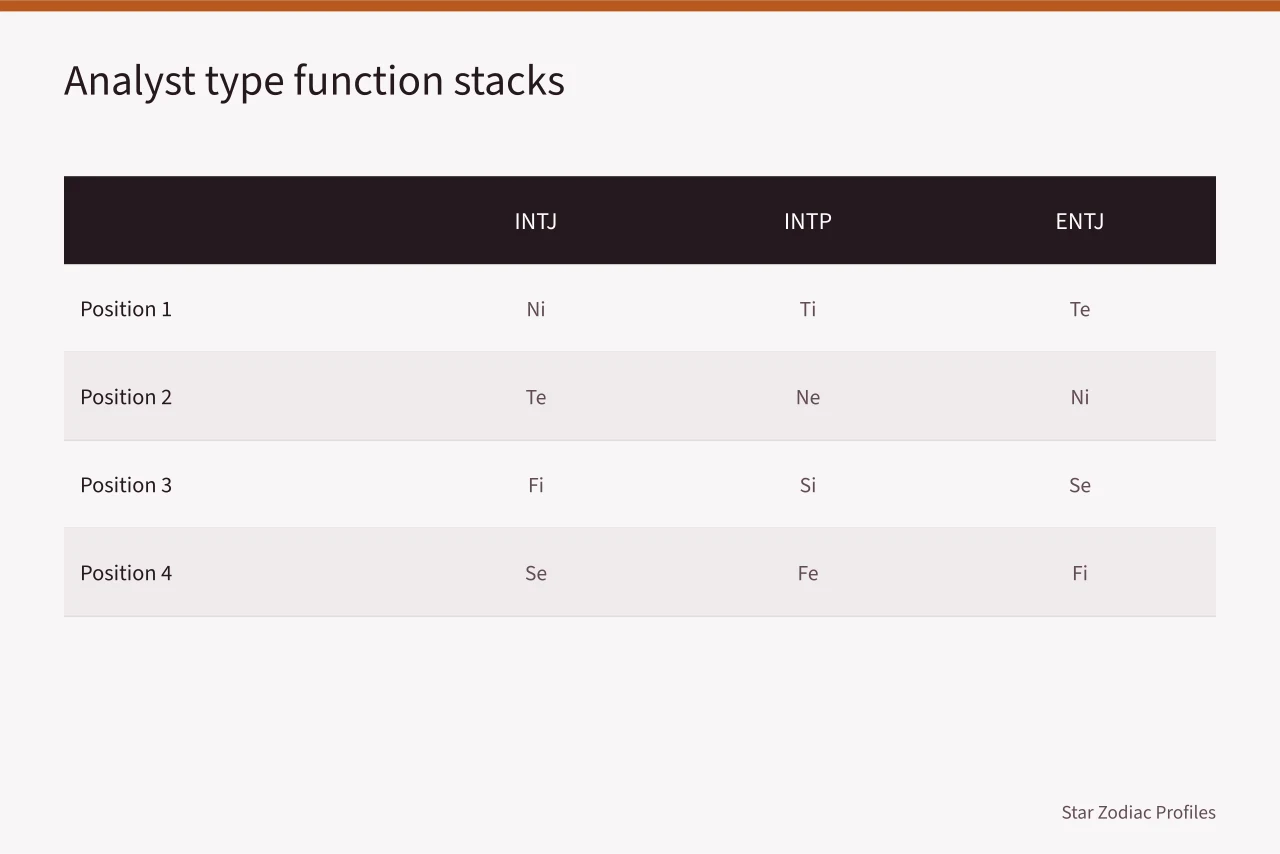
INTJ and INTP share three letters and share no function in the same position. The codes look symmetrical. The stacks are not.
The usual misreading treats the four letters as four separate traits, each scored on its own. The model treats them as one pattern in which the fourth letter changes what the first three mean.
Three steps, and only one of them is the type
- The questionnaire. Forced-choice items in a self-report inventory, each item offering two options the model treats as equally acceptable. The answers produce a reported type and a clarity score for each of the four pairs.
- The explanation. An administrator walks through what the pairs mean and what they do not: thinking is not intelligence, introversion is not shyness, judging is not judgmental.
- The best-fit decision. The respondent reads the description of the reported type and of the neighboring types, then picks the one that fits. Where the score and the choice disagree, the choice wins.
Step three exists because any questionnaire can be answered carelessly. It makes the respondent the final authority on their own preferences, which matches what the model claims to measure: an inner preference only that person can inspect.
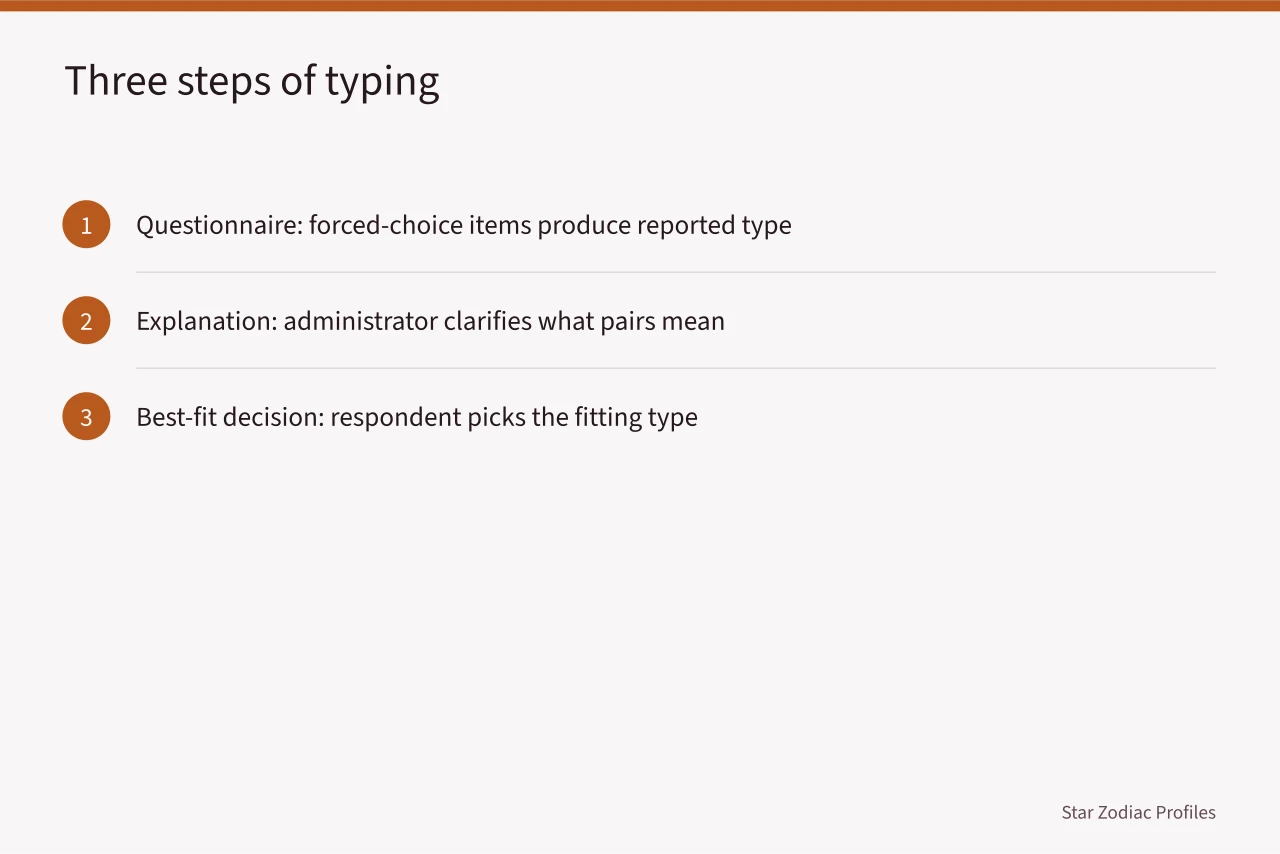
It also makes third-party typing impossible on the model's own terms. An outsider can guess at step one. Nobody can perform step three for someone else, because the point of step three is that it happens from the inside.
What an observer actually has
Behavior, and with a public figure, a curated slice of it: interviews shaped by a publicist, work shaped by a market, a manner shaped by years of feedback about what plays well.
Take the group's signature trait as usually described, a habit of thinking in systems. It could be a Ti or Te preference. It could be a sensing type trained by a job that rewards systematic thought. It could be a feeling type whose values include rigor. It could be an act.
From outside, all four look identical, and the model supplies no rule for separating them because it never claimed behavior was the evidence.
The same holds letter by letter. A guarded figure reads as an introvert and may only be media-trained. One who holds forth reads as an extravert and may be performing.
Where "N plus T means clever" came from
The stereotype is old, the model does not support it, and the instrument's publishers have argued against it for decades. It comes from the vocabulary. "Intuition" sounds like insight. "Thinking" sounds like being good at it. The published descriptions of these four types lean on words like strategic and analytical.
The model claims a preference in the sense of handedness, the sense the 1921 book behind it gave the term.
A thinking preference means that, given a choice, a person tends to decide by impersonal criteria. It says nothing about how well they decide.
A feeling preference is not a deficit of logic. A sensing preference is not a deficit of imagination.
Every published type description in the system lists the costs of the preference next to its uses, and the analyst descriptions are no exception. The same pages that describe long-range vision describe the neglect of what is in front of you.
The stereotype drives third-party typing, which is why it matters here. Someone assigns an NT code to a public figure as a compliment, and the compliment is the actual assertion. The type is the vehicle.
What the instrument is for
Its own literature agrees on the purpose: self-understanding, and a neutral language for groups. It lets one person say they want the proposal in writing beforehand, and another say they want to talk it through, without either being wrong.
Publishers advise against using it to select or screen people, and against telling anyone their type. The general literature on personality testing extends that caution to the whole family of instruments.
Inside those limits it does a real job. Outside them it becomes a way of labeling people who never took the questionnaire and never made the best-fit choice.
The design was built to prevent exactly that. The same argument applies with more force to public figures, and the notes on why an astrology page names nobody make the parallel case for birth charts.
Common questions
Can a trained administrator type someone from an interview?
Not under the model's own procedure, which ends with the respondent's decision. An administrator can form a hypothesis. Only the person can confirm it.
If someone's behavior is very consistent, doesn't that show their type?
It shows consistent behavior. Several types, and several non-type explanations, can produce the same behavior for different reasons, and the model locates type in the reasons. The zodiac equivalent draws the same line between a claim about a symbol and a claim about a person.
Are the analyst types rare?
Published distributions vary by sample and by country, and the model does not treat rarity as meaningful. A type is a preference pattern, not a rank.
Why do online lists agree about which public figures are which type?
Because they copy each other, and because the stereotypes are shared. Agreement among observers using the same stereotype is evidence of nothing about the person, which is also the flaw in a list of well-known names under a sign.
How does this differ from the nine-type system?
That system describes what drives a person rather than how they prefer to perceive and decide, and it carries the same self-report requirement for the same reason. The second half of the zodiac is a third scheme with the same limit.
In this guide
- Notes on famous MBTI analysts from the fieldFamous MBTI analysts who type in public, from Heidi Priebe to Susan Storm, and what each one actually sells you in books, courses, and community.
- The honest guide to MBTI analysts traitsMBTI analysts traits come from a cut applied to four continuous tallies: what the letters hide, what a clarity figure means, and how to read a profile.
- 5 things nobody tells you about MBTI analysts compatibilityThe 256-cell pairing grid is a third-party invention, and the four analyst codes get read through it hardest. Here is what survives a check.
- MBTI analysts quiz: what to keep and what to dropMBTI analysts quiz results come from free questionnaires missing two steps: what the answer format changes, and how to turn a code into a decision.
- MBTI analysts misconceptions and where they come fromMBTI analysts misconceptions divide into vocabulary, structure and status: eleven common slips, where each one enters, and the repair for each one.