Reviews
Part of MBTI analysts: the one typing step no outside observer can perform
Notes on famous MBTI analysts from the field
Famous MBTI analysts who type in public, from Heidi Priebe to Susan Storm, and what each one actually sells you in books, courses, and community.
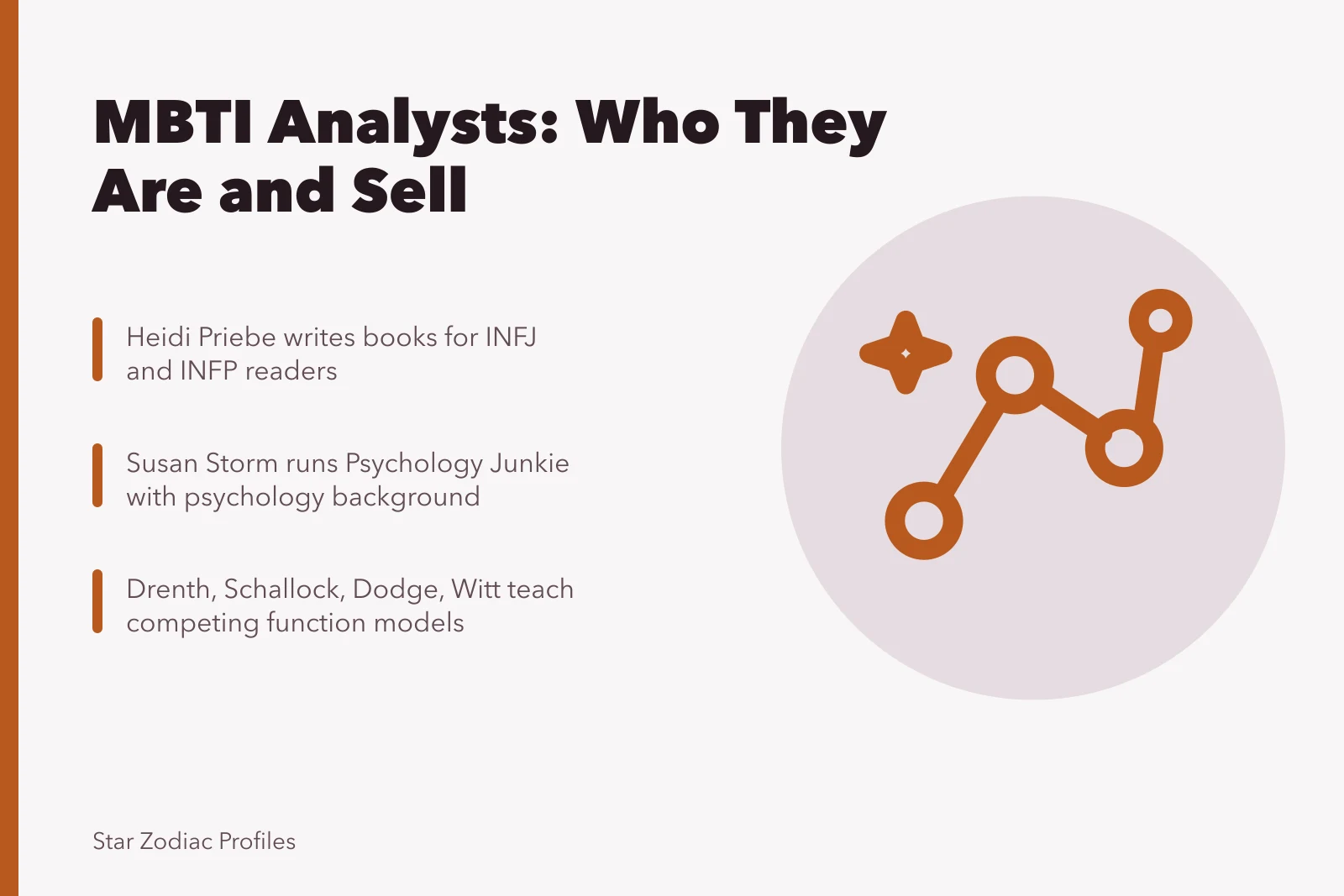
These notes on famous MBTI analysts from the field name the working roster. Heidi Priebe, Susan Storm, A.J. Drenth and Elaine Schallock publish under their own bylines; Antonia Dodge and Joel Mark Witt run Personality Hacker.
Each of them writes, coaches or researches in the open, and several hold a graduate degree in psychology. What separates them from the twenty-five-name celebrity lists is that they type themselves, in public, and show the reasoning.
What to take away
- The working roster runs to a handful of names: Heidi Priebe, Susan Storm, A.J. Drenth, Elaine Schallock, Antonia Dodge and Joel Mark Witt.
- Each one publishes under a real byline, and several hold a graduate degree in psychology or a related field.
- None of them will type a celebrity for you. The credible ones type the person in front of them, or themselves.
- Paid work in this field is coaching, courses and books, not certificates. There is no licensing body for MBTI practitioners.
- A named analyst is checkable. You can read their archive, see their method and decide whether it holds up.
Who the analysts actually are
Heidi Priebe writes about the types, attachment and emotional development, mostly for an INFJ and INFP readership. She wrote The Comprehensive ENFP Survival Guide and How You'll Do Everything Based On Your Personality Type, and she publishes essays and videos rather than quizzes.
Her work suits readers who want the feeling side of type explained without mysticism.
Susan Storm holds a psychology background and runs the Psychology Junkie site, where she writes type profiles and answers reader questions. She wrote The INFJ: Understanding the Mystic. She is one of the few analysts who cites research next to the type descriptions, and her material suits readers who want a bridge between the instrument and academic personality psychology.
A.J. Drenth founded Personality Junkie and wrote My True Type, The INTP and The INTJ. Much of the current INTP and INTJ internet vocabulary comes from those books. He works from the cognitive-function model rather than the four letters, so his writing suits readers who want the stack explained.
Elaine Schallock writes on type and development, with an emphasis on the introverted functions and how they show up in real behavior. She is a frequent collaborator with Drenth. Her work suits readers who already know the four letters and want the next layer.
Antonia Dodge and Joel Mark Witt run Personality Hacker. They produce the Personality Hacker Podcast, a self-paced typing course and the book Personality Hacker: Harness the Power of Your Personality Type. They teach a modified function model and coach people through self-typing.
Their material suits readers who want a structured program rather than an article.
| Analyst | Format | Model | Suits |
|---|---|---|---|
| Heidi Priebe | Books, essays | Four letters, attachment | Readers who want the emotional layer |
| Susan Storm | Psychology Junkie, reader Q&A | Letters plus research | Readers who want citations |
| A.J. Drenth | Personality Junkie, My True Type | Cognitive functions | Readers who want the stack |
| Elaine Schallock | Essays | Introverted functions | Readers past the basics |
| Dodge and Witt | Personality Hacker Podcast, typing course | Modified functions | Readers who want a program |
What none of them will do
None of these analysts publishes a roster of typed celebrities, and the reason is procedural rather than coy. A type is settled when the person reads the descriptions and picks the one that fits. That decision is the result.
An outsider watching interviews cannot reach it, so a name on a celebrity list is a guess wearing a code.
This is why the parent discussion of how type is actually established refuses the list format. The refusal is the method, not a shortage of names.
The analysts who do publish lists, and why to skip them
A second tier of pages does produce the twenty-five-name roster. They are usually aggregators, and the assignments trace back to a handful of unsourced posts.
Ten sites give the same actor the same code, which reads as confirmation and is not: they copied each other, or they applied the same stereotype to the same public persona.
The tell is the denominator. A list of hits without a count of misses supports nothing, which is the base rate problem in its plainest form.
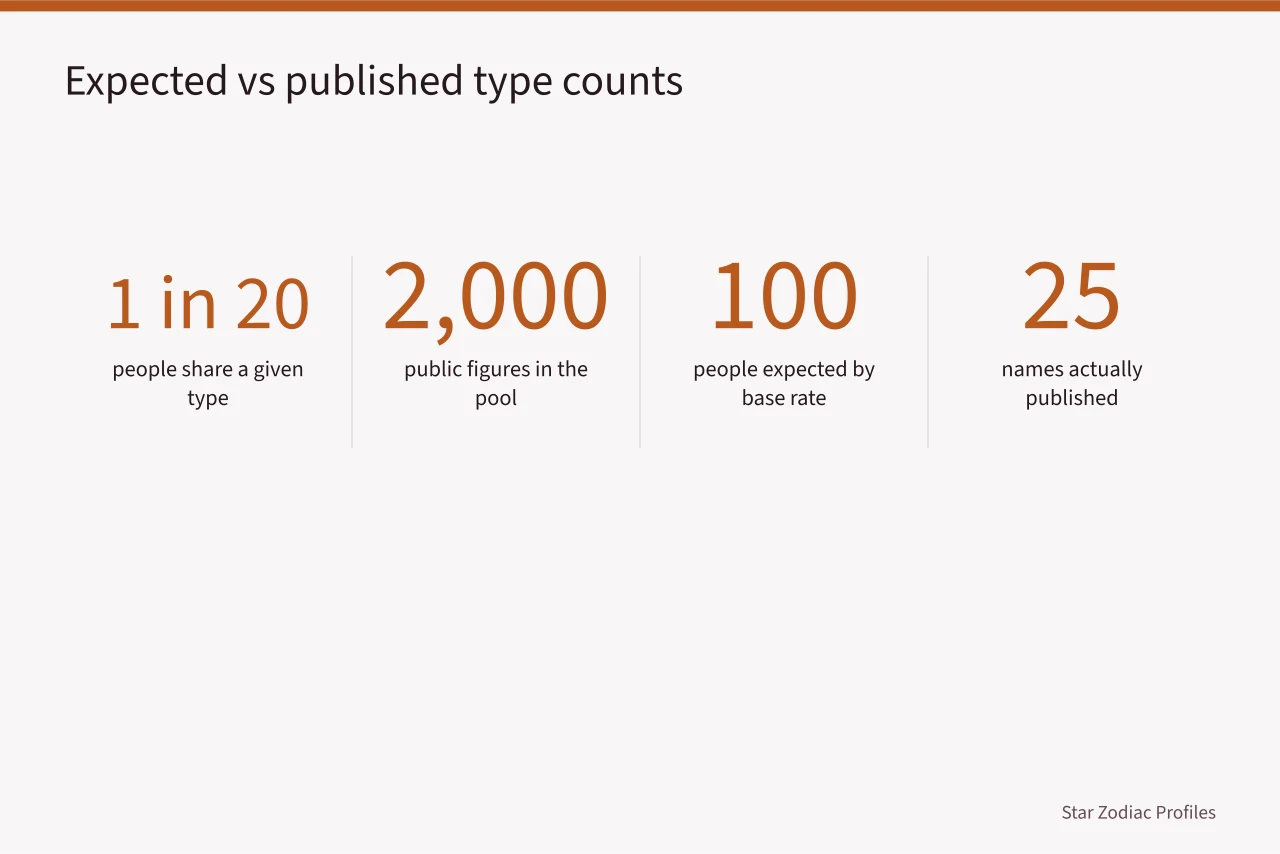
Take invented figures to see the arithmetic. If a type covers one person in twenty and a pool holds two thousand public figures, that is a hundred people. Publishing twenty-five and calling it a cluster means publishing a quarter of the expected number and calling it a surplus.
The names are also gathered by looking for people who already fit, then reported as if sampled at random. That is selection bias doing the whole job: the search term and the finding are the same thing, so no case can count against the claim.
And a vivid label on a vivid person is close to the ideal conditions for illusory correlation, where a reader perceives a link between two independent categories.
Where the analysts disagree with each other
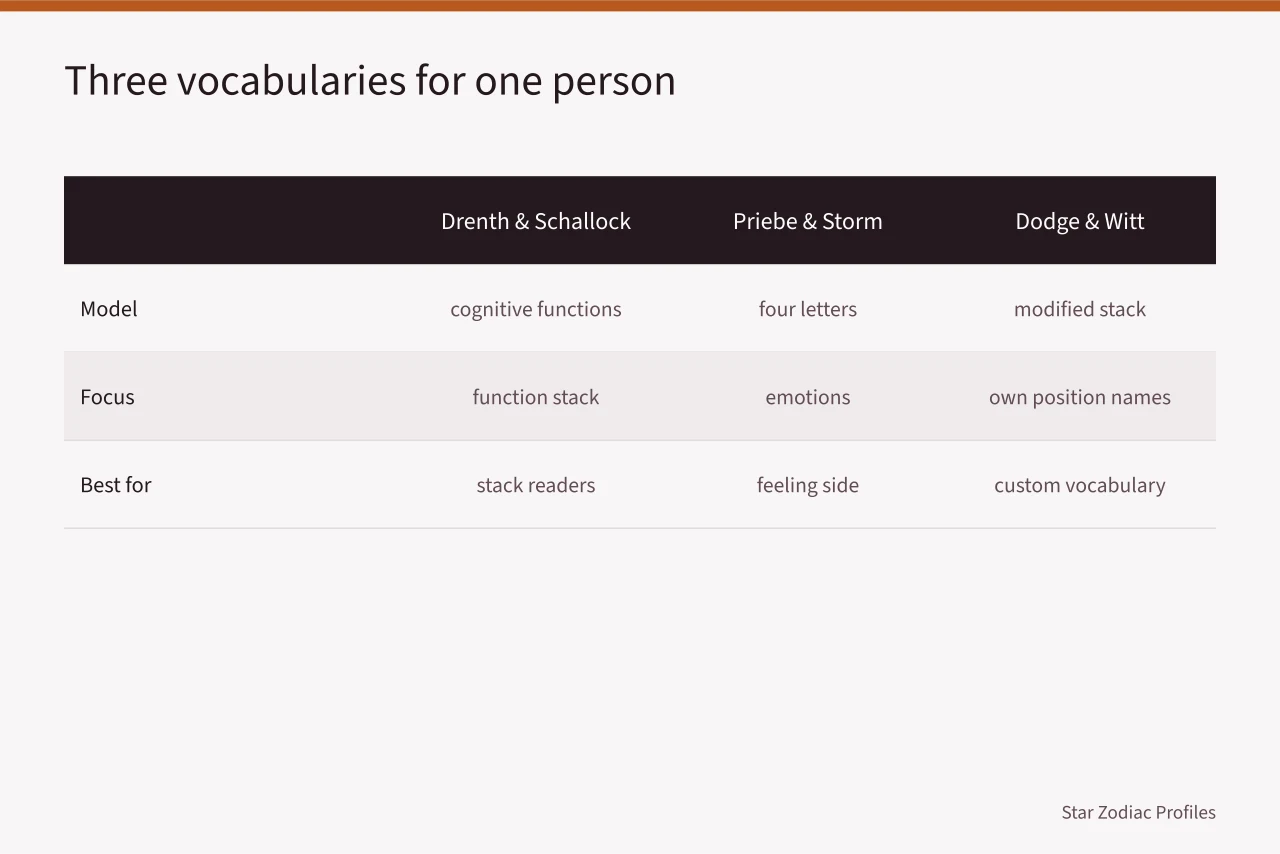
Drenth and Schallock work from functions. Priebe and Storm work closer to the four letters and the emotional material. Dodge and Witt teach a modified stack with their own names for the positions. A reader who moves between them will meet three vocabularies for one person.
That disagreement is a feature for a self-typer and a problem for a list. If the named analysts cannot agree on the model, a stranger assigning a code to an actor from a press tour is not resolving anything.
What a paid reading costs, and how to check one
Coaching in this field is priced like other one-to-one consulting, and the figure moves with the coach's market.
Typing sessions and type coaching typically run $75 to $250 an hour in most markets. A self-paced typing course typically sells for $50 to $200, and the books from these analysts typically cost $10 to $25 in paperback or ebook. A package with a written report sits at the top of those ranges.
To check a quote, run the arithmetic: a session fee of S dollars for H hours gives an hourly rate of S divided by H. Compare that against the hourly rate of a licensed therapist in your state, which professional bodies and insurers publish.
There is no licensing body for MBTI practitioners. The Myers-Briggs Type Indicator is published by The Myers-Briggs Company, which runs its own training for practitioners, separate from the coaching market around it. If a coach claims a certification, ask which organization issued it and check that organization exists.
Common questions
Are these analysts psychologists?
Some hold graduate degrees in psychology or a related field, and some do not. Susan Storm writes with a psychology background; others come from writing, coaching or business.
The type commentary is not clinical care in any case, and anyone seeking help with anxiety, depression or trauma should see a licensed clinician and can check credentials through the American Psychological Association.
Why will none of them type a celebrity?
Because the step that decides a type is the person's own best-fit choice, and a stranger cannot perform it. An analyst who typed a celebrity would be guessing and presenting the guess as a reading. The credible ones type clients, readers and themselves.
Is there a list of public figures who typed themselves?
A short one, and it would still not support a claim about types in general. A self-report is the right kind of evidence, and it remains one person's account of one sitting. Collected, it becomes a set of anecdotes, not a finding.
What is the type model good for, then?
Giving a person vocabulary for their own preferences, and giving a group a neutral way to describe a difference in working style. The same caution applies across the sixteen types, including the practical, detail-oriented group and the group most often typed from stage presence.
The nine-point system draws the same kind of list, as the notes on that model set out.