Guides
MBTI sentinels compared: common in samples, rare in celebrity type lists
MBTI sentinels are common in samples and rare in celebrity lists, and the gap is stereotype rather than measurement. Seven questions, answered plainly.
Ask people to guess a famous person's type, and the four sensing-judging types almost never come up. Ask those same people to type their colleagues, and those four types are everywhere.
That gap is the most useful fact about this group, because it shows what public-figure typing is made of. This page works through the questions readers actually ask about ISTJ, ISFJ, ESTJ and ESFJ, and answers each in the model's own terms.
What to take away
- The group is defined by a sensing preference (attending first to what is concrete and established) combined with a judging preference (wanting matters settled). Neither letter measures a competence.
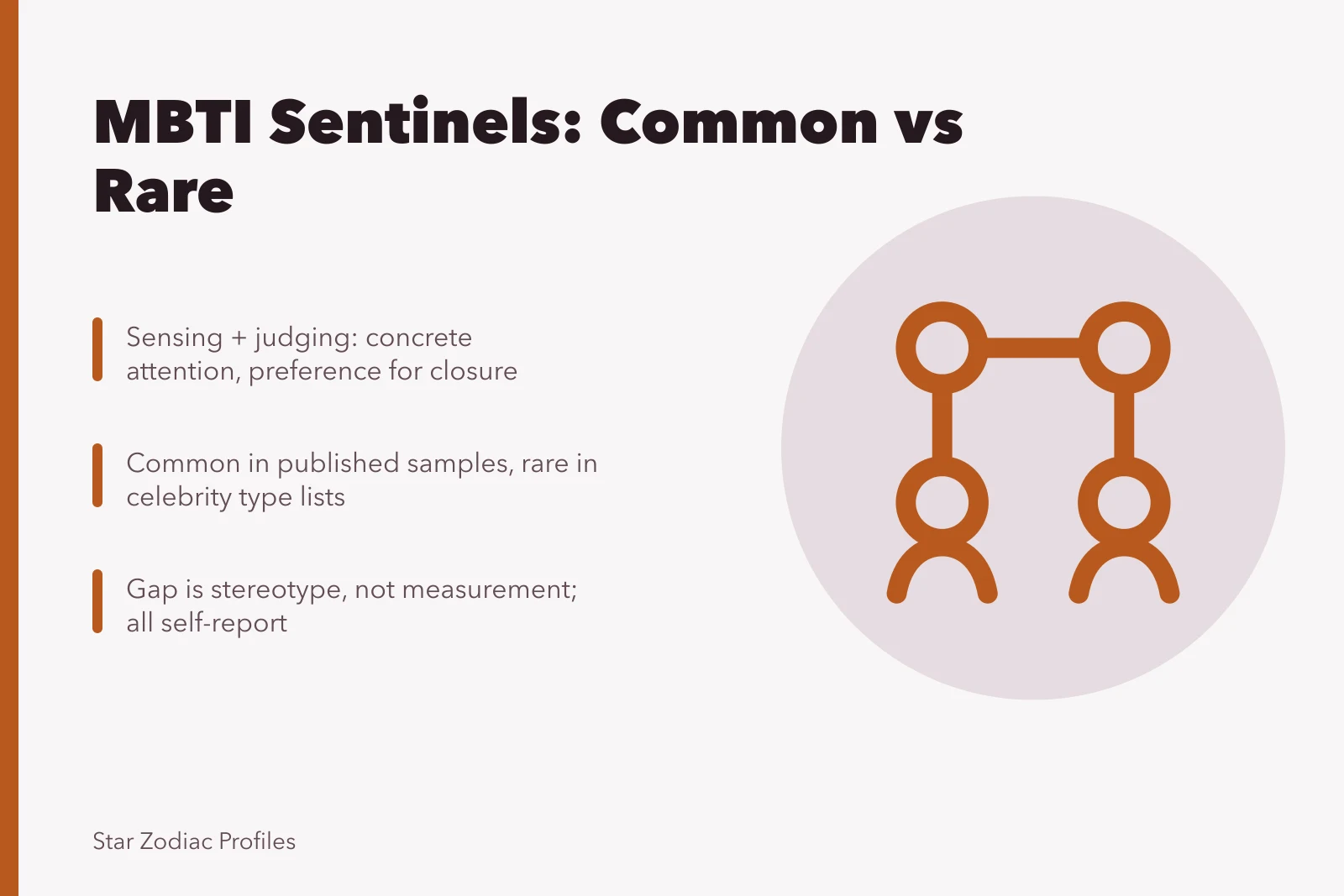
- The four types are among the most frequently reported in published samples yet among the least assigned to public figures. The difference is stereotype, not measurement.
- Every answer below rests on self-report. The model's claims are about inner preference, and observers, including of celebrities, do not have access to it.
Does "judging" mean judgmental?
No, and the instrument's publishers have spent decades saying so. The J in the code indicates which of a person's two preferred functions faces the outside world: the judging one (thinking or feeling) rather than the perceiving one (sensing or intuition). Descriptively, that is said to show up as a preference for closure: plans made, decisions reached, matters settled.
It says nothing about being critical of other people. A J type can be tolerant and a P type censorious. The word is a technical label that happens to collide with an ordinary English one, and most of the group's bad press comes from the collision, in the way a sign's technical vocabulary collides with everyday English.
Is sensing the less imaginative preference?
The S in each code describes attention that goes first to the concrete: what is here, what has happened, what has worked. The N preference describes attention that goes first to patterns and possibilities. The model presents these as two ways of taking in information, each with costs, and gives no ranking.
The stereotype ranks them anyway. In popular use, N means visionary and S means literal. Public figures are assumed to be visionaries, so they get N by default.
That assumption removes eight of the sixteen types from most celebrity lists before evidence. The four in this group are among them.
Are these the most common types?
Published distributions vary by sample, country, and version of the instrument. That is a general caution about personality testing, not a quirk of this model, which attaches no meaning to frequency.
Sensing-judging types tend to appear among the most frequently reported in general samples. Treat that as a rough fact about questionnaires, not about nature.
Then set it beside the previous answer. A group that is common in the population and rare in lists of famous people's types has not been measured in either place. It has been filtered by an idea of what famous people are like. The lists are a record of that idea.
Can you tell a sentinel by how organized they are?
Only if you already believe behavior equals preference, which the model denies. Consider four people who all keep a tidy calendar and dislike surprises.
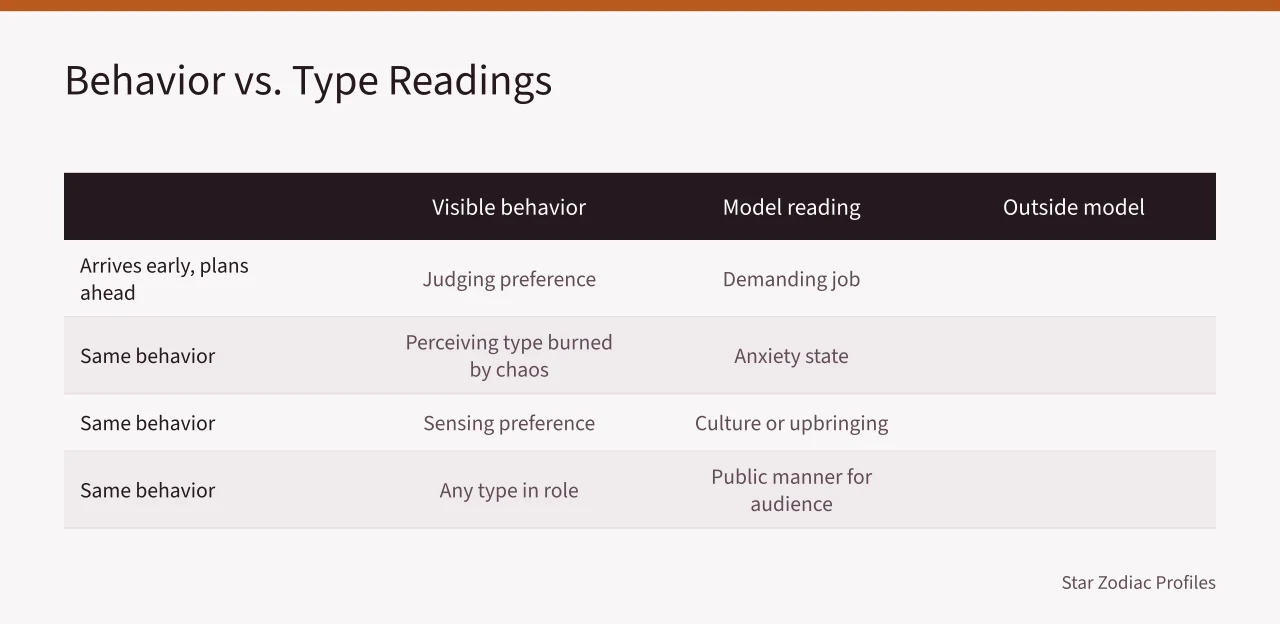
| What is visible | Readings the model allows | Readings outside the model |
|---|---|---|
| Arrives early, plans ahead, keeps records | A judging preference expressed in the usual way | A demanding job that trained the habit |
| Same behavior | A perceiving type who was burned by chaos and built a system | Anxiety, which is a state and not a type |
| Same behavior | A sensing preference for the established and reliable | A culture or upbringing in which this is simply how things are done |
| Same behavior | Any type at all, in a role where the alternative is failure | A public manner, maintained for an audience |
Behavior underdetermines preference. The instrument exists because of that: it asks the person, since watching them does not settle the question. With a public figure the observer sees less, not more, because what is visible has been edited for effect.
Why do public-figure type lists skip this group?
Three reasons, and none of them is measurement.
- The N-means-visionary assumption above, which excludes the group before it starts.
- The compliment function. Assigning a type to a well-known person is usually a way of praising them, and the group's vocabulary (dutiful, reliable, practical) reads as faint praise next to strategic or idealistic.
- Copying. Lists reproduce earlier lists, and agreement between them reflects the shared stereotype rather than repeated observation.
The result is a body of "famous types" that fails on the model's own terms twice. It types from behavior, which the model says cannot be done, and it does so with a thumb on the scale.
notes on the intuitive-thinking group describe the best-fit step that makes the first failure a matter of procedure rather than opinion. notes on the intuitive-feeling group show how the function model deepens it.
Does type change over a lifetime?
The model holds that underlying preference is stable, while what develops is a person's use of their less-preferred functions. Reported type, from a questionnaire, is less stable than that.
Results shift between sittings, a failure of repeatability rather than of the person, and it concentrates in people whose scores sat near the middle of a pair.
For this group the practical version is: someone reported as ISTJ at twenty-five and ISFJ at forty has not changed type in the model's sense. They have answered a few items differently, and they were probably near the T/F cut point both times. The model would say the best-fit decision, made by the person, is what settles it.
Are sentinels good managers?
The question smuggles in a competence claim, and the model makes none. A judging preference describes a wish for closure; a sensing preference describes attention to the established. Neither is management ability, and the model's publishers advise against using type to select or promote, precisely because readers keep hearing preference as competence.
What the model does offer a team is a vocabulary: a way to say that one person needs the plan in writing before the meeting and another thinks by talking, without either of them being the problem. Used that way, this group's descriptions are as useful as any other's. Used as a ranking, they are misread.
Common questions
Is ISFJ a "feminine" type and ESTJ a "masculine" one?
The model assigns no gender to any type. Reported distributions differ between men and women on the T/F pair in many samples, which is a fact about questionnaires and about how people are taught to answer, not about the types.
Why is this group called sentinels at all?
It is a nickname from a popular four-way grouping of the sixteen types, not part of the original instrument. An older temperament scheme grouped the same four types under a different name.
If behavior does not show type, what does?
Self-report, followed by the respondent's own best-fit decision. That is the model's whole method, and it has no substitute for the person's participation.
Can I use these descriptions for my own reflection?
Yes; that is what they are for. Read the costs of the preference alongside its uses, treat the result as a hypothesis, and notice where it fails to fit.
Does the group have anything to do with the zodiac?
Nothing structural. The two systems share a site here. Both describe temperament from a distance.
Both fail to describe named people for one reason: neither has the person's participation, as the account of the first sign sets out.