Features
Part of Gemini celebrities: reading half an axis that runs all the way to Sagittarius
6 things about Gemini celebrities traits worth your time
Gemini celebrities traits are Mercury motion turned into words: speed, closeness to the sun, a double appearance and frequent retrogrades, layer by layer.
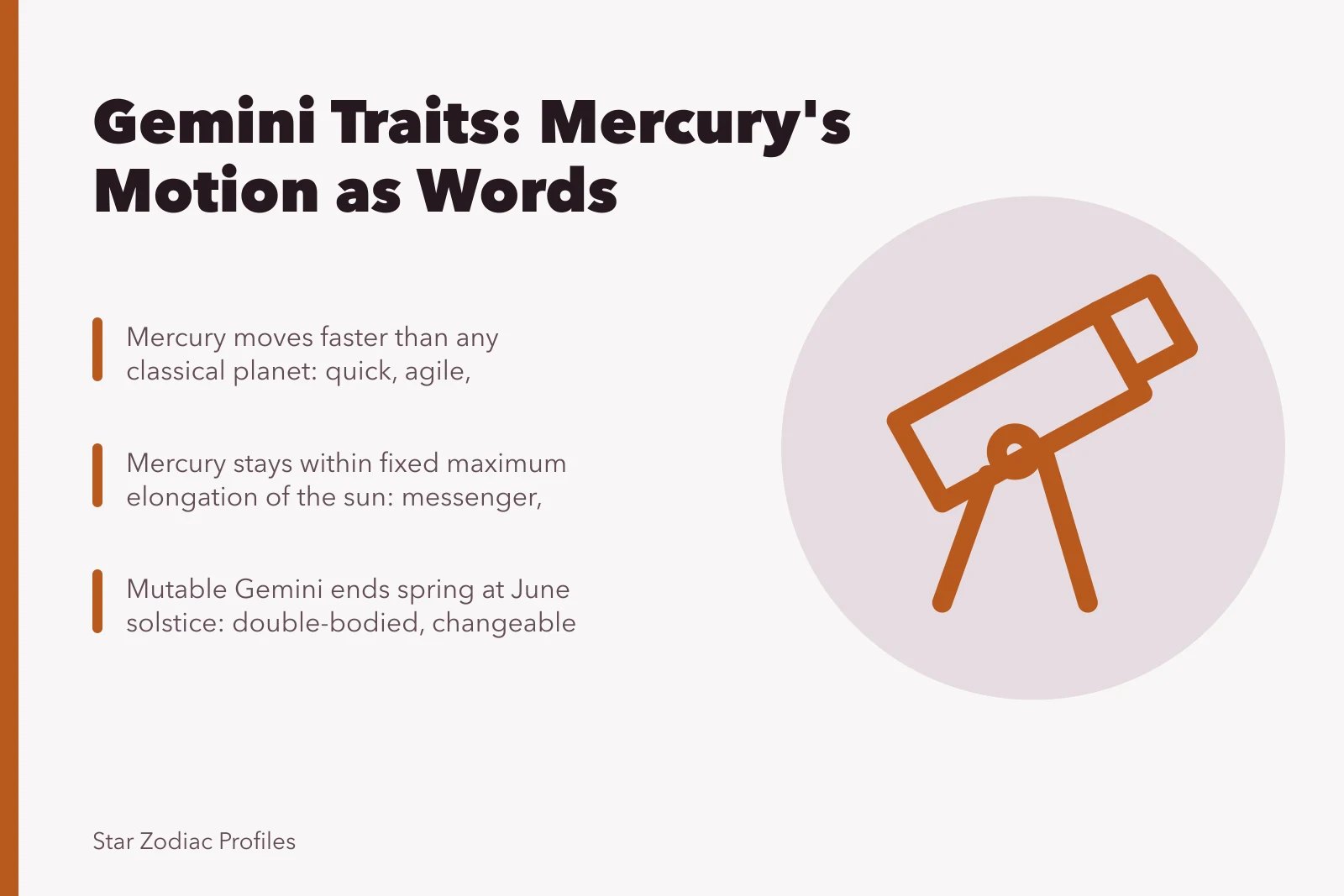
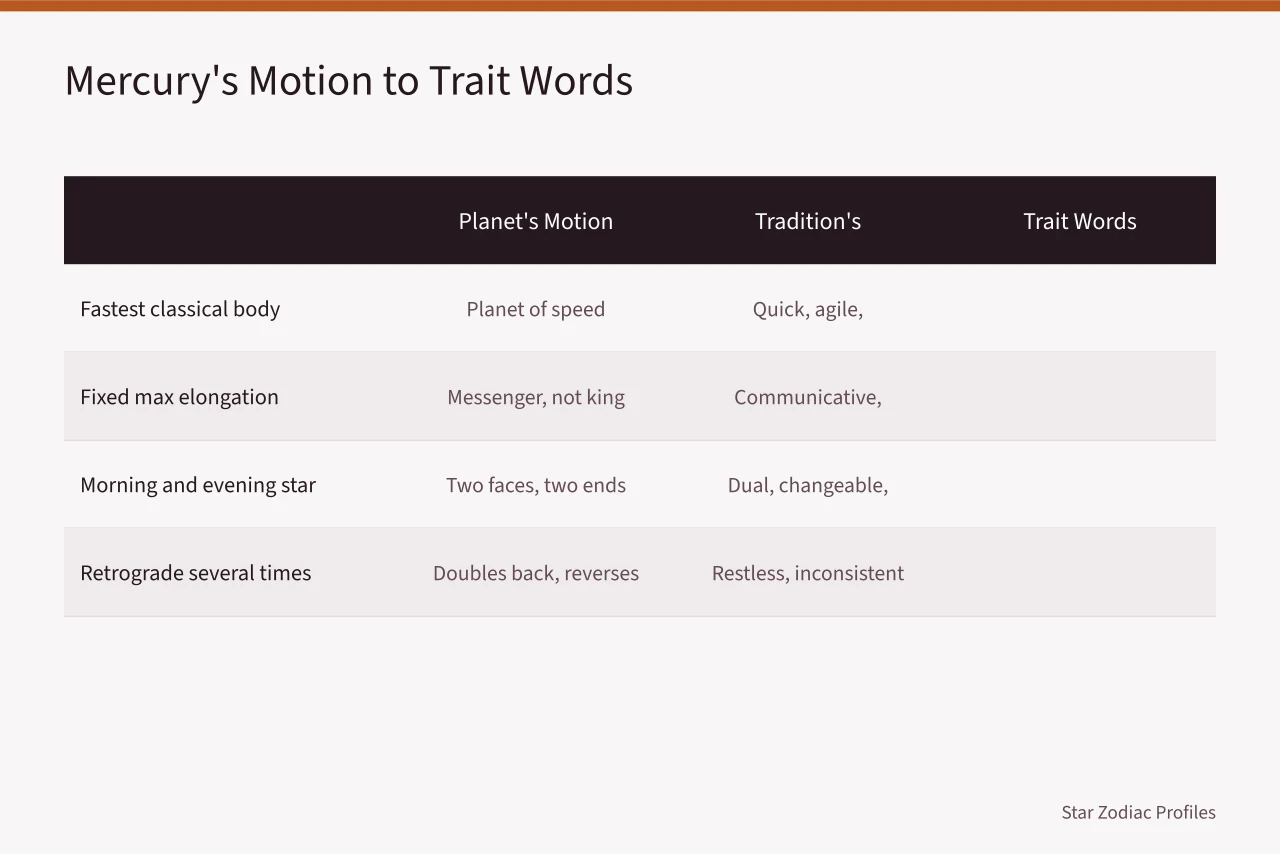
Watch Mercury for a year and you will see the whole trait list for this sign written in the sky. The planet is the fastest of the seven classical bodies, never strays far from the sun, appears sometimes before dawn and sometimes after dusk, and turns backward against the stars more often than any other.
The tradition took each of those motions and made a word of it. That is where "quick", "changeable", "restless" and "two-sided" come from. The sign's traits describe a planet's behavior, not anyone's.
What to take away
- In this tradition Gemini is mutable air, ruled by Mercury. Most of its trait vocabulary is Mercury's observed motion turned into character words.
- The planet's speed, its closeness to the sun, its double appearance as morning and evening star and its frequent retrogrades each contribute a distinct layer of the list.
- The tradition holds that the sign is associated with these qualities. It does not hold, and its method could not support, that anyone born in June has them.
Four things Mercury does, and the words they became
| What the planet does | What the tradition made of it | The trait words |
|---|---|---|
| Moves faster than any other classical body | The planet of speed, of the quick response | Quick, agile, nimble, impatient with slowness |
| Stays within a fixed maximum elongation of the sun | Bound to the source of light but not identical with it; the messenger, not the king | Communicative, mediating, the carrier of information rather than its author |
| Appears alternately as a morning star and an evening star | A body with two faces, seen at two ends of the day | Dual, two-sided, changeable, adaptable |
| Turns retrograde several times a year | The planet that doubles back, revisits and reverses | Restless, inconsistent, given to second thoughts and revisions |
Read the right-hand column as a trait list and it is the familiar one. Read the left-hand column and it is a set of observations any careful sky-watcher could make. The tradition's move was to treat the planet's visible habits as a character and then to hand that character to the signs the planet rules.
The neutral planet
Classical astrology sorted planets into benefic and malefic, hot and cold, moist and dry. It gave Mercury no fixed place.
Mercury took the nature of whatever it sat with: benefic with a benefic, dry with a dry planet. A body always near the sun and always in someone else's company was read as having no color of its own.
The sign inherits the neutrality, and it is the source of the trait most often misdescribed. "Adaptable" and "chameleon-like" are the tradition's neutral Mercury rendered as a personality; "insincere" and "two-faced" are the same rendering from someone who disapproves. The scheme made neither judgment. It described a planet that reflects its company, and the sign borrows the description.
The body map and the humors
Two older layers add to the list.
The tradition mapped the zodiac onto the body from head to foot, and Gemini took the shoulders, arms, hands and, in most authors, the lungs. From that come dexterity, manual skill, gesture and breath, and by extension speech, which the tradition already had from Mercury. When a description mentions "talking with the hands" it is reading the map.
The humoral mapping gave air the sanguine temperament, hot and moist; in the old medical vocabulary, quick, sociable, easily moved, easily distracted.
Those words remain in the sign's trait list, arriving through medicine, not astrology proper. The notes on the second sign show the same grid of elements and modes giving the previous sign a very different vocabulary.
The mutable contribution
The third assignment, the mutable mode, is the least visible in the trait list and the most structural. Mutable signs close their seasons; Gemini ends the spring at the June solstice. The tradition reads that as transition, distribution and adjustment, and calls the mutable signs double-bodied because they face two ways in the calendar.
The outline of the sign and its axis covers the twins and the double-bodied idea in full. Here it is enough to note that "changeable" has two sources, Mercury's double appearance and the mode's position. The tradition supplied both without either being a remark about a person.
Reading the list as a derivation
| Trait word | Source |
|---|---|
| Quick | Mercury's speed |
| Communicative | Mercury as the sun's messenger; the body map's lungs and hands |
| Curious | Mercury as the planet of information; air as the element of exchange |
| Adaptable | Mercury's neutrality; the mutable mode |
| Restless | Mercury's retrogrades; sanguine distractibility |
| Two-sided | Morning and evening star; the double-bodied mode |
| Superficial (the cost) | Mercury's speed and neutrality, read by a critic |
| Scattered (the cost) | Retrogrades and the mutable mode, read by a critic |
The last two rows are the same sources as the rows above them, described by someone who wanted the opposite qualities. Every word in the tradition's vocabulary has that second reading, because the scheme describes a position and not a virtue, which is the doubling worked out for the first sign.
Why the derivation matters
A trait list traced to a planet's motion is checkable: open the scheme and see whether the association is there, and it is.
A trait list applied to a named living person because of their birthday is not checkable by anyone. Their chart, where the tradition places character, needs a time, a place, and a conversation.
This site describes what the tradition associates with the sign, and never says what people born under it are like. The first is astronomy turned into vocabulary, the second a guess about strangers.
The outline of the six signs from Libra onward applies the same test to the other half of the circle, including Sagittarius, the sign opposite this one.
Common questions
Is Mercury really retrograde more often than other planets?
Yes. As the innermost planet it passes between the Earth and the sun several times a year, and each pass produces a period of apparent backward motion. The tradition made that frequency a trait.
Does the sign's trait list change if Mercury is in a different sign in the chart?
For a practitioner, yes. Mercury is often in the sign before or after the sun's, and the tradition reads the sun in Gemini with Mercury in Cancer quite differently from the paragraph written for the sign alone.
Why is the sign linked to the hands and lungs?
Through the body map that gives each sign a region from head to foot. Gemini's region is the shoulders, arms, hands and chest, which the tradition connected to gesture, dexterity and breath.
Is "sanguine" a compliment?
In the humoral scheme it was a temperament, not a verdict: hot and moist, quick and sociable, with distractibility as its cost. The air signs were all filed under it.
Where does the "two-faced" reputation come from?
From three sources rendered unkindly: Mercury's neutrality, its double appearance as morning and evening star, and the double-bodied mode. The tradition described a planet that reflects its company and a sign at a turning point; it made no remark about sincerity.