Reviews
Enneagram types from the ground up, 2027 edition
Enneagram types are read off a drawing: three centers, nine points, and two lines from each. A reference to the parts, and why nobody else can assign you one.
The nine-point model is drawn before it is described. Nine points on a circle, joined by a triangle and a six-pointed figure. The whole system of nine types is read off that drawing: which points sit together, which are joined by a line, which triangle a point belongs to.
This page is a reference to the drawing and what the tradition attaches to each part of it, followed by the one thing the drawing cannot do, which is tell you which point belongs to somebody else.
What to take away
- The nine types sit in three groups of three, called centers, and each center is assigned a governing emotion: anger for the body center, shame for the heart center, fear for the head center.
- Each type is joined by lines to two others, read as the direction a person is said to move under stress and in security.
- A type is defined by motivation: what a person is organizing their attention around. Behavior is the surface. Two people doing the same thing can belong to different points for different reasons, which is why nobody can be typed from outside.
The three centers
| Center | Points | The emotion the tradition assigns | What each type is said to do with it |
|---|---|---|---|
| Body (or gut) | 8, 9, 1 | Anger | Eight expresses it outward; Nine goes to sleep on it; One turns it inward as self-criticism |
| Heart | 2, 3, 4 | Shame | Two covers it by being needed; Three by achieving; Four by making the wound itself distinctive |
| Head | 5, 6, 7 | Fear | Five withdraws and prepares; Six seeks security and tests it; Seven keeps moving so it never lands |
The centers are the first thing a teacher asks a student to consider, before any number. In the tradition's view, which of the three emotions runs underneath sorts the nine into three.
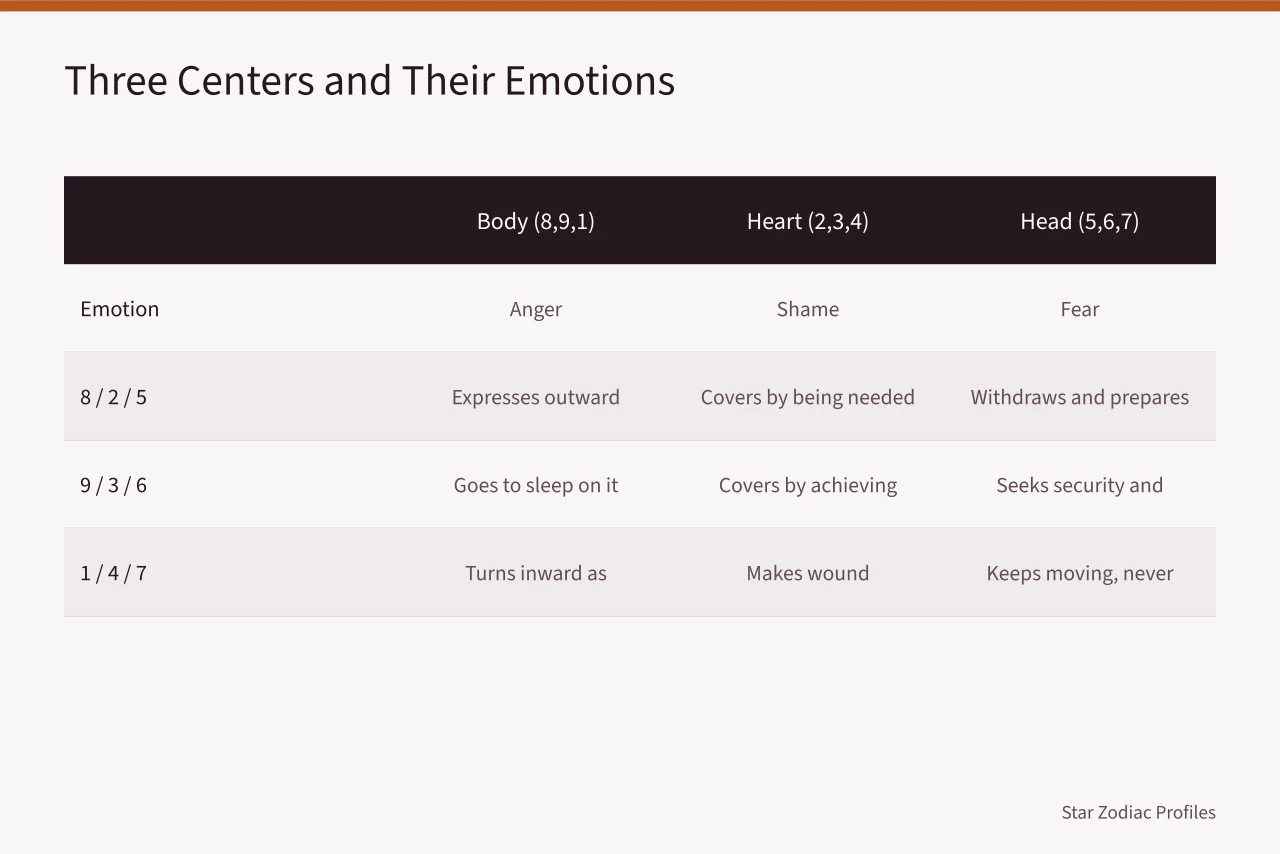
The sorting comes by introspection: which one is present even when nothing is wrong. Only the person can answer that, and the tradition says so.
The nine, point by point
| Point | Usual name | What the type is said to want | What it is said to avoid |
|---|---|---|---|
| 1 | The Reformer | To be right, to improve | Being corrupt or wrong |
| 2 | The Helper | To be loved, to be needed | Being unwanted |
| 3 | The Achiever | To be valued for what they do | Failure, or being seen to fail |
| 4 | The Individualist | To be themselves, to be understood | Being ordinary or without identity |
| 5 | The Investigator | To understand, to be capable | Being depleted or overwhelmed |
| 6 | The Loyalist | To have security and support | Being without guidance |
| 7 | The Enthusiast | To be satisfied and free | Pain and deprivation |
| 8 | The Challenger | To be in control of their own life | Being controlled or vulnerable |
| 9 | The Peacemaker | To have peace and stability | Conflict and separation |
The names vary between schools; the wants and avoidances are more stable, and they are the definition. A type is not a list of behaviors. It is the thing behind the behavior.
The lines
Each point is joined by the figure to two others. The triangle joins 3, 6 and 9. The other figure joins 1, 4, 2, 8, 5 and 7 in that order and back to 1. The tradition reads the lines as directions of movement.
| Point | Under stress, moves toward | In security, moves toward |
|---|---|---|
| 1 | 4 | 7 |
| 2 | 8 | 4 |
| 3 | 9 | 6 |
| 4 | 2 | 1 |
| 5 | 7 | 8 |
| 6 | 3 | 9 |
| 7 | 1 | 5 |
| 8 | 5 | 2 |
| 9 | 6 | 3 |
So a One under pressure is said to take on the moods of a Four. A One who feels secure is said to take on the ease of a Seven. Schools disagree about how literally to read this, and about whether the "stress" line is only negative.
What is agreed is that the lines make a type a dynamic thing, not a fixed portrait. A person's own account of how they behave under pressure is part of how they find their point.
Wings, meaning the two neighboring points, one of which is usually said to color the type, along with instinctual variants and levels of health, are further layers on top of this. They arrive from the teaching lineage behind the figure rather than from any questionnaire. The drawing is the skeleton they hang on.
Why the drawing cannot be applied to someone else
Take one behavior and run it through the table of wants.
Show the numbers
| Works constantly, rarely rests | 3 |
|---|---|
| Same | 1 |
| Same | 8 |
| Same | 6 |
| Same | 2 |
Five points, one behavior. The tradition would say all five accounts are coherent and that only the person can say which is true. The difference is in what they are afraid of, and fear is not on display. A sign description runs into the same wall from a different direction.
With a public figure the situation is worse. What an observer sees is behavior selected and shaped for an audience, so even the surface is unreliable. Assigning a point to a well-known person on that basis is a guess about their inner life presented as a finding, and the system's own definition of type says the finding is unavailable.
The notes on the four-letter system reach the same conclusion by a different route: there, the type is confirmed by the respondent; here, it is defined by a motivation only the respondent can see.
Finding your own point
Teachers in the tradition generally advise against trusting a questionnaire result on its own, for the same reason, and general accounts of personality testing give the same caution about any self-report result. The usual method is slower.
- Start with the center. Which of anger, shame or fear is the one that is always somewhere in the room?
- Read the wants and avoidances for the three points in that center, and notice which one is uncomfortable to read. Recognition in this system often arrives as reluctance.
- Check the lines. Does the description of your stress point match what you do when cornered? The four-letter model's best-fit step asks the same question in its own vocabulary.
- Sit with it. The tradition treats a type as something confirmed over months of self-observation, and expects the first guess to be wrong at least some of the time.
That process has no external version. It is built entirely from access the person has and nobody else does. The notes on the intuitive-thinking group describe the equivalent step in the four-letter system, where the respondent's best-fit decision is the type.
Common questions
Is the drawing ancient?
The figure has older roots, but the nine-type psychology attached to it is a twentieth-century development from a contemplative and teaching lineage. It did not come out of research, and the tradition's better teachers say so.
Can two people share a point and be nothing alike?
Yes, and the tradition expects it. Wings, instinctual variants, levels of health and the whole rest of a life sit on top of the point. The point is the pattern of attention, not the personality.
Why does the tradition put anger, shame and fear at the base?
Because the system is built around what a person is defending against, and it holds that the three centers each have a characteristic defense. It is a claim of the tradition, offered for self-examination, not a finding.
Is a questionnaire result my type?
The tradition treats it as a starting hypothesis. Most schools expect the person to read, reflect and revise before settling.
Why does this site never assign a point to a celebrity?
Because the type is defined by a motivation the person alone can see, and a public figure's visible behavior has been shaped for an audience. Any such assignment is a published guess about a real person's inner life.