Rules
Part of Gemini celebrities: reading half an axis that runs all the way to Sagittarius
What apparent retrograde motion has to do with Gemini misconceptions
Gemini celebrities misconceptions start in the sky: what apparent retrograde motion really is, what the tradition made of it, and four other slips.
Misreadings of this sign almost all come from one planet and, more specifically, from one piece of its sky behavior. Mercury appears to reverse direction several times a year.
That appearance has a plain geometric cause, and tradition built a technical term on it. Popular writing has since built folklore on that term, and separating the three is most of the work.
What to take away
- The apparent reversal is a perspective effect produced by two bodies moving at different speeds on different orbits. Nothing changes direction.
- The tradition treats the period as a technical condition of a planet, with rules attached. It did not invent the modern list of things said to go wrong.
- The rest of the sign's misreadings come from the twins, from the word mutable, and from a planet ruling two signs at once.
What is actually happening in the sky
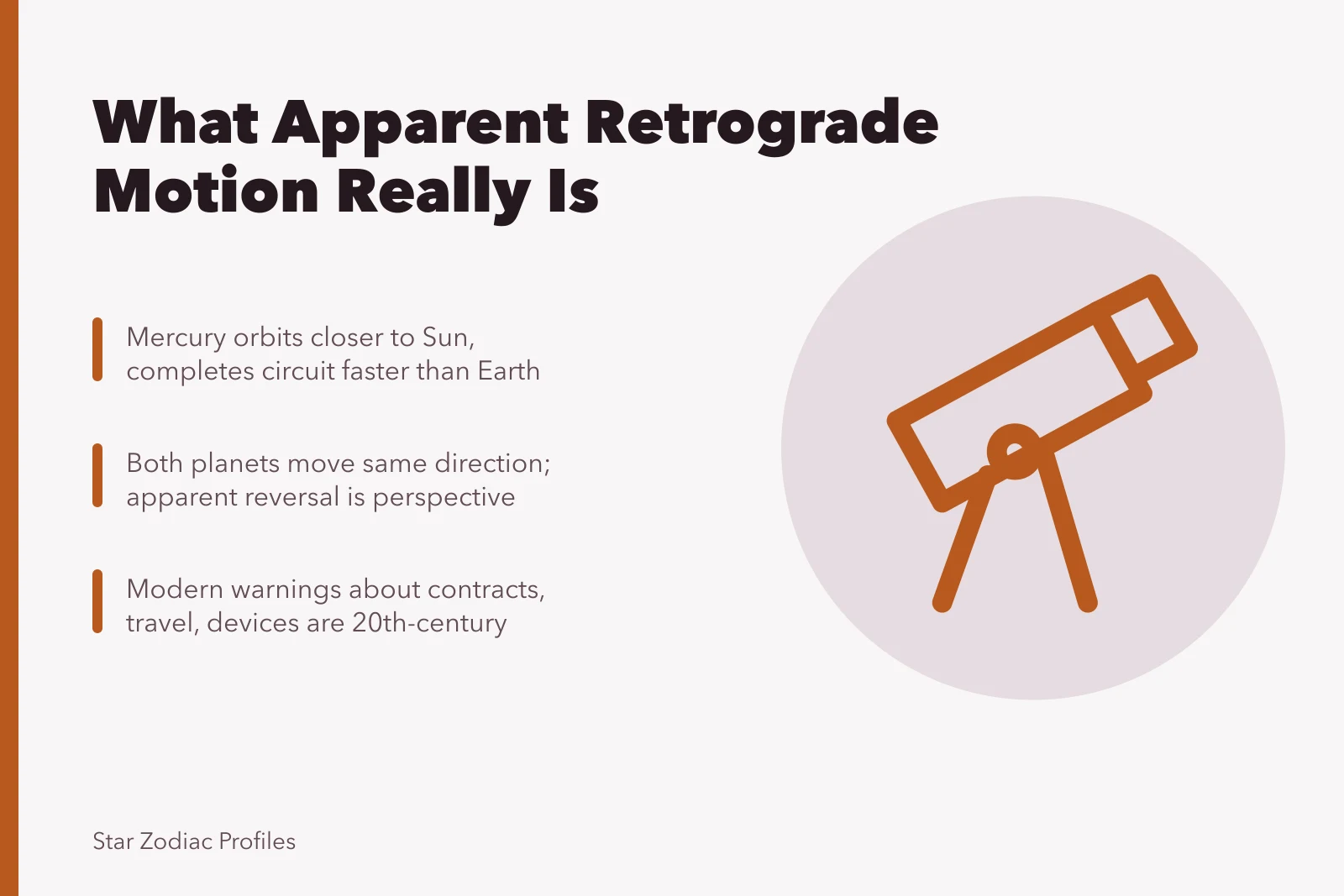
Mercury orbits closer to the Sun than Earth does and completes a circuit faster. Both planets move in the same direction. Because the Earth is watching from a moving platform, there are stretches when Mercury's motion against the background stars appears to run backward, in the same way a car being overtaken appears to slide rearward against a distant hillside.
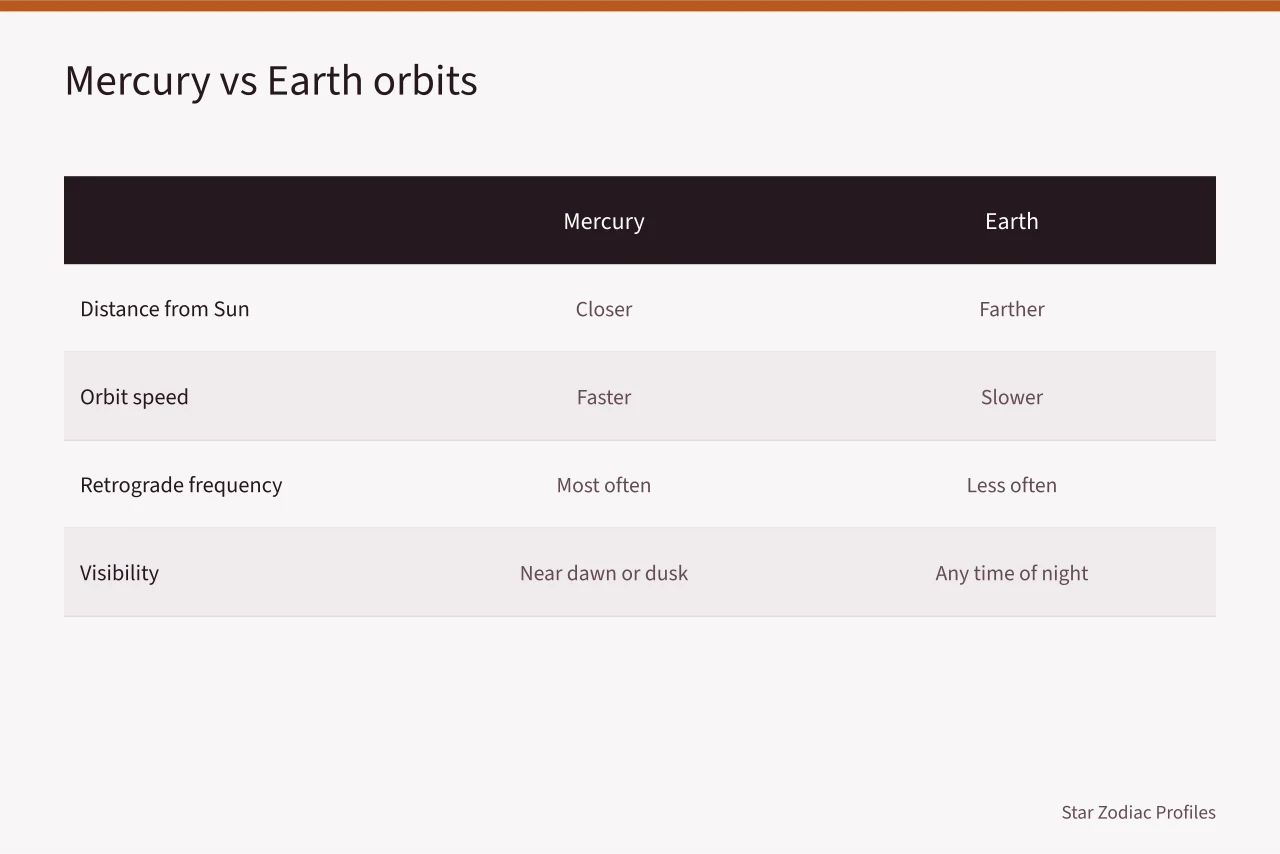
That is apparent retrograde motion, and it happens to every planet visible from Earth. It happens most often for Mercury because Mercury is the fastest and its cycle relative to Earth is the shortest.
The two planets closer to the Sun than Earth behave differently in one other respect worth knowing. They are never seen far from the Sun in the sky. That is what makes them inferior planets in the older terminology, and it is why Mercury is only ever visible near dawn or dusk.
None of this is disputed, and the physical body itself is a small, cratered, airless world with an orbit that planetary science describes in detail. The motion is real. What it means is where the disagreement starts.
Misreading one: retrograde is a physical event
It is a viewing angle. Mercury does not slow, stop or reverse, and nothing about the planet changes during the period. A tradition may attach meaning to an appearance, and often does. The appearance is still an appearance.
Misreading two: the tradition invented the modern folklore
Traditional astrology treats a retrograde planet as one condition, along with the sign it occupies and its relation to the Sun. The rules are technical and mostly about how a practitioner weighs that planet in a chart.
The modern warnings about contracts, travel and devices are a twentieth century popular addition. Their content follows Mercury's keywords, not older doctrine.
Misreading three: the twins mean two-faced
The constellation supplied the name and the image. The tradition draws a sign's vocabulary from its element, mode and ruling planet, not the animal or figure shown, as the derivation of this sign's keywords explains.
The duplicity reading takes the picture as an argument. That is the same move that turns a bull into stubbornness, examined in the misreadings of the second sign.
Misreading four: mutable means unstable
Mutable is one of three modes. It names a sign's position at the close of a season, where one set of conditions gives way to the next.
The vocabulary that follows covers adaptation and transition. Instability is a reading of that, not a definition. The tradition attaches this mode to three other signs with quite different reputations.
Misreading five: a planet cannot rule two signs
In the older scheme it did, and so did every planet except the Sun and the Moon. The seven visible bodies were distributed across twelve signs in a symmetric arrangement. That required five of them to take two signs each.
Mercury taking both a mutable air sign and a mutable earth sign is part of that structure. Reading it as an anomaly means reading the modern rulership scheme back into the old one, a confusion the outline of the sign sets out.
Misreading six: the retrograde period explains a bad week
This is the one with consequences, because it is the one people act on. A period named in advance, applied to a broad category of events, and remembered selectively will always appear to work. Nothing counts against it: a smooth week is unremarkable and goes unrecorded, and a difficult one confirms the forecast.
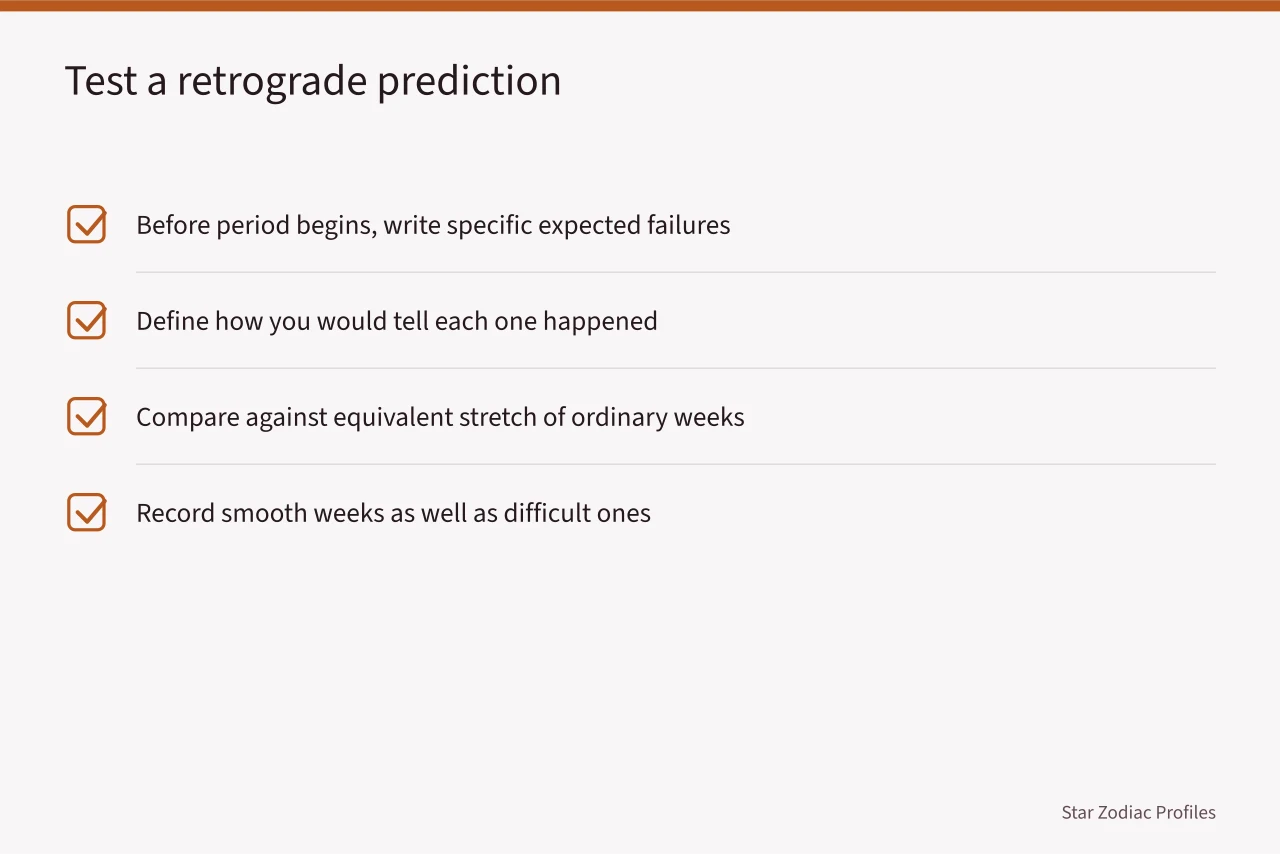
A meaningful test is available and almost never run; before the period begins, write down the specific things you expect to go wrong and how you would tell. Then compare against an equivalent stretch of ordinary weeks.
The notes on what a zodiac quiz can be scored against describe the same problem in a different format. Without a criterion fixed in advance, any result confirms the claim.
The pattern behind all six
| Source | The move | The correction |
|---|---|---|
| Sky motion | An appearance is read as an event | Ask what would be seen from elsewhere |
| Technical vocabulary | A term of art is read in ordinary English | Look up what the tradition uses the word for |
| The picture | The image is treated as an argument | The vocabulary comes from element, mode and ruler |
| Modern rulership | A later scheme is read into an older one | Note which scheme a source is using |
Four different mechanisms, one shared shape: something narrow and documented gets replaced by something broad and satisfying. That is worth knowing whichever side of the tradition a reader stands on, because it is what makes a sign description unfalsifiable rather than merely disputed.
Common questions
Does Mercury really go backward?
Not in its orbit. It appears to move backward against the stars for a stretch, because the Earth is also moving and the two viewing lines cross.
Do other planets do this?
All of them, as seen from Earth. Mercury's turns come around most often because it moves fastest.
Is the retrograde folklore part of traditional astrology?
The condition is. The modern list of practical warnings is a twentieth century popular development, and traditional texts do not read that way.
Why is this sign so associated with talking?
Mercury's older associations cover messages, exchange and language, and the sign is one of the two the planet governs. The link runs through the planet, not through the twins.
What is the strongest of these misreadings?
The retrograde one, because it is acted on. People delay decisions on the strength of a viewing angle.