Rules
Part of Gemini celebrities: reading half an axis that runs all the way to Sagittarius
What matters most in famous Gemini celebrities
Famous Gemini celebrities are named here with birth dates, the work each is known for, and the one trait their chart placement actually speaks to.
Almost everyone knows their sun sign. Almost nobody knows their rising sign, and fewer still know where their Moon sits. That imbalance is about a century old, and newspapers caused it. The famous Gemini celebrities below show what a sun-sign list can and cannot tell you.
What to take away
- A sun-sign list can only use a birth date, so it can only describe one factor in a chart. Treat it as a starting point, not a verdict.
- Famous Gemini celebrities here include Marilyn Monroe, Morgan Freeman, Prince, Paul McCartney and Stevie Nicks. Each entry carries a birth date you can check at a named source.
- Sun-sign columns began in the early twentieth century for print reasons, not because anything was discovered.
- A birthday tells you where the Sun was, not what a person is like. Every sign has famous names, because birthdays fall across the calendar.
- If a sign description gives you a useful word for yourself, that is a fair use. Using it to describe a stranger is not.
The Gemini names, and what each is on the list for
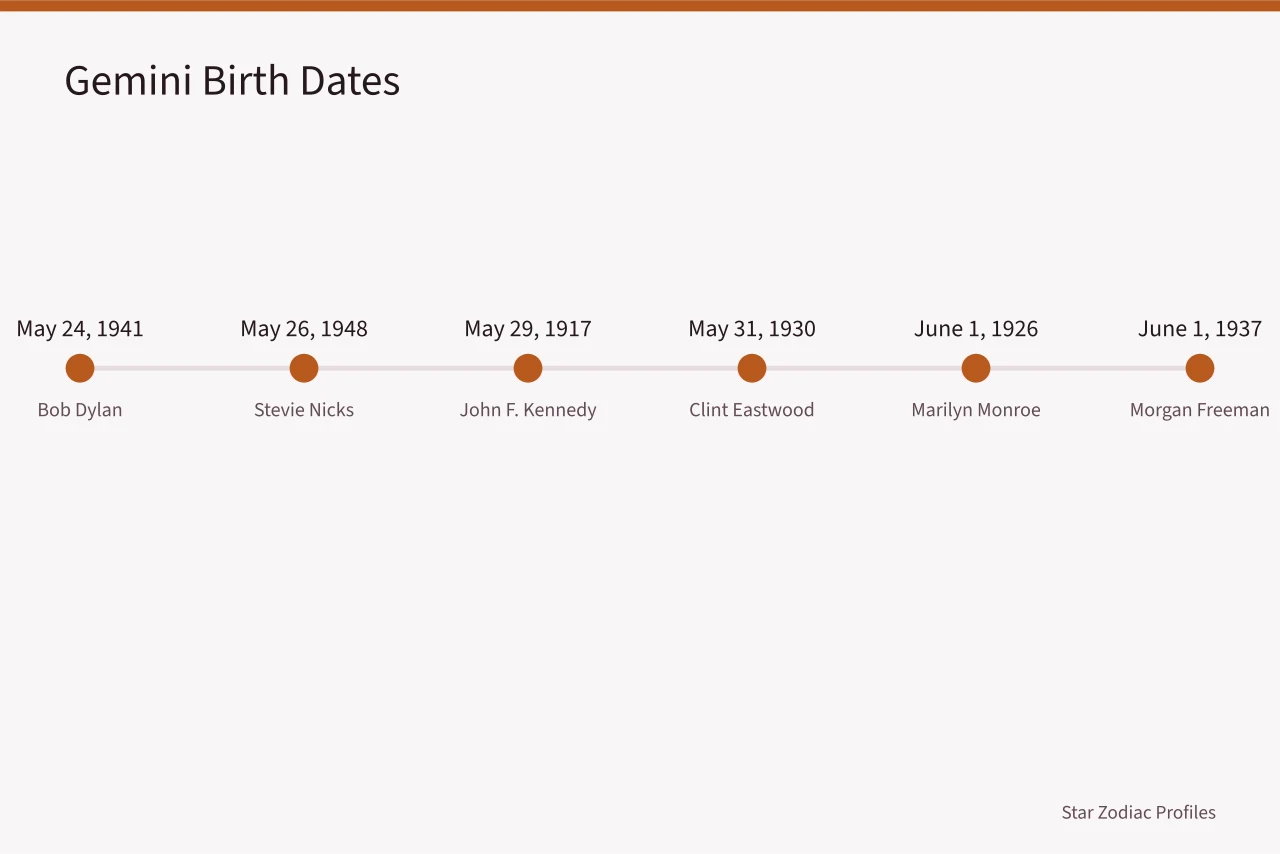
Gemini covers roughly May 21 to June 20. The dates below come from published birth records and standard reference entries. Where sources disagree, the entry says so.
| Name | Birth date | Known for | Why it sits on a Gemini list |
|---|---|---|---|
| Marilyn Monroe | June 1, 1926 | Actor and singer | Starred in "Some Like It Hot" (1959); her birth time is disputed across sources |
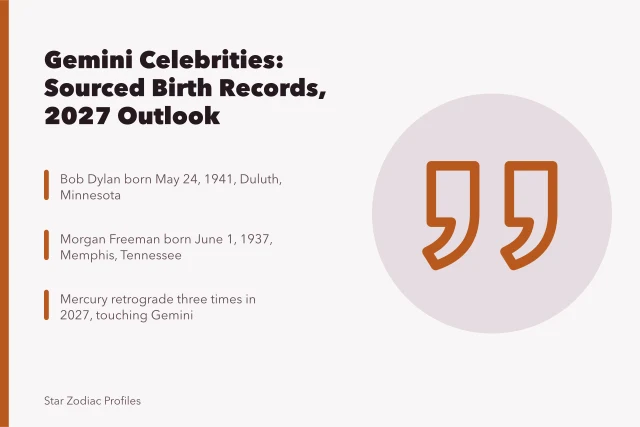
| Morgan Freeman | June 1, 1937 | Actor | Won an Oscar for "Million Dollar Baby" (2004); same calendar day as Monroe, 11 years later |
| Stevie Nicks | May 26, 1948 | Singer and songwriter | Joined Fleetwood Mac in 1975; late-May birth, at the early edge of the sign |
| John F. Kennedy | May 29, 1917 | US president | Took office in 1961; a May 29 birth, near the sign's start |
| Clint Eastwood | May 31, 1930 | Actor and director | Directed "Unforgiven" (1992); one day before the June cluster |
| Bob Dylan | May 24, 1941 | Singer and songwriter | Won the Nobel Prize in Literature in 2016; the earliest birth date on this list |
| Prince | June 7, 1958 | Singer and producer | Released "Purple Rain" in 1984; a June 7 birth recorded in press and court files |
| Kanye West | June 8, 1977 | Rapper and producer | Released "My Beautiful Dark Twisted Fantasy" (2010); June 8 birth, well documented |
| Johnny Depp | June 9, 1963 | Actor | Played Jack Sparrow in "Pirates of the Caribbean" (2003); same day as Portman, 18 years earlier |
| Natalie Portman | June 9, 1981 | Actor | Won an Oscar for "Black Swan" (2010); June 9 birth, listed in standard film references |
| Judy Garland | June 10, 1922 | Actor and singer | Starred in "The Wizard of Oz" (1939); a June 10 birth |
| Tupac Shakur | June 16, 1971 | Rapper and actor | Released "All Eyez on Me" in 1996; a mid-June birth |
| Kendrick Lamar | June 17, 1987 | Rapper | "DAMN." won the 2018 Pulitzer Prize for Music; a June 17 birth |
| Paul McCartney | June 18, 1942 | Singer and songwriter | Co-wrote the Beatles catalog with John Lennon; near the sign's close |
Two entries share June 1, and two share June 9. That is not a coincidence in the data. It is what happens when you sort a calendar by sign instead of by person.
Every row shares one trait at the level the chart placement speaks to. Mercury rules Gemini, so the tradition hands talk, quick exchange and restlessness to all fourteen names at once. The list carries no individual claim about any of them.
Why a birthday is the weakest input in a chart
A chart needs date, time and place. A sun-sign list has one of the three.
The Sun moves about one degree per day, so a birth date pins it down well enough. The Ascendant moves through all twelve signs in a day, so a date alone cannot touch it. The Moon covers roughly thirteen degrees a day, which means it can shift sign inside a single date.
That is the whole reason the newspaper format settled on the Sun. It is the one placement a reader can supply without a birth certificate.
What the Gemini keywords actually rest on
Mercury rules Gemini. The sign is air by element and mutable by mode. Those three facts generate the standard keyword set: talk, quick exchange, variety, restlessness.
None of that is a claim about Marilyn Monroe. It is a description of a position in a symbolic scheme, and the scheme says the same thing about everyone born in that window.
Where a chart position stops explaining anything is the useful boundary. Mercury in Gemini says something about how a tradition groups people. It says nothing about how a specific person handles a contract, a marriage or a Monday morning.
The celebrity roundup problem
Naming a famous person and describing their character from a birthday makes a public claim about a real person with nothing behind it.
The tradition does not license that. Classical practice worked from a full chart and a conversation with the person whose chart it was. It did not work from a paragraph assigned to a twelfth of the population.
Birth times for public figures are also frequently wrong, missing or invented after the fact. When a birth certificate, a hospital record and a biography disagree, the honest move is to say so and name the record, not to pick the tidiest version.
Where the sun-sign format came from
Sun-sign astrology became the dominant popular form in the early twentieth century. Cheap mass-circulation papers needed a recurring feature that could be written to a deadline. Twelve short paragraphs fit a column.
The format took hold in British papers between the wars, spread to American ones, and later moved into magazines and apps.
Nothing was discovered in that shift. A technical craft was compressed to the one component that needs no arithmetic, and print economics did the compressing.
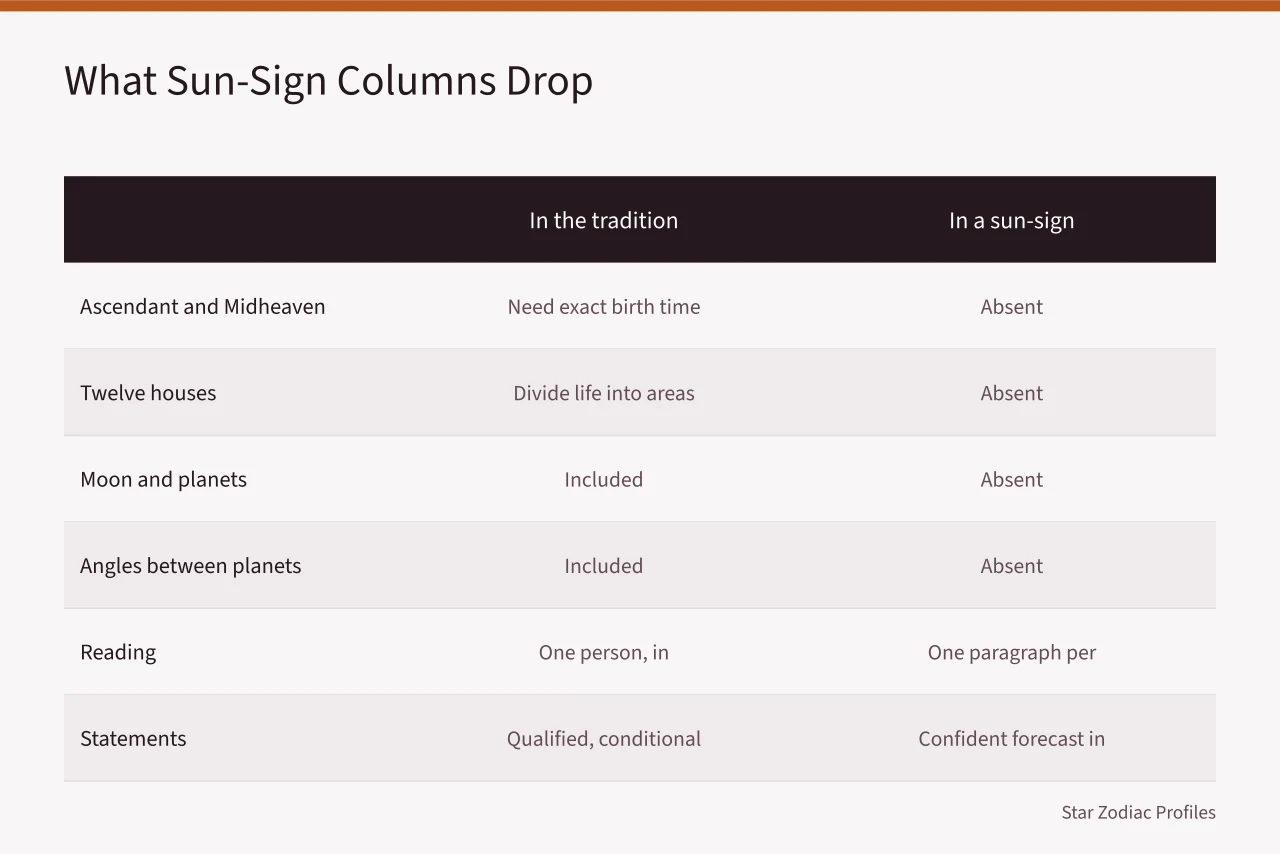
What the compression dropped
| In the tradition | In a sun-sign column |
|---|---|
| The Ascendant and Midheaven, which need an exact birth time | Absent |
| Twelve houses dividing life into areas | Absent |
| The Moon, the planets, and the angles between them | Absent |
| A reading made for one person, in conversation | One paragraph per birth month |
| Qualified, conditional statements | A confident forecast in the second person |
Professional astrologers are often the sharpest critics of the horoscope column for this reason. From inside the practice, it looks like reading one line of a page and calling it the book.
The vocabulary that stayed
English absorbed astrological terms so thoroughly that most no longer register as such.
- Disaster joins the prefix of negation to the word for star, from the sense of an ill star.
- Influenza is Italian for influence, once meaning a flow from the heavens, applied to epidemics before viruses were understood.
- Lunatic comes from the Latin for moon.
- Jovial, mercurial, saturnine and martial each name a planet to describe a temperament.
- Aspect was a technical term for the angle between two planets long before it meant a side of a subject.
You can be entirely unpersuaded by astrology and still speak it several times a day.
How to read a Gemini list without overreading it
Check the birth date against more than one source before repeating it. Where a birth time is claimed, ask which record it came from.
Then separate the two questions. What does the sign position explain? It explains how a tradition sorts people. What does it not explain? Anything about a specific person that you could verify another way.
The Encyclopaedia Britannica astrology overview covers the older history, including the branches the newspaper format left behind.
Common questions
When did horoscope columns start?
They became a regular newspaper feature in the early twentieth century, first in Britain and then widely. Astrology itself is thousands of years older and looked nothing like a column.
Why can a Gemini list never be complete?
Because it sorts people by one input, the birth date, and most public figures do not have a verified birth time. A list built that way is a sample of who has a documented birthday, not of who is a Gemini.
Are the sign descriptions accurate?
They are interpretations of a symbolic scheme. They tend to feel accurate because broad statements about character fit most attentive readers, an effect with a long research history.
Where do the Gemini keywords come from?
From Mercury as ruling planet, the air element and the mutable mode. The outline of the sign works through that derivation, and the notes on the first sign's lists show the same method applied elsewhere. For the wider pattern of misreadings, see the misconceptions sorted by source and the layers set out for the first sign.