Features
Before you act on MBTI explorers, updated for 2027
MBTI explorers are described in the vocabulary of visible action, which is exactly the evidence the model says cannot establish a type. The trap, in full.
Of the sixteen types, the four grouped as explorers are described most in terms of what can be seen: action, timing, physical skill, response to the present moment. That makes them the group most often pinned on athletes, performers and anyone whose job is to be watched.
It also makes them the clearest case of a trap that catches every attempt to type a public figure. The thing being observed is exactly the thing the model says is not the evidence.
What to take away
- "Explorers" is a nickname for the four types that combine a sensing preference with a perceiving preference: ISTP, ISFP, ESTP and ESFP. All four have extraverted sensing, attention to the immediate and concrete, in their top two functions.
- Because the group's descriptions are written in terms of visible behavior, observers assign it to visible people. The model locates type in preference, which is not visible.
- The current fashion for treating a four-letter code as an identity is a trend in how the vocabulary is used, not a change in what it measures.
The group in the function model
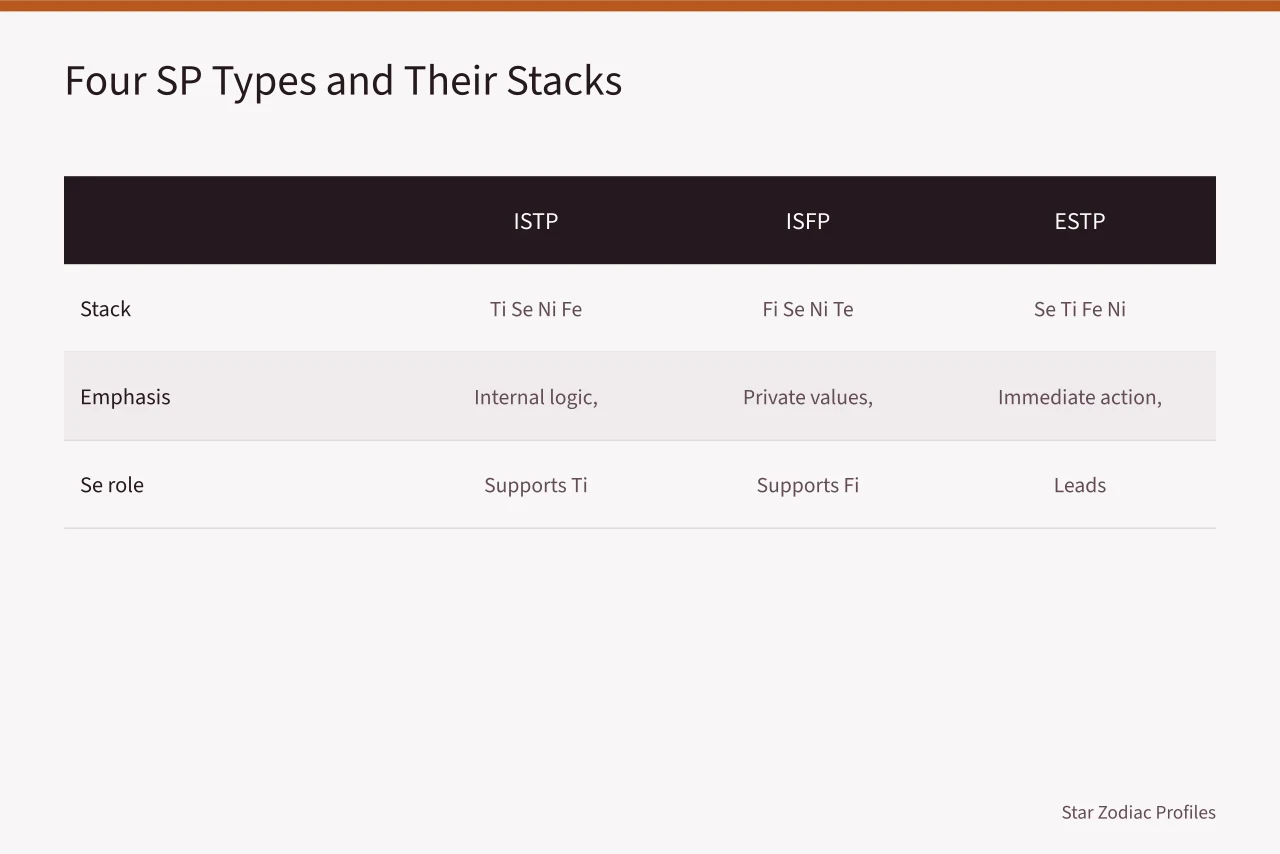
| Type | Stack | What the description emphasizes |
|---|---|---|
| ISTP | Ti, Se, Ni, Fe | An internal logic of how things work, applied hands-on in the moment |
| ISFP | Fi, Se, Ni, Te | Private values, expressed through direct sensory engagement |
| ESTP | Se, Ti, Fe, Ni | Immediate action, checked by an internal logic |
| ESFP | Se, Fi, Te, Ni | Immediate engagement with people and surroundings, anchored to private values |
Se, extraverted sensing, is the common element in the function model: the function the model describes as attention to what is happening right now, in full sensory detail. In two of the types it leads; in the other two it supports a private judging function.
That difference matters more than the shared nickname suggests. An ISTP and an ESFP share one letter and, in the model, share a preference for the concrete and little else.
What the P means
Perceiving is the most misread letter in the code. It does not mean perceptive. It indicates which of a person's two preferred functions faces the outside world: the perceiving one (sensing or intuition) rather than the judging one. In the descriptions this appears as a preference for keeping options open, adapting as things develop, and resisting premature closure.
The stereotype reads it as disorganized, which is a competence claim the model does not make. A perceiving preference can produce a person who plans loosely and improvises well, or a person who has built elaborate systems precisely because improvising failed them. The letter describes a preference; the system they built describes their history.
The observability trap
Here is the problem in one move. The group's descriptions are written in the vocabulary of action: quick, practical, present, physical. Action is what an observer can see. So an observer watching someone act decisively in public concludes that they are seeing an Se type, and the description confirms it, because the description was written in the language of what they saw.
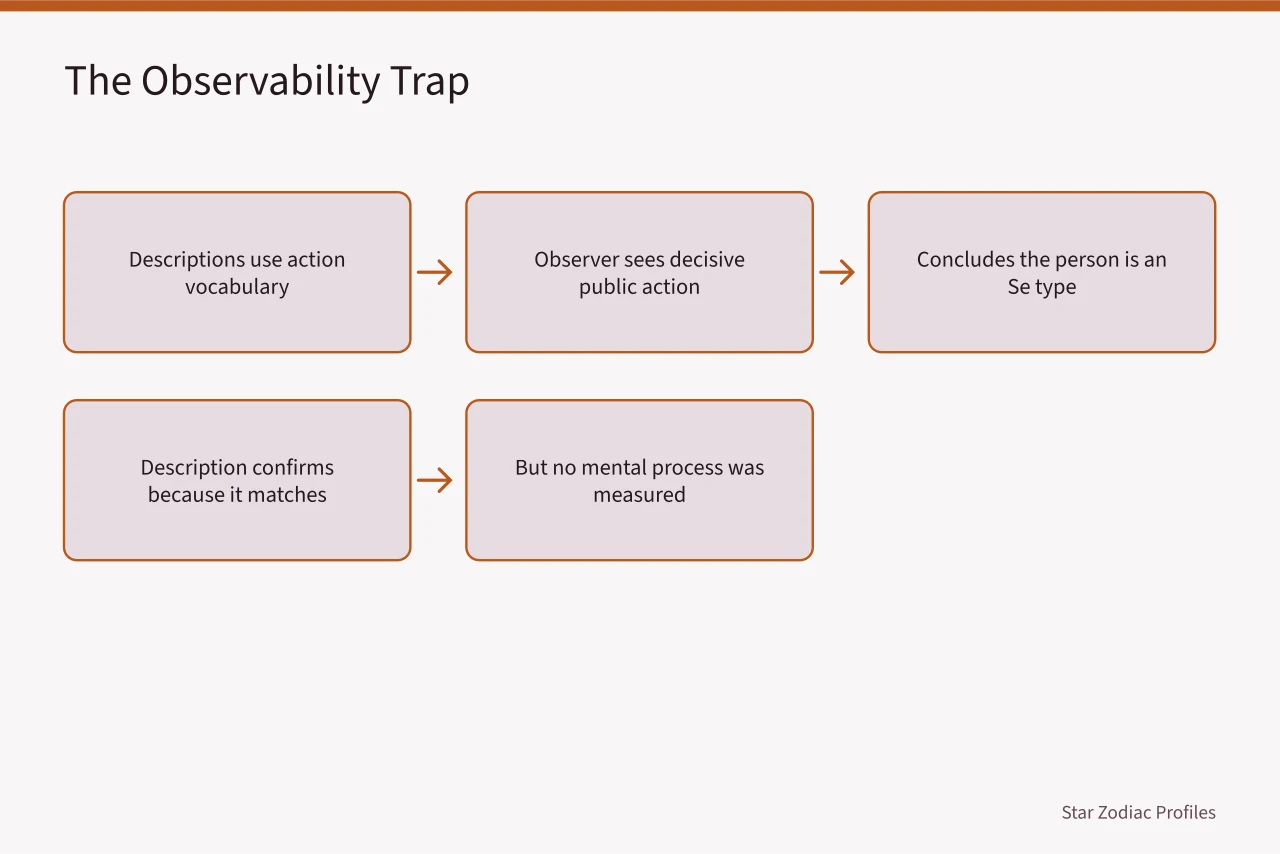
Nothing has been measured. The model's claim is about which mental process a person prefers, and its method is a self-report questionnaire. The same decisive public action is available to every type for different reasons:
- An Se preference, expressed in the way the description predicts.
- A judging type who prepared exhaustively and is executing a plan.
- An intuitive type acting on a hunch.
- A professional doing what the role requires, regardless of preference.
- A performance, which is what most public behavior is.
The trap is worst for this group because the mismatch is largest: the descriptions are the most behavioral and the model's claim is no more behavioral than for any other type. The notes on the intuitive-thinking group set out the best-fit step, in which the respondent confirms their own type, that makes third-party typing a procedural impossibility rather than a matter of skill.
Why performers get this group by default
Three habits of the celebrity-typing genre push its subjects into these four types.
- Visibility. People whose work is physical or performed are seen acting, and acting is read as Se.
- The descriptions' own vocabulary, which uses words like spontaneous and bold that overlap with how performers are marketed.
- Distribution across the sixteen slots. A list that wants every type represented needs someone in the SP slots, and performers are the obvious candidates.
None of this is evidence. It is the list being assembled to look complete, and the group being the one that the look of the job matches. The notes on the sensing-judging group show the mirror image: a group common in samples and rare in celebrity lists, because its vocabulary does not flatter.
The current trend: type as identity
The vocabulary has moved from the training room to ordinary conversation, and in the process it has changed use. Where the instrument was designed to name a preference so that a team could work around it, the code is now often used as a badge: something to put in a profile, sort friends by, or explain oneself with. Short video and image formats have accelerated this, since a four-letter code is exactly the length of thing they reward.
Two things are worth keeping straight as that continues.
- The codes in circulation mostly come from free online questionnaires that borrow the letters and measure something closer to continuous traits. A code from one of those is not a result from the original instrument, even when the letters match. The notes on the intuitive-feeling group cover the difference.
- A badge is a claim about the self, and the model would treat it as a hypothesis to be revised. The instrument's own procedure ends with the person choosing the description that fits, and it expects that choice to be revisited.
Used as a badge, a type is harmless and often useful. Used as a verdict on someone else, including someone famous, it makes a claim about their inner life that the model gives no way to check.
Common questions
Is ESFP the "entertainer" type?
That is a nickname from popular derivatives, not part of the model. The description emphasizes immediate engagement with people and surroundings; entertainment is one thing that preference might be used for, not what it is.
Do explorer types dislike planning?
The descriptions say the preference is for keeping options open. Whether a person plans is a matter of role, history and skill, none of which the model measures.
Can an introverted explorer type still be an "explorer"?
Two of the four are introverted. The nickname groups on the S and P letters, not on E, and in the function model ISTP and ISFP lead with an inward-facing function.
Why does my result keep changing between P and J?
Scores on each pair cluster near the middle rather than at the poles, so a small change in how you answer moves the letter. The model treats the best-fit decision, not the score, as the type.
Are these types better at sport or performance?
The model makes no competence claims, any more than a sign's keywords claim ability. It describes a preference for the concrete and the present; skill in any field is a separate matter and is not measured.